A Pretty Pickle

screen-shot-2016-11-07-at-14-23-55

If I were the sort of person to jump to conclusions, I might think that the above TripAdvisor user and self-described customer of Darsham Nurseries Cafe were an old-fashioned racist, the kind who thinks Turkish food begins and ends with dubious kebab shops, just as the sum total of Chinese cuisine can be found within the walls of the Golden Dragon; as it is, I will confine myself to the observation that he doesn’t know a huge amount about the food of the Eastern Mediterranean. If he did, he might join the dots between the plate of largely Stamboulite vegetable preparations he was served and the origins of the kebab, and figure out the bizarre reason why such a chilli might have adorned his plate; either way, he is certainly a snob, as anyone who professes a dislike for those “chillies you get in kebab shops” must be. For one thing, what he was actually served was Spanish guindillas, similar to those chillies you get in kebab shops, and for another, those chillies you get in kebab shops (CYGIKSs, from now on) are one of the finest of all pickles, a standout even in the impressive pickling world of Turkey.

img_5242

A good pickled chilli needs crunch, heat – but not too much heat – sweetness and sharpness and salt; it should be edible by itself with only a slight wince, so it can be eaten with abandon as a counterpoint to rich, fatty meats or sharp cheeses and nuts. The CYGIKS is a perfect expression of these qualities, and the Spanish guindillas we used to use at work are one of the closest equivalents that don’t come in 10l tins, for delivery, presumably, to kebab shops. I say ‘used to use’ not because the above review showed us the error of our ways but because we have started making our own, which, if anything, are even more like those CYGIKSs. We grow a huge number of sweet and chilli peppers at Darsham, among them the two main varieties used for CYGIKSs, the short stubby pale green ones and the long curly pale green ones. They probably have names, but I’m no expert. As it happens, I have spent a decent portion of the past four years perfecting my chilli-pickling method, starting with a frankly useless Jamie Oliver recipe and a box of generic greens and ending with a major breakthrough just as this year’s plants started seriously fruiting. We now have jar upon jar upon jar of the things, and they will be proudly adorning our mezze for many months to come.

CYGIKSs

This is more of a method than a recipe. As a general-ish rule, a 1l jar will take about 500g or so of chillies, which will need about 500ml of liquid to cover them. You’ll want to make loads, anyway, because they’re delicious.

STAGE ONE

chillies, preferably green curly mild ones

salt

sugar

water

Slit each chilli through one side of its flesh, all the way from stalk to tip, and pack them into a jar or crock. Pour water over them, then pour it off into a measuring jug – just to see how much brine you’ll need.

The brine is 3.5%, which is to say you’ll need 35g of salt and the same of sugar for each litre of water, so make this up, pour into a pan and bring to a boil, just to dissolve the solids. Let it cool to room temperature or thereabouts and pour over the chillies. Weight them down with something and leave to ferment for a week.

STAGE TWO

brined chillies

white wine vinegar

sugar

By now the brine should be cloudy with lactobacteria and the chillies should be crunchy and well flavoured. Drain them well and pack back into the jar.

For the pickle, you want 400g of sugar for each litre of vinegar – it helps to make a little extra up, to top up the chillies as necessary. Bring this mixture to a boil and pour straight over the chillies, remembering that hot acid hitting chilli seeds can sting the eyes a little (quite a lot, actually). Seal and leave for a week, then eat with your mezze or kebab.

Sweet-Meats

img_0236

It’s fascinating, the things people leave in books. I volunteered at Oxfam Books for a couple of months, and in that time amassed a folder (which I still have, somewhere) full of various items found between the pages of donations. I dog-ear, personally, having little respect for the ‘book’ as a totemic object, so the breadth of things used as bookmarks surprised me. Flyers and train tickets, yes, lots of them, but also very personal pieces, postcards, letters, photographs, and so on. Are these the things nearest to hand in the urgency of bookmarking, or are they saved for that purpose, a little memento kept always close by?

Inserts in practical non-fiction (gardening and cookery especially) tend towards the useful. For every copy of Mrs Beeton with all the colour plates cut out there’s an old Delia bristling with newspaper clippings, supermarket recipe pamphlets, old shopping lists … and maybe, if you’re lucky, some original recipes, carefully recorded in neat pencil. I found this one between the pages of an American book on game cookery, from 1945; some newspaper pieces within (on cooking with coon and reindeer) are of a similar vintage – a column on the back of one of them railing against socialism – so I assume this recipe is too. More research, as they say, is needed.

So. The recipe – which, as you can see, is a list of ingredients with no method or yield given – is untitled, but looks, from the sugar, the fruit, the adding of alcohol to each jar, like a recipe for mincemeat, of the old English and it seems the American kind which actually contains meat. (I was always dubious about the existence of such a thing, as ‘meat’ in some contexts [sweetmeat] just means ‘food’, and it seemed to go hand-in-hand with the preposterous assertion that spices were used to mask rotten meat, but it seems I was wrong.) When I shared the ‘recipe’ on Twitter, Dan Lepard came to the same conclusion, and proffered the helpful fact that Wellington is a variety of cooking apple, similar to our Bramley.

The final piece of the puzzle came from the fine Penguin Handbook The American Heritage Cookbook, dating from the 60s but collating rather older dishes, which features a recipe for Sunnyside Mincemeat Pie, with a strikingly similar list of ingredients – only beef instead of venison. I had assumed that a meat-containing mincemeat, unlike the usual British variety, must require cooking prior to jarring, and here was confirmation! I had a method – and my neighbour was giving away bags of windfall Bramleys. Isn’t it nice when things work out?

VENISON MINCEMEAT

With apologies to the original cook, I have streamlined the amounts somewhat in converting to metric. That half an ounce of venison might have seemed very important – or maybe it’s just what she happened to have. Either way, I’ve kept things simpler. I’ve also gone with the original mix of dates and prunes, because I like prunes. Do as you like – dried cherries are nice.

You can see that the original recipe called for meat and fat to be marinated, but not in what; I’ve skipped this altogether. Unless it means heavily brined (possible), I can’t see that you’d get much of the marinade through the blanket of fruit and spice.

DISCLAIMER: This involves cooking meat in what seems like an insufficiency of salt or acid and leaving it in the fridge for a month. Make sure you cook it thoroughly when you make it into pies. If I get botulism, I’ll let you know.

Makes 3 1l jars, which is far too much mincemeat.

500g venison, minced

200g suet, shredded (preferably deer, but that’s quite hard to get hold of. I used sheep, but beef will do)

1.25kg cooking apples, chopped

500g light muscovado sugar

500g dates, chopped

500g prunes, chopped

300ml nice apple juice

150 mixed candied peel, chopped

.25 t ground cloves

.25 t ground mace

.25 t ground ginger

.5 t ground nutmeg

2 t salt

1 t ground cinnamon

some booze (I don’t drink rum, so I used bramble whisky)

Put everything except the booze in a big pan, and bring to a slight simmer. Leave it there with a lid on for two hours, stirring occasionally, then pack into sterilised jars, adding a couple of tablespoons of booze to each jar. Put in the fridge and leave for a month.

[fungi pun]

img_0143

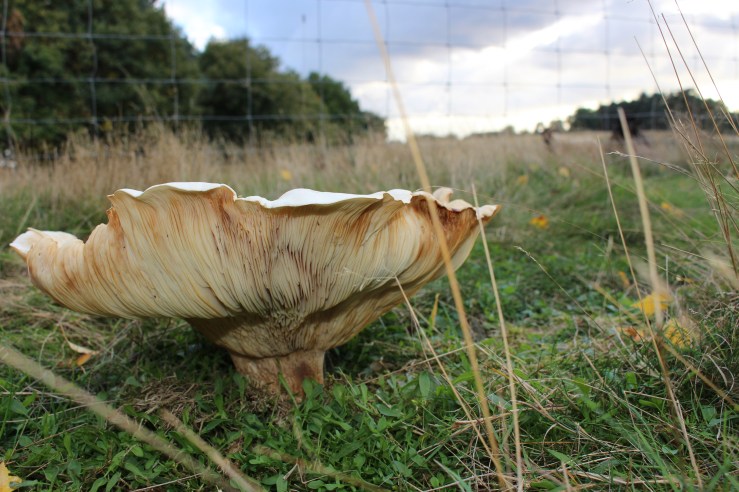
I’ve been learning about mushrooms. Everyone tells you to go picking with an expert, and only eat anything they personally examine; I don’t, unfortunately, have such a tame expert, so I’ve been relying on several books and websites, as well as the online hive mind. There is, it turns out, a keen community of mycologists eager to help out a beginner; hopefully they know what they’re talking about. I was looking forward to roaming the countryside with my battered (second-hand) copy of Food For Free, looking back and forth between description and specimen, but unfortunately the book’s previous owner had the same idea, and ripped out the relevant colour plate. Instead I pick a few and attempt to identify them when I get home, which means the place is littered with possibly-toxic fungus.

People often ask me if I worry about poisoning someone with one of my various ferments and cured items; honestly, I don’t. I fussed a bit about botulism the first time I made salumi, but since I had used both salt and the legal maximum of saltpetre, I needn’t really have worried. The key with ferments is to create an environment where harmful bacteria will not thrive, and then to leave the others to it; a sort of intelligent design, if you like, with the microbiome of each jar guided by your invisible hand. Mushroom hunting, on the other hand, requires constant and informed decision making, with the possible price of a mistake being a prolonged and quite unpleasant death.

Most toxic mushrooms (or fungus, rather) will just make you slightly ill, and possibly hallucinate (these are features that some people seek deliberately, of course), with, it seems, not universal effects. If you look through a mushroom guide, you’ll see that many are ‘reported by some people’ to be toxic; there are so many possible influences on our stomachs, not least the psychosomatic contribution of paranoia, that I suppose it’s hard to be sure. A lot of fungus are tiny or not very nice, anyway, so there’s little point in risking sickness. The noble exceptions, of course, are the aptly-named Death Cap and Destroying Angel mushrooms (the latter of which [SPOILER ALERT] plays a starring role in John Lanchester’s excellent debut novel), which look and probably taste like delicious white mushrooms but are in fact viciously, horribly poisonous, turning your organs against each other and shutting down the entire mechanism which keeps you alive; stay away from white mushrooms unless you know what you are about.

img_0192

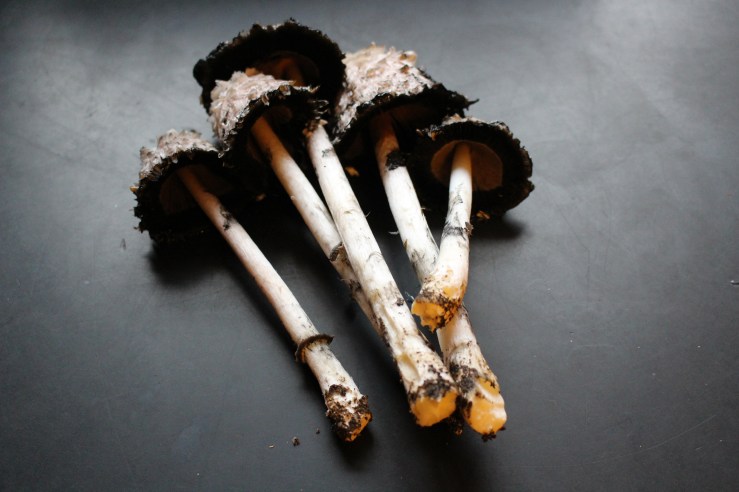
It seems an unfortunate part of the British disconnect with our food culture is the lack of general interest in (and therefore confident knowledge of) wild fungus. In Italy, wooded France or Eastern Europe, for example, mushroom hunting is a popular and respectable pastime; such delicacies as the cep are there for the taking, so why not? We have them here, too, of course, called Penny Buns and just as lovely – alongside various poisonous cousins. Some, luckily, are much easier to identify, even for a beginner. The Shaggy Inkcap, for example, has an inky cap and is distinguishable from the (rarer) Common Inkcap by being shaggy; it looks rather like an old-fashioned lawyer’s wig, hence its other name Lawyer’s Wig. I found some this morning, on a little verge by the road, where they were just starting to deliquesce and stain the fingers, but still whole and edible. I took them home and sautéed them with just some salt – I had no garlic – and ate them on slightly stale sourdough toast, and they were very good, the more so because I picked them with my knowledge and my hands.

Clammy Cells

img_4957

I’m sure I say this every year, but autumn really is an extraordinary time for British food. We spend the height of summer eating greenhouse tomatoes and endless gluts of courgette, wishing we were south of the thick black coffee line drinking something cold and pale in a cafe by the sea; it’s a season that we are not fully equipped to deal with, and so we spend it semi-conscious, drifting between shore and field in a sort of gentle fever dream, punctuated by ice-cream. Autumn, on the other hand, is the time to wake up. The hedges are making good on the promise of the early blackberries, with damsons, crabapples and soon sloes weighing down the spindly branches; country roads are once again teeming with semi-wild game birds, running idiotically between their Scylla and Charybdis of front wheel and gun. On the days after the first shoots, the flattened corpses of young partridge carpet the roads.

At least partridge tastes quite nice. The strange situation with pheasant is that these birds are bred in protected environments (often to the detriment of other, perhaps more native creatures), then released into the wild to be shot at, in such numbers that ‘hunters’ give them away for free; no-one wants to eat as much pheasant as can be killed, because, finally, it’s just not very interesting. A sort of dark white meat which dries out easily, it has none of the bloody excitement of a duck or pigeon, it’s too big to tear apart with your hands … to make matters worse, people often don’t prepare them properly, so the legs are full of tough sinews which must be picked laboriously from the meat. All in all, a waste of everybody’s time. If you do get given one, best to brine it in salty tea and then joint it so you can roast the legs slowly, the breasts quickly. Like all game birds, it goes nicely with a jelly or compote of appropriate fruits.

The chickenish paleness of their flesh is, I assume, due to both their early captivity and to their lifelong habit of walking everywhere, even out of the way of oncoming cars; it is certainly shared by the similarly-raised partridge, though the meat of these latter birds is somewhat finer, capable, I’m sure, of a rewarding blush when carefully and delicately cooked; I like to brown them in hot oil and then pickle them. This is a treatment native to Andalusia, but it seems appropriate for an English autumn, and as a recipe it is about as simple as that – just make up a vinegary brine, flavoured appropriately, and pour it, hot, over the browned birds. You don’t need to worry too much about acidity and salinity unless you intend to put them up in a barrel for the winter, in which case you are on your own; fermentation is one thing, but the sterile preservation of protein is fraught with danger. Just put them in the fridge and eat over a few days, and no-one will get botulism.

If you roast or stew your partridges, remember that, as with all pale, wild flesh, they will need a good helping of fat, having very little of their own, either in layers or running through the meat. It’s traditional to roast such birds covered with little strips of streaky bacon, which the cook can then silently eat while preparing the accompaniments; another way is to wrap them in prosciutto or similar and pack them tightly into a casserole for pot-roasting. I once cooked this for Julian Assange, oddly, though I don’t know if he liked it. He certainly never came back. I don’t know if partridges traditionally hide in pear trees because they are themselves pleasingly pear-shaped, or even if they do so at all, but they certainly go nicely with pear, perhaps pickled; or possibly it is just the pleasure of the association. Either way, worth a try.

So much for these sort-of game birds. My own personal favourite is the pigeon, as I think I’ve said before, but as they are easily availably year-round, they don’t carry the seasonal thrill of, say, a nice mallard (smaller and neater than the fat, farmed Gressingham duck), which is what I happen to have in my fridge right now, next to the pot of pickled partridge. Duck is perfect with the sweet tartness of the season, the hedgerow fruits, the heavy, honeyed flavours; there are so many options that I’m not quite sure, having briefly considered Pekinese and Venetian treatments, what I should do with it. Duck and damsons sounds nice, but if you have any suggestions, I would be glad to hear them.

What We Talk About When We Talk About Lunch

I have never had much time for lunch. At primary school, lunchtime could bring the whispered excitement of macaroni cheese, swiftly spreading round the hall; it could also bring the dishwater grey of poorly-drained spag in under-reduced bol, our generation’s equivalent of the thunderous cabbage of school dinners past. Pudding might be jelly, with that weird sweet cream which tasted like cake mix, but it might equally be a heavy sponge in a pond of thickening custard, smelling strongly of furniture polish. A packed lunch was a more predictable procession of Marmite-and-cheese sandwich-Petit Filous, except when said fromage frais exploded in my lunchbox; possibly the first but definitely not the last time I would regard my meal through blinked-back tears.

As a teenager, eating is the last thing to do on your lunch break, and food the last thing to spend your lunch money on, while for the student, lunch is the same as breakfast, and both are taken more medicinally than gastronomically; we’ll draw a veil over those years. Then I started working, and a chef rarely eats lunch. It, rather, eats you.

For most of my life, in other words, dinner was the thing. By then, you and your tastebuds have woken up properly, open to spice and fish and offal and, of course, booze – it’s a social occasion, with a dinner party often turning imperceptibly into an actual party. If you’re going to be up until seven in the morning, it doesn’t really matter if dinner starts at 11pm; perfect for a young chef’s lifestyle, but not something I can do any more. The open-endedness of dinner could be its downfall, with any memory of the truffled pork ravioli we had spent all day making dissolving in a slurry of cheap red wine. If you’re already tipsy by the end of dinner, you may as well keep drinking. Lunch, on the other hand (with the honourable exception of the Sunday roast), is a neatly finite affair.

The key to lunch is the proper procession of drinks, for which you need to look to France and Italy – it was there, at least, that I learnt about lunch. The adman’s 3-martinis and the clubman’s magnum of claret are no good for a lunch where you intend to move about afterwards, which is the greatest promise of lunch; what you need is wine by the carafe and a good coffee afterwards. The caffeinated line this draws under the booze is the defining part of the meal for me, whether a thick Neapolitan espresso or a gentler French press. “Enough!” it says; “On with the day.” This done, you can go back to your symposium or your museum or simply your street-wandering, though preferably not your heavy machinery, with a sparkle in your eye and a spring in your step from that carafe.

A lunch wine, of course, should be light. If you’re struggling to agree on one, or if one of your party “only drinks red”, and there’s nothing suitable, get prosecco instead; this goes with everything, at least at lunchtime. You might have to get it by the glass, but if you can get it in carafe (especially on tap), you’re onto a winner. The flattening effect that decanting has on prosecco’s effervescence turns it into the perfect lunchtime drink, especially if you are enjoying it with deep-fried seafood. Soft-shell crab is best, I suppose, but whitebait, calamari or plaice and chips (with a scattering of scraps, of course) will do almost as well, with a shower of rain, starting just after you ducked into the restaurant, the ideal accompaniment; and salad, of course. In fact, you should probably have the salad first, then you can eat as much deep-fried soft-shell crab as you like.

A lunch like this, which, you might have gathered, is not hypothetical but in fact an actual, fondly remembered lunch, has as much of a medicinal effect as those student breakfasts; any tired- or illness, any arguments or problems which might have blighted the morning as you traipsed around an unfamiliar city, getting first thrillingly and then frustratingly lost in the maze of little streets and canals, weaken in the chink of cutlery on plate, the gently meandering conversation, the dying bubbles in the carafe, the espresso’s bitter full stop.

Meagre Bread

Our common food is no longer our daily bread, apparently; I’m not sure whether we should be alarmed by this. It depends who they’re polling, I suppose. Personally, I eat bread all the time. I eat it when I should, nibbling on the impeccable bread selection which precedes the stately procession of the tasting menu at The Sportsman; I eat it when I shouldn’t, using a stale end to transfer the last smears of carbonara sauce into an already full stomach. When I need food, I eat bread. Nothing calms the stomach like a cheese-and-cucumber sandwich from the petrol station shop. Now it seems this puts me in a minority. As I said, though, it depends who they’re polling.

It could be pernicious clean-eaters eschewing bread for its gluten; it could be people getting all their carbs from elsewhere, from porridges and pastas and potatoes; it could even be those so in love with bread they buy one impeccable loaf a week, and save it for their Sunday. Good bread – real bread, or as it used to be called, ‘bread’ – is expensive, as it should be. Good ingredients are expensive, good labour is expensive, time is expensive. If good food is out of the reach of many, then there are many other things which should be changed, rather than degrading the staff (and indeed the stuff) of life to the point where it barely nourishes. Nearly half of everything baked in the UK is thrown away, for example, a shocking waste which would be considered a crime in other cultures.

Bread in Islam is considered a symbolic food, a synecdochic representation of all nourishment as it comes from God, as it is also, I suppose, in Christianity (our daily bread being hopefully not just bread); they tend to take this more seriously, though. Walk old streets in Morocco and you will see stray khobz stuffed between buildings and in cracks in walls, saved from the street and awaiting charitable redistribution; like the feet of angels, it can not touch the base earth. More prosaically, Istanbul, for all its problems, feeds its populace from subsidised and strictly regulated bakeries, as London used to do. Buy bread from anywhere in the city and it will match in price and quality. The responsibility of government to ensure the poor do not starve has been steadily shrugged off in the so-called developed world.

Even with good flour, bread doesn’t cost that much to make, if you make it yourself, but it is hard, and it takes a long time, which is why we’ve always got bakers to do it, a strange group of people who scuttle about at all hours, covered in flour and little bits of dough. I like making bread, but I lack the skill and the patience to do it every day. I certainly can’t make as much as I like to eat, at least when it comes to sourdough. This sort-of focaccia is a good alternative when I want something fresh-baked, though. The initial rise is so accelerated it seems you’re watching it in time-lapse, and it tastes good, too.

CHICKPEA BREAD

1 tin of chickpeas

1 tsp honey

160g cold water

1 packet dry yeast / 15g fresh

260g strong white flour

14g salt

15g extra virgin olive oil

1 tsp caraway or cumin seeds


Empty the tin of chickpeas into a saucepan and bring to a boil, then blitz smooth with the honey and cold water. Let it cool to blood temperature, then blitz in the yeast. Tip the whole mush into a bowl.

Pour the flour over in a layer, then sprinkle over the salt, drizzle over the oil, and, I don’t know, throw in the spices. Leave in a warm place. In about 20 minutes it should have risen significantly; there will be deep cracks in the flour layer with chickpea porridge bursting through.

Beat everything together with a wooden spoon, and use this same implement to knead it – it’s too sticky to do by hand. Just use the spoon to drag up one side of the mix and fold it back down into the middle, a few times until it starts to resist and feel alive. Put the dough in a greased skillet or baking tray to prove for an hour. Heat the oven as high as it’ll go.

When the hour is up, bake the loaf for half an hour, turning and perhaps drizzling with more oil halfway through; it won’t rise a huge amount in the oven, but it will be soft and springy and golden, and, of course, sound hollow when you tap the bottom. Let it cool for 5 minutes before tucking in, for appearance’s sake.

Quel Outrage!

img_4899

The best of summer requires so little in the way of human intervention on its way to the plate that it often seems, by the end of the season, as if I have almost forgotten how to cook. Tomatoes fall apart under the knife, providing their own dressing to soak into yesterday’s bread; slices of cured fish nestle just-so against piles of freshly-picked herbs; torn pieces of greengage and peach drip down the chin and onto the wrist. I’ve gone for months barely chopping an onion – I’m not ready for the endless peeling and dicing of squashes, roots, tubers and stalks, the slow building of flavour through sweating, stirring and braising.

Although the weather still thinks it’s high summer, however, the garden disagrees, and this time of year demands that you at least show willing, perhaps heating a few things together, boiling this, toasting that, moving slowly back from assembling towards cooking; it helps, in this situation, to have a well-stocked cupboard, fridge and freezer. It’s amazing what you can throw together when you’ve spent the last few months squirrelling things away. If you don’t spend your entire life in either a professional or amateur kitchen, then this recipe will take a little more time – in fact, it will become a whole series of recipes. All of them are worth making, though. Sit down with a bowl of this and a glass of rosé and you will have successfully extended summer by another hour.

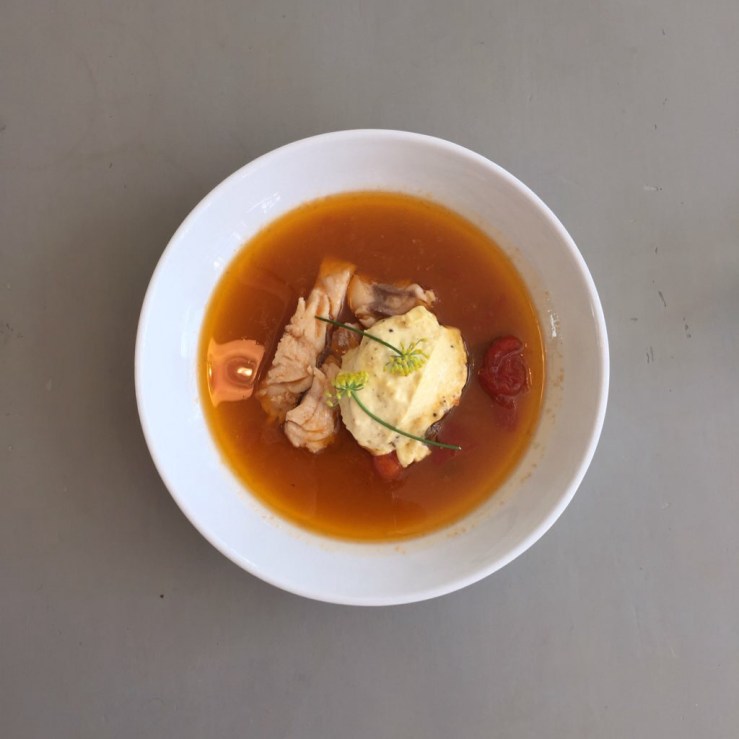
FERMENTED TOMATO BOUILLABAISSE

To serve 4, or thereabouts

around 2.5 l of good fish stock

8 fermented tomatoes, plus 250ml of their brine

1 tbsp tomato puree

a long splash of absinthe or pernod

a small wine glass of good olive oil

some fish

Basically, you just put all of these things in a pan and boil them, hard. This is to force by violence the oil to emulsify with the other liquids, and is probably the only fish soup to require this treatment. You want to reduce the whole by about half.

I suppose the fish stock is the thing here. Any Marseillaise or probably any other Frenchman, and certainly anyone who has read Elizabeth David, will tell you that it is impossible to make a bouillabaisse outside of that fair port. The variety of fish is key, this soup originally being composed of the tiddlers too small to go to market; the only essential, we’re told, is that is contains scorpion fish, a peculiarly ugly creature which lends, I believe, a certain gelatinous quality to the broth.

To all this I offer an elaborate Gallic shrug. If the real thing is impossible to make, then so be it; we can do as we like. My stock was made with lobster carapaces (although I didn’t, it is quite fun, when making soup, to smash these up with a thumping pole) and cod cheek trimmings, along with several branches of flowering fennel and of sweet cicely. The cartilaginous frames of the various rays do very well in a stock, replacing, perhaps, the aforementioned horror; fishmongers, who normally sell the wings alone, often have several of these quasi-skeletons knocking around in their freezer. The carcasses of whatever fish you intend to use should probably go in, unless they are sardines, herrings or mackerel. What the hell are you doing, putting pelagic fish in a bouillabaisse? Salmon heads, on the other hand, turn the whole a rather lovely shade of coral. At this stage, you don’t want to boil your stock, and neither do you want to cook it for long – a gentle simmer for twenty minutes or so should do nicely.

That’s that, then. The fish depends on how much of a meal you intend to make of it – perhaps a fillet or two of white fish per person, a handful of mussels or clams, whatever. You have already offended the proud Provençal, you might as well carry on. Stick a whole bloody crab in it.

Oh, and you’ll need aioli, rouille, croutons and cheese. Carry on.


Just a Snicket

“Toasted cheese”, moans Ben Gunn, marooned in a lonely paradise; of all the trappings of his lost past, it is this that he craves the most. I, too, have been a stranger in strange lands, and I have always longed for cheddar cheese. Ubiquitous across Britain, synonymous, in fact, with the very idea of British cheese (imagine ordering a cheese-and-pickle sandwich and getting crumbly Wensleydale or aggressive Stilton), a decent or even semi-decent cheddar is almost impossible to find elsewhere. The stuff that some Americans call cheddar would be a joke, if it were funny; as it is, it is horrifying. I spent a year in upstate New York, and though, I think, every single sandwich I ate had cheese in it, not one cheese sandwich did I see. My (vegetarian) father tried to order one once, at a gas station deli somewhere in the Adirondacks, and was met with polite confusion. “Mayo, cheese, yes – what filling would you like?” Your American cheese lacks both the structure and the physical presence to carry a sandwich by itself – with the exception, of course, of the grilled cheese.

The grilled cheese is grilled in the sense that it is cooked directly on a solid flat-top grill, possibly alongside eggs over-easy, fat pancakes and little sliders; that is to say, it is fried. In its platonic form, before the current sourdough-and-raw-cheese reinvention, it consists of cheap sliced white sandwiched around cheap American cheese, the outside buttered or even mayonnaissed and fried or ‘grilled’ until golden brown. The stated ingredients perfectly match the treatment given them; sliced white (I will not call it bread) is of a uniform density which allows for both maximal surface crispness and minimal escapage of the cheese within, which, being so heavily processed, easily melts in the time taken to cook the sandwich. Sourdough is obviously a vast improvement in terms of flavour, but its irregular size and numerous holes present a new set of challenges to the sandwicheer; best, in most cases, to wrap the whole thing in foil and fry within. As for the cheese, I find the hard calcified click of a good cheddar wasted here, unless you happen to have some gratable odds and ends lying around. A classic melting cheese, something like a raclette or ogleshield, seems most appropriate; it is like a reminder of what American cheese could have been.

Personally, I prefer cold cheese; cold cheddar cheese, in malted brown bread. I resist the idea that every sandwich should be toasted – and no-one would argue that all cheese should be fondued. The joy of fresh mountain cheeses, crumbly, soft and sharp, lies partly in their coldness. Like a cucumber, there is something refreshing about their existence, so clean and white. These are also the easiest sorts of cheeses to make at home, which is nice; just sour and salt some milk and drain off the whey – no culture or clamp required. These are ancient things, particular to animal and soil and air; they are born fresh every day, in country, in village and in farm. It would be instructive and, of course, delicious, to do a comparative study of cheese terroir, ranging across all of Anatolia, Greece, Sardinia, Spain, to see the different flavours wrung out of dry slopes and distant seas.

Who could possibly say which is better, a ball of mozzarella cold out of its brine or melted across a scarce few millimetres of dough – the way the former tears into strings, the way the latter pools and glistens? I would rather eat a whole burrata with my hands. In a good pizzeria, I like my dough almost bare, just a few razor-shavings of garlic across the sweet tomato sauce. As the bread gets worse, the toppings pile higher – which isn’t to say I would turn my nose up at pepperoni, hot peppers, olives or even mushrooms, though I draw the line at sweetcorn; that way lies pineapple. To be honest, I have never encountered a pizza or indeed any form of melted-cheese-on-bread that I have truly, viscerally disliked. Even that sliced white grilled cheese, though barely providing sustenance, has a beauty of its own. Nothing else sits so well next to a cup of cream of tomato soup. Still, for all the joy of cheese-on-toast, of Welsh or Italian rarebit, of saganaki and fondue, if you put me on a desert island it is a good strong cheddar, cold from the fridge, that I would cry for in the depths of the night – so long, of course, as there were pickled onions.

Sour & Bitter

IMG_4628

 I’ve recently been discovering the joys of putting things in barrels. If you put neutral grain spirit in a barrel and leave it for some time, you get whisky; it’s easy, really, despite all the mystery and romance piled around the subject. I suppose that’s the Celtic way. Now, neutral grain spirit isn’t very nice, while whisky, of course, is. It follows, then (I suppose), that if you put something nice in a barrel and leave it for some time, you get something better than whisky. To really test this theory, I guess I’d have to leave the something in the barrel for a good ten years; I don’t know about you, but I don’t really have the patience. However, putting things in smaller barrels sort-of speeds the ageing process, or at least some aspects of it (surface area, don’t you know); to cut a long story short, I’ve put a bottle of Morris Gin in a small oak barrel. It’s been in there for two months now, and is starting to get some colour and good whiskiness from the wood. I’m going to leave it a couple more months, I think. My next project is to barrel-age two litres of mixed Negroni; I can only imagine that this will be extremely delicious.

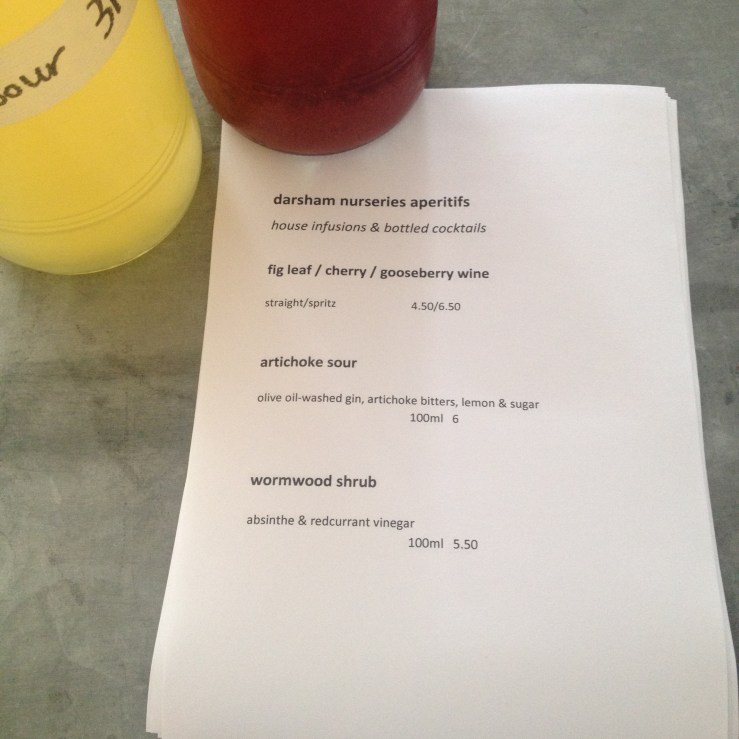
None of this is very useful unless you intend to fill your house with barrels. It reminded me, though, that flavours can leak from unlikely places, and that alcohol is very good at capturing them. If you read a recipe requiring you to macerate oak twigs in wine, you would be surprised, though that is essentially what happens when you age the stuff in barrels. I have, in fact, a recipe somewhere for an oak-branch aquavit; “this sounds disgusting”, I thought, before the penny dropped. I’ve never actually tried this sort of reverse barrel-ageing, though. Silly, really, when we’ve got an oak right outside the kitchen. One reason alcohol is such a good medium for capturing these flavours is that unlike, say, water, it is capable of dissolving flavours from fats and oils; this is the principle behind ‘washed’ spirits, which have become a thing recently. This basically involves mixing a fat with booze and leaving it for a few days, then skimming the fat off. Easy! The first I heard of it was with bacon-fat bourbon (tastes like bourbon with bacon in it) but I was reminded of the technique recently by the olive oil-washed gin in Sardine‘s dirty martini – a very fine aperitif cocktail. It so happened that at the same time I was looking for something to do with the cynar I had made. Cynar, if you’ve never had it, is an Italian bitter made chiefly of artichoke; it is truly, horrendously bitter – and I say this as a lover of Fernet Branca. Artichoke and olive oil, I thought – and so this drink was born. You may have heard it mentioned in passing on this Radio Four programme – I know the fig leaf wine was the star, but you can get the recipe there, so I thought I’d give you this.

ARTICHOKE SOUR

This takes ages and has several steps. Sorry!

CYNAR

about 20 artichoke leaves

a few angelica stalks

a bottle of vodka

Put everything in a jar and leave for at least a month, preferably two. Strain and bottle. Or buy some Cynar.

OLIVE OIL-WASHED GIN

a bottle of gin (I used Plymouth)

350g extra virgin olive oil

Whisk together in a big jar or bowl – something you can cover tightly. Leave for three days, whisking and re-covering every day, then put in the freezer overnight. Scoop off the solidified oil and strain the gin into a bottle.

SIMPLE SYRUP

equal weights of sugar and water

Boil together for five minutes, cool and bottle. Or buy some gomme.

LEMON JUICE

Juice some lemons. Or, yes, buy some pasteurised lemon juice in a squeezy lemon. You’ve got this far, though…

When you’d like to actually drink this, just mix equal quantities of everything. I assume you keep all of your booze in the freezer; if not, stir over ice. Enjoy! You’ve earned it.

Inglorious Bustards

There is no wilderness in Britain. The landscape which today forms the battleground between conservationist and farmer, developer and gentry, is only the latest expression of the work of millennia, to shape and subjugate wildness into something more amenable to humanity. The land is manmade. Once a vast forest covered the country, almost to the peaks of the uplands; the Broads and the Fens were water; the Suffolk coast was heath and bosky wood. The nature which inhabits these industrial landscapes is that which, broadly, we allow to exist – everything dangerous is long-gone, and everything not useful has retreated significantly, adapted itself around human settlement. Hares, snails, pigeons, rabbits, deer, introduced by waves of invaders and migrants as sources of food or entertainment, have all become part of the British ecosystem. Nothing is natural, nothing is wild; a muntjac eats the brambles in my back garden. The pig farms of Blythburgh have as much right to the land as Folkestone Warren.

Any radical conservation (if you’ll excuse the phrase), that is to say, any attempt to rebirth a truly wild British landscape, would require, ironically, a huge intervention, in the form of a vast holocaust. A near-total annihilation of the human population, not to mention of dogs, cats, cattle, sheep, pigs, alpacas, horses, goats, elephants, wallabies, rheas, hares and so on, a final eradication of the mark of so-called civilisation from the map, would be followed by the reintroduction of wolves and of bears; the regular cull that our semi-wild deer population receives would be carried out more naturally. There are those who advocate for this, if not in such extreme terms – it is the logical conclusion of a certain strand of conservationism, but most people tread a more compromised path.

To return to total wildness, let’s say, is impossible or undesirable or both – what then? If you agree that we have some responsibility towards the rest of nature, to try and ensure we do as little harm as we can – well, it seems arbitrary to choose now or rather a rose-tinted recent past as the moment to conserve, but what else to do? Muddle along, I suppose. Even if we had the inclination to resurrect ecosystems past, we don’t have the ability or the knowledge. The culture in a pot of naturally fermented kimchi has still not been successfully modelled – imagine the complexity of the wild wood! So we tend to our garden, we manage and conserve, we farm the things we think are farmed, we hunt and forage the wild ones – and this, really, is the problem. Most of them are not wild.

The humane farming of animals for meat has taken huge strides in recent years. A loose coalition of chefs, farmers and consumers has made a huge positive change to animal welfare and to its importance in public discourse; everyone knows to at least pay lip service to happy hens, blissful cows, quietly ecstatic pigs. If there is still some distance to go, there is at least a general recognition that, quite apart from ethical issues, meat tastes better when it has spent its life outside, eaten a varied diet, had a gentle death. The quality of good meat in Britain now is really quite astonishing, and cooks both professional and amateur are right to insist on the good stuff; it is more expensive, but so it should be; it takes space and time to farm well, and these things cost money.

On the other hand, we have game. I have written a few times before about rabbit, and nothing’s changed since then; it is still, alongside pigeon, plentiful and generally healthy in its large feral populations, shot at by farmers as pest control. It is, I think, right to eat it for as long as these conditions attain. Although farmed in some places, the various types of deer which roam Britain are in a broadly similar situation – in the absence of their apex predators, they are regularly culled. I don’t especially like venison and, still treated as a meat of kings, it is pretty expensive, but I don’t have a problem with it; eat away!

Game birds (pigeon excepted) on the other hand, are very different. Most, like the rabbit, were introduced to be kept as a semi-wild food source, though lacking the rabbit’s capacity to breed, adaptability to various environments, and resilience to even horrific biological warfare, they need keeping, breeding and rearing as chicks, their environment heavily managed to the detriment of other species – all so they can be shot at. Are they wild or farmed? The huge pens called ‘grouse moors’ are kept solely for the benefit of these creatures. Foxes and stoats, which prey on them, are trapped and killed, as are hares, which can carry parasites harmful to grouse; the surface of the moor is burnt away. All of this, I think, is legal, but there are also many recorded instances of birds of prey trapped or poisoned, which is not. Higher ground is drained, to the detriment of lowland towns.

This is farming, free-range farming on a wastefully gigantic scale – but without the payoff. Where cows are herded into abattoirs one-by-one, unaware of the imminent blow of the bolt-gun, calmly led to euthanasia, semi-tame grouse and partridge and pheasants are released, hounded and flung into the air to be shot at, winged, dispatched, shoved into ‘the bag’. No wild meat should require such intervention; no farmed animal deserves such a death. Driven grouse shooting gives us the very worst of each world. The reason it is allowed to continue, of course, is that it is a hobby of the very rich, for whom nature is not red in tooth and claw but just another playground under their petulant command. It creates jobs, they cry, it is economically necessary – stop buying grouse, that cruelly half-farmed highland chicken, and it won’t be. Remember that when you cook with grouse, when you eat it, you are cooking not wild untrammelled nature but the discarded carrion of an aristocrat’s game.