
Humblebrag

IMG_4446

It seems to have become the thing, when receiving an award, achieving some ambition long-worked-for or completely out of the blue, to declare yourself ‘humbled’. I’m not really sure what this means. I am humbled by the sublime majesty of the Adirondack peaks, the wild Atlantic, or the North Norfolk coast; I am humbled when I eat the food, say, of James Lowe or Stephen Harris, or read W.G Sebald or MFK Fisher, and realize I may never work with such simple grace. When, on the other hand, the restaurant at which I work is named the 80th best in the UK in a prestigious and well-respected list, I am far from bloody humbled. Why should I be? I am QUANTIFIABLY better than you – or at least most of you. I don’t know why it’s not considered acceptable to instead declare yourself ‘distended with drunken pride’, but there it is; etiquette, I suppose.

Another thing about which I find myself decidedly un-humble is that I have finally, two years after seriously starting, succeeded in making sourdough bread good enough – with that crust which crackles just-so as you squeeze it – to sell in the restaurant. Two years is just about as long as I’ve ever worked at anything (well, apart from my degree, but I’m not sure I count reading Jack London as work; he certainly wouldn’t have), so I consider this a justified result for my effort, which consisted largely of doing the same thing over and over again until I got good at it – the final step missing from all pastry and bread recipes – as well, of course, as stealing advice and techniques from whoever I could, including monks, Prussian princes, long-dead writers, and, on occasion, bakers.

As the adoption of these techniques, and the various pieces of equipment they require, which demands a certain amount of time, money, and practical experience, would form the bulk of any recipe, it would be largely pointless for me to write one down here; the only changes I have made from my last bread post, anyway, have been to adapt the flours, to add a secret improver, to alter the constituents of the starter, to make a wetter dough, and to change the equipment and therefore the process I use in almost every respect, so you might as well just follow that one.

I think, anyway, that it does’t much matter which recipe you follow. The important thing is to stick to one, and to stubbornly follow it again and again until the bread which comes out of the oven is perfect in every respect. Feel humble if you like, but it makes me feel alive.
Europa

I am a European cook. So many of my favourite cookery writers, constant inspirations in my professional life – Elizabeth David, Fergus Henderson, Diana Henry – in turn found inspiration in the food of continental Europe and used that inspiration to change British food very much for the better. Whenever I go abroad, ranging freely around Europe, it is largely to eat, collecting recipes and ingredients and imbibing a more general sense of a food culture that is still largely unmoderated by supermarkets – clear and direct.

I use European ingredients, such as Spanish olive oil; everybody does, including the Italians. It is the best – the ancient Romans used it too. There is much to be gained from the free movement of the best things. I use local ingredients too, of course; often extremely local, grown for us at work – from European seeds. Almost no-one uses exclusively local ingredients, though. If you are looking for quality  you might get Datterini tomatoes and blood oranges from Sicily, good French mushrooms and that lovely purple garlic, Spanish anchovies and chorizo; if you are cooking in quantity most of your ingredients – tomatoes, onions, peppers, celery, salads – will come from the vast fields and polytunnels of Holland or Spain. Potatoes are usually British, but only because they’re so heavy that it works out cheaper. We don’t know what’s going to happen to these supply chains.

At the moment, with a farming industry that is heavily reliant on European labour and subsidies, we grow less than 60% of our own food; we don’t know what’s going to happen to that, either. If we grow more, prices will have to rise; if not, we keep on importing and shoulder the inevitable extra costs.

Like all good Europeans, I love to eat and cook with local, regional cheeses, of which Britain has a huge number and diversity, many of them protected and therefore rendered profitable by the EU PDO system, which also covers Yorkshire rhubarb, Jersey Royal potatoes and suchlike, defending these short-seasoned, high-quality products from the unscrupulous machinations of big business; these things might otherwise have disappeared or at least become bland and unreliable. We could, of course, legislate to protect these industries; we could equally end up like America, with sawdust in the Parmesan, calling piss Champagne.

Civilisations come together to feed people; the EU came together to feed people, to make sure that we grew and raised and caught enough food to go round. It hasn’t been an unmitigated success, but it has muddled along. Now, with some of the poorest people in Great Britannia starving to death, we have severed ourselves from that safety blanket and taken a step forward into the dark. We don’t know what is going to happen to our farms, to our fisheries, to the huge network which allows us to eat, to the people who grow and pick and prepare our food.

I am a European cook, and I am scared.

White Flannel Trousers

IMG_4334

I heard, the other day, of someone who doesn’t like strawberries. Not “could take them or leave them” or even “obviously they’re nice but I prefer raspberries”, you understand; actively dislikes them. Who knows what such a person might be capable of? I always preferred raspberries myself, as it happens. Easier to eat, which should count for something, and less likely, in my experience (which covers many of the PYOs and markets of East Kent) to disappoint than a strawberry, which, when bad (underripe, cold, et cetera) can serve more as a reminder of the essential purposelessness of life than as a berry, which, in fact, they are not. (Like everyone else, I have always assumed that strawberries are so-called because of the beds of straw they are coddled in; this is, apparently, also untrue). Still, if a bad strawberry has an upside it is that it reminds you that strawberries, when good, can be very good indeed; anyone who dislikes them is clearly under suspicion, but so is anyone who declares them their favourite fruit – at least past the age of eight. (Anyone who says their favourite fruit is tomato should be removed from your social circle).

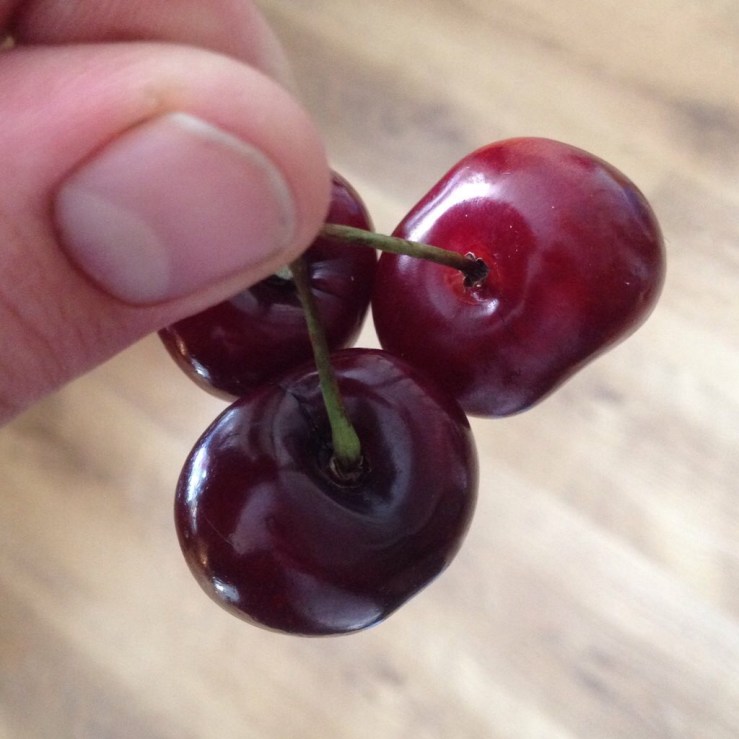
People wax in all kinds of directions about the peach; there is something about stone fruit which inspires food writers to a sort of erotic prose-poetry, especially when it is dripping and ripe, with a barely-perceptible down fuzzing its clefts and its curves, but peaches in particular don’t do much for me. Sweet, yes, soft, yes, perfumed, sometimes… perhaps my taste for them has been ruined by peach-flavoured sweets, which are, more often than not, absolutely foul. Give me a greengage, with its taut skin snapping over its fleshy cells! Give me, actually, a cherry. Cherries are obviously the best fruit. They are bite-sized, with a stone small enough to suck and then spit out; they are red, as fruit should be (except greengages); they are delicious. There is a reason why things come with a cherry on top, and not, say, a nectarine. The best thing about cherries is that they can be sour. Dried sour cherries are a magnificent thing, good with lamb or chicken or pork or baked into a tart. I have never, I am sorry to say, had the pleasure of a fresh one, but it is only a matter of time, and besides, the potential for sourness inherent in even the sweetest of cherries (they need each other, you see; the sour ones pollinate the sweet ones) means that you can happily add your own. Anything with cherry in will benefit from a squeeze of lemon or a splash of vinegar, or, indeed, a huge amount.

If you are in possession of a quantity of cherries and some good, preferably live vinegar, then you can (once you have eaten about half of the former) pit and crush the one and pour the other over it, leave to macerate overnight or for longer, then strain, mix with enough honey or other sugar to make it palatably sweet, and then dilute with sparkling or plain water; this is a shrub, and very tasty it is too. I have incorporated this ‘recipe’ as it were by stealth partly because the quantities I use are precisely that vague (although I could have easily made them up, and no-one would be any the wiser) but mainly because it is not the sort of thing you have to think about making, and set out your ingredients carefully; you just mix some nice things together, and then you have something different but also nice. Fill your kitchen with nice things, among them ripe cherries.


Panacea

IMG_4286

Whatever some might say about the roast beef of old England, the pig is, in religiously amenable areas at least, the indisputed king of the eating animals. Although it arguably deserves this accolade for its belly meat alone, not to mention the succulent beauty of its shoulder, cheek, and plump double chins, a large part of the utility and therefore the beauty of the pig comes from its suitability for curing of all kinds, in nitrate-protected salamis, salted raw hams, chunks of smoked bacon and jowl, dry-cures and Suffolk-cures, treacle and beer and vinegar; its ability, in other words, to be charcuterised. Since time immemorial, or at least a short time after that, the pig has lent itself, from snotter to trotter, to the sausage-maker’s trade – and we should all be very glad of that.

Still, there are hams beyond the porcine. Turkey, which has a pickle culture to rival that of Poland, has the meats to match, the best known here being suçuk and pastirma, both made from beef, the latter related in etymology if not technique to pastrami, which has in recent years overtaken the simpler salt beef as the most famous cured meat product of the Ashkenazi Jewish deli culture which has brought dill pickles to so many disparate parts of this world. The beef being cured here is generally brisket, sometimes fillet; the parsimonious celebration of flesh gifted to the pig is, for the cow, mainly expressed in the search for ever-more niche cuts of steak, possessed of either odd French or quaint English names and cooked bloody as hell, bavette, onglet, hanger, butler’s, butcher’s, baker’s , and candle-stick-maker’s, though an honourable mention should go to the salted and pressed ox tongue, one of the few pieces of world charcuterie which requires its own, specialist device.

Where, though, is the cured lamb? Perhaps the climates where lamb is the main protein are ill-suited to the curing of meat; perhaps I am just extremely ignorant on the subject. Either way, I know of few traditional recipes for cured lamb. This is a shame, as it can be extremely delicious. I have made a Serrano-style ham with the leg of a hogget, which was a thing of beauty; you had the squidge and edge of a good raw ham, but with an almost overbearing sheepiness, not quite edging into rancidity … I can taste it now. It did, however, apart from the whole leg, take several kilograms of salt, besides space and time and probably, I suppose, quite a lot of luck; a charcutier of my acquaintance was surprised and jealous that I had managed to make a bone-in cured lamb leg without rot or mould. I suppose the chimney in which I hung it must have been a particularly hospitable environment.

Whatever the reason, it is not a recipe suited to repeating at home, and, indeed, I never have. We should be getting another sheep soon, so I will try again; until then, this is an excellent, and extremely easy, cured lamb dish. Lamb fillet can be pale and unappetizing, but a couple of days makes it as dark as a Carpaccio; if it looks like a Caravaggio, it’s gone off.

CURED LAMB, BROAD BEANS AND FENNEL

2kg lamb fillet

600g coarse sea salt

400g granulated sugar

zest of 4 lemons

2 tbsp fennel seeds

Mix the salt, sugar, lemon and fennel together, and spread a layer in a plastic or otherwise non-metallic tub. Nestle in the lamb, and cover completely with the cure. Leave in the fridge for two or three days, then rinse and dry. Slice thinly and top with

a handful of raw broad beans, from however many pods it takes to get a handful

2 bulbs fennel, sliced wafer-thin

dressed with

juice of two lemons

200ml extra virgin olive oil

a pinch of salt

a good 6 grinds of pepper

whisked together.

Into Temptation

IMG_4135

If you pushed me to describe my style of cooking, or the food I most like to eat, I would, I think, after considering “nose to tail”, “vaguely Italianate” and “messing about”, settle with some hesitation on a long sentence involving the words “ingredient-led”, the hesitation being because the latter is such a popular, buzzy phrase that my gut assumption is that it is probably meaningless, or at least wildly overused; I think, though, that my gut is, on this occasion, wrong. All food is ingredient-led, my inner grumpy old man declares – it is, after all, made of the bloody things – and this is sort of true; you are always, at least, at their mercy. The implied dichotomy, I suppose, is between food that is ingredient-led and food that is technique-led, which could be rephrased as a debate between Italian food and French food, or at least the way those two cuisines are popularly understood.

The pinnacle of classical French cuisine is, of course, the sauce, without which no piece of protein can be considered a proper dish; the saucier is the master craftsperson of the brigade, and the so-called mother sauces, which certain food publications still seem to think we should know all about, are the Ten or rather Five Commandments of this dying religion. True to form, the defining features of these sauces are largely the techniques used, in each one, to thicken a selection of basic ingredients – the kind of ingredients that don’t get to lead. You’d get them all for free in the cupboard on Ready Steady Cook, with the possible exception of tomatoes, the sauce of which is at any rate a late and somewhat out-of-place addition to the canon. The technique most often used is the roux, one which I associate much more with Delia Smith and macaroni cheese, lasagne, gravies cooked up in the roasting tin than with French cuisine, partly because it has been superseded, as a thickening method, by various other techniques since the days of Escoffier; then it was everywhere. Imagine making a roux for a tomato sauce – in fact, that’s a good way to contrast these two imaginary styles of cuisine. The French cook takes fruit of any stripe, peels and purees them and thickens with a roux, seasoning to cover any indifference of flavour; your hearty Italian, on the other hand, simply cooks the best tomatoes she can find, reducing them to a delicious sauce.

It has often struck me, in fact, that culinary ages could be defined by their sauce-thickening techniques, from the breadcrumbs and crushed nuts of the Middle Ages through the various experiments with flours and fats which coalesced into the roux and into beurre manie, through the uses of egg yolk in combination with various substances and up to the late 20th century obsession with reduction, concentrating flavour into sticky near-solids which, often enough, make everything taste the same. Molecular gastronomy, I suppose, gave us not thickeners but lighteners; the emulsion, often now declared as such on otherwise sparse menus, remains extremely popular, having received a boost from the Spanishisms of original gastropub the Eagle and that institution’s alumnodes at Moro; aioli has become the default cold emulsion to the point where a certain chip shop of my acquaintance offers a so-called ‘garlic aioli’. So, as they say, it goes. Alongside these mayonnaises, which might contain wild garlic, Jack-by-the-hedge, fermented seaweed, fermented squid ink or fermented chilli (to take a short sample from our own menus) sits a newly-respectable style of sauce, that made of actual ingredients you would want, separately, to eat.

Broadly speaking, these can be split into yoghurt sauces and green sauces, the latter based not on the French sauce verte (another kind of mayonnaise) but on the Italian salsa verde, and both stand or fall on the quality of their ingredients. If your sauce consists of either harissa or tahini stirred into yoghurt, or of vast piles of herbs simply seasoned, then those few things had better be good. I once put a dish on the menu solely because the parsley we had was so good it deserved to be front and centre, a pungent hit of chlorophyll; that, I suppose, is ingredient-led cooking – it led me by th’ nose. Good thick Greek yoghurt is good enough to eat with just a little salt and pepper, with that dairy trick of a rich, sour blandness, so far from the thin, grainy, homogenised ‘natural’ stuff as to be a completely different product. Once you have it, there is very little that needs doing to it, and although such things are not short on technique – you will soon get bored of making salsa verde if you lack in knife skills – the technique and thus the recipe and indeed the final dish proceed with at least the natural logic of dreams directly from some quality inherent in the ingredient itself, or so, at any rate, you tell yourself while elbow-deep in mackerel viscera and wondering what the hell you are doing.


Nothing But Flour

Imagine if there were no more recipes. A provincial lifestyle blogger quietly posts a gluten-free iteration of Southern Fried Chicken, accompanied by her Smashed Cucumber Salsa and Rainbow Slaw, and that is it; the last possible combination of edible ingredients with heat, salt and time. There are no more recipes. The deluge of food related content begins to slowly dry up. The first things to go are the words “my”, “new”, “unique”, from headlines, tweets and titles; the writers know there is nothing unique in their oat cookies, their mixed salads and complex braises – not that there ever was. The adjectives of surprise start to disappear, too; as the rabid hunt for the new dies down, cooks realise that they never wanted dinner to amaze, only to fill and to delight.

As professionals and amateurs alike return to the archives, to their heaps of coffee-table cookbooks, to family recipe collections and to the depths of the Good Food website, to revisit old favourites and to finally try that dish they’d always meant to, the food-writing community is thrown at first into a blind panic. What are they to do without their newness? For a while there are no food pages in the supplements, no blog posts, no stop-motion recipe videos; Ottolenghi weeps into his spice cupboard, for there are no more worlds to conquer. Gradually, though, they recover. If they cannot create, at least they can still cook, interpret, curate; days can be spent exploring the possibilities inherent in a few lines of Elizabeth David, Mrs Beeton or Apicius. The fringe elements of cooking, the bakers, brewers, charcutiers, anyone who has spent months or years perfecting a single technique, come to the fore at last; their patience, long appreciated, is finally celebrated as a love of craft overtakes that of creativity.

This new sensibility, transferred to more everyday cooking, to the slow perfection of pasta, crackling, fried fish or salad, has immediate results; palates widened by a thousand flavour combinations become narrow of focus, gradually attuned to more subtle variations, to salt applied half an hour before or five minutes into cooking, to leaves picked in the heat of the day or by wet moonlight, to different ages of wheat. No-one can master all of these things; as specialisation deepens, meals become communal and sprawling, as everyone contributes the element they do best to the table, which might be cultured butter, pork pies, or a croquembouche. All of these things are equals at the feast, and our food has never been better.

Craft turns into cult, as the special knowledge of each technique – of little interest to anyone else, busy as they are with their own trades – is hardened into mystery, to the secrecy of family and guild; experimentation and perfectionism, at first the lifeblood of what has become known as the New Cooking, is discouraged. Adherence to the rules, to the recipes laid down in the ancient texts and websites, becomes a matter of almost religious discipline. There is clearly a best way to make, say, bread, which is that enshrined in the Book; any deviation is, by definition, inferior, and should be rooted out in case it spoils the palates and the hands of future bakers – so the thinking goes. Understandably, many baulk at this; they are suppressed. Finally, after generations of this, someone dares to tinker. Rebellion builds in their heart until they can take it no more. One day, at Stage Two of The Recipe, they swap the vinegar for lemon juice and capers for finely chopped cornichons; they serve it, against all precedence and logic, with salmon. It is disgusting.

Wild Ferment


Although I’m still learning and experimenting, I’ve done enough fermentation now, I think, to consider myself reasonably experienced, at least when it comes to solid, savoury foods; in the field of fermented drinks, I’m still a complete beginner, at least in my adult life. The first ferment I made, in fact, was Binger Geer from The Weird And Wonderful Cookbook, a comically fizzy and powerfully gingered concoction made first with the help of, and then, as I got bored with the lengthy, repetitive process and realised I didn’t much like the stuff, almost entirely by my dad, himself a keen home brewer. He makes a fine dark ale, and a number of more or less experimental and palatable country wines; the blackberry has, in years past, made an excellent mull for Christmas Eve.

Brewing beer has always seemed like a complex and arcane process to me, requiring large investments of time, skill and equipment, and so, in fact, it is; you can buy one of those can kits and make yourself a batch of indifferent bitter with relative ease, but as you can easily buy indifferent bitter at any supermarket, cornershop or pub, it seems a little pointless. Making anything decent or interesting is hard, and best left to professionals or dedicated hobbyists; making country wines is much easier. This is obvious, when you think about it. With beer, you take a sweet-smelling but fairly unpalatable mash and coax it gently into a complex deliciousness; wine-making lets you start with something delicious and basically leave it alone, your only input being to not cock it up. Moreover, light, gluggable wines are something I generally want to drink, and they’re quite hard to come by in this country. So.

With this in mind, and with the help of Sandor Katz, I thought I’d try making honey wine. Given that honey is basically the tastiest natural thing, this is very easy. You just mix honey with water (1:4) in a bucket and leave it to do its thing; once it’s done that, you put it in a sequence of bottles until you want to drink it. There’s a little more to it than that, but those are the basics. Deciding when you want to drink it – that is, when it is at its best – is the hard part, but since it’s your wine you can sort of decide what its supposed to taste like anyway. There, that was easy, wasn’t it? Even if it goes really wrong, you’ll probably end up with vinegar, and fresh, unpasteurised vinegar is a lovely thing. You can, if you want, use it to make more drinkables, in the form of shrubs or sipping vinegars; or you can pickle things in it, taking the all-my-own-work glow of preserving up a notch. Or you can just use it as vinegar, in dressings and sauces and marinades. Honey wine vinegar is bloody lovely. Next time you find yourself with a lot of something sweet, I urge you – stick in a bucket and wait. You might not be disappointed.

Never Failed Me Yet

Cooking with offal was once truly common sense. You slaughtered Francis (I’ve always wanted a pig called Francis) in the late autumn, and it was not just respectful to his memory but entirely necessary to your own survival that you used every single bit of his fat pink carcass; except for the oink, of course, which had in any case departed when you stuck him. With the help of salt and smoke and many hands, each part would be rendered gradually edible, for today, tomorrow, or for the long winter ahead. Most of us no longer live like this.

Some parts which come under the broad heading of offal are still truly waste; my butcher gives me heads and feet, hearts and scraps for free, as they would only be destined for landfill, and I’m more than happy to take the time and energy to transform these stubborn pieces of meat into something delicious. Others, perhaps, are making the slow transition from unwanted cut to delicacy; a pig only has two cheeks, after all, and if everybody realised how good they were they would be prized higher than fillet, with a price tag to match. Still other bits are so hard to get hold of that their consumption becomes more performative than practical, in which category I’d put blood.

Fresh blood is hard to find, but even in its dried form it is cheap, nutritious and delicious; if we no longer need to use it to thicken or to bind, or just as a handy, sausageable form of protein, it is still worth doing, both – I’ll admit – for the B-movie fun of it and for the elusive, rusty flavour. Perhaps, too, by keeping a taste for it alive, we prepare for a time when its fresh form is not treated as a poison but used and celebrated at its abundant source. This southern Italian recipe would once have been a part of the pig-killing festivities; now, almost black and with a fudgy, spoonable texture, it is simply a delicious thing to eat. You’ll need, I’m afraid, a reliable thermometer.

SANGUINACCIO

Makes six little cups

35g dried pig’s blood

100g lukewarm (blood temperature) water

100g light muscovado sugar

200g dark chocolate, chopped

100g olive oil (a lowish grade is fine)

100g double cream

Whisk the dried blood with the water and a pinch of salt until you have a smooth liquid, rather thicker than water; pinch a drop between your fingertips to check it has all dissolved, then add to all the other ingredients in a heatproof bowl.

Set this over a pan of simmering water, and stir the whole lot together while the sugar dissolves and then the chocolate melts; keep stirring until it reaches 67°C, and then immediately pour into a waiting jug and from there into your six little cups. Put in the fridge for a few hours to set.

Serve, if you like, with candied pine nuts, raisins and orange peel, or with more cream. Ask your diners to guess the secret ingredient, and then await their wrath.

Icumen In


The weather seems to have finally caught up with the calendar, having sensibly skipped April in favour of a rerun of February; the skies are a bright, clear blue, small birds sing in the hedges, hares roam the fields, and greengrocers start to stock local produce other than various and manifold forms of cabbage. God, in short, is in his heaven, and all is right with the world; it is time to sit down and write about asparagus.

Asparagus is green, and while it was once the thing to cook it in bunches to a muted pliability, you are now as likely to find it fried, grilled, or otherwise blackened, wrinkled and intense; that’s all I have to say about asparagus, delicious though it is. I like to serve it with feta blitzed with salted lemon until it goes grainy, separates, and then comes back together into a thick cream, though you might not. If there is any overlap between the seasons (which seem to be longer, for wholesale purposes, than the ones stated in magazines and shops), then a blood orange hollandaise can be a lovely thing. So much for asparagus. There is more to the endless somersault of the seasons than green vegetables.

I made the most of one of the hotter days of the year thus far by cooking four halved pigs’ heads, filling the kitchen with a thick, fatty steam for around five hours, extended to six while I picked the nuggets of meat from the skulls and reduced the resulting liquor, which could probably, if the smell didn’t bother you, be used as hair product, though not on hotter days. As an added bonus, the kitchen temperature (hovering around 20°C) and humidity seems to be ideal for fermentation of various kinds – my honey and rosemary wine is bubbling away merrily, and the usual array of pickles are all doing what they do at a steady pace; summer will soon be here, and with it the heaps of courgettes, tomatoes, herbs, beans and flowers, all needing preserving in their various ways. It’s good to get the practice in now.

If you get bored of pickling things, and bored of plain-ish asparagus, and if the weather drops a bit, a risotto primavera is a nice thing to make; if you get bored of risotto rice, the same thing done with buckwheat grains, quick to cook, nutty and wholesome, can be very good. As ever with spring cooking, lemon is your friend. A recipe? This is no time of year for recipes. You just take what looks good and you cook it, to make it the best it can be; recipes are for the darkening tail of the year. Besides, any recipe would be redundant soon. The broad beans and the peas, the radishes, the lettuces and the soft herbs are filling the air with the bright promise of a late English spring.

Sloppy Thinking


It’s surprising (to me, anyway) how difficult it is to make a luxurious dessert from cocoa powder and pig blood. The problem, I’m convinced, is the powdered blood I’m using, the jars of impossibly fine purple powder which sit on the shelves like something in an alchemist’s workshop; no matter what combination of temperature, hydration and whisking I use to produce a thick, black liquid blood, there always seems to be a slight grainy residue on the back of the tongue – though perhaps this is a residual squeamishness from thoughts of scabs, clots, stains and streaks. Eaten incognito, maybe this blood custard would seem the creamiest of desserts.

It always seems to be this issue of texture – that is to say, of the precise feeling in the mouth – which divides people over certain meats and offal. Take tripe. A beautiful shade of marble-white, the bleached and pre-cooked stomach lining has, once stewed in its usual heavy accompaniments of abundant onion or heavy tomato sauces, little distinct taste of any kind, let alone an offensive one; but the texture! Either rug-hairy or covered in soft, giving spikes, above all rubbery, it can seem like chewing on some chimerical alien’s hide; I find it edible, but I can’t say it’s something I would seek out very often – unless I was in Rome.

We don’t tend, in this country, to particularly value sloppiness – unless it is mitigated by a surrounding crunch. Jellyfish and sea cucumber have never made inroads here, and nor, really, have gelatinous okra, fermented beans, or the slimier of sea vegetables. Put it in a fritter, though, and that’s a different matter! I find simply poached brains, with their creamy, spreadable texture, intriguing if not overwhelmingly enjoyable; but deep-fried brains! Beautiful clouds, with a perfect surrounding crunch. While any sloppy meat – cheek, foot, belly, chest – does well in a croquette or similar situation, nothing matches the absolute transformation of the brain from worthy curiosity to pure, golden joy.

I suppose, really, that this is just a late adolescence of the palate, the start of a parallel journey to the one from chicken nuggets, turkey burgers and fish fingers to un-breaded protein; I need to go back to those spreadable brains, and see if the fritters have taught me their value. I suppose the lesson here is that anything can be made delicious by deep-frying, which we all knew anyway. Apologies for taking up your time. Now, where did I put those rabbit eyes?