
Tongue & Cheek

In the rather macho world of nose-to-tail eating, there is, I think, some confusion as to what is being propounded – a confusion which can easily put off interested newcomers. Offal is never going to become big business – even when you get past the idea that you are eating a specific, named organ with specific functions, there is still that taste to contend with, that weird, ferric tang, as well as the texture, a dense sponginess that makes it quite hard to cook, responding to heat differently than muscle fibre. I love offal, but I can see why people don’t – and some vaguely ethical idea about eating ‘the whole beast’ is not going to convince them otherwise. It’s no less ethical to feed the weird bits to dogs.

At the other end of the ‘variety meat’ spectrum, though, you have perfectly meaty cuts of meat which we, as a culture, have simply fallen out of the habit of using, cuts which maybe take a little more time or effort to prepare but which are, if anything, more delicious than their more familiar neighbours. It wasn’t that long ago that pork belly fell into this category – look at the first Nose To Tail Eating, published in ’99, and you can find good old St Fergus preaching its virtues as if for the first time – and now it is everywhere, the go-to pork cut for gastropub and restaurant alike. Brisket, thanks largely to the American barbecue craze, is making similar headway, and we are getting more used to ‘difficult’ steak cuts (bavette, flat-iron, onglet) that require more careful cooking than the bleeding/shrivelled dichotomy of old. I think the slightly dubious ‘ethical’ aspect of nose-to-tail has more weight here – you don’t have a responsibility to eat things you hate, but it is irresponsible to ignore cuts of meat that are cheaper, tastier and often healthier, simply because you don’t know what to do with them. With that in mind, here are a couple of suggestions.

OX TONGUE, BREAD, GREEN SAUCE

While in Sicily, I saw, but never got the chance to eat at, a restaurant called Casa Del Brodo, which specialised in tortellini cooked in a rich meat broth (brodo). Presumably to supply adequate quantities of this broth, they also seemed to specialise in simply boiled meat dishes, generally beef or veal, and generally served with green sauce. Having been denied this pleasure, I ordered a brined ox tongue from the butcher when I got back. To cook the tongue, simply poach it with a few stock vegetables until very tender – it’ll take about 3 and a half hours – and then peel it as soon as it’s cool enough to handle. Then do as I did, and follow Fergus Henderson’s excellent recipe, which can be found here. A tongue is still obviously a tongue when you acquire it, and might induce some squeamishness, but the meat is firm, tender, lean and delicious, like a perfection of corned beef. We also ate the broth, with some macaroni and a few veg cooked in it, as a starter. A meat based meal that was clean and simple.

BRAISED OX CHEEK WITH SHERRY & ORANGE

This is quite different, a ridiculously rich and beefy concoction. It requires a couple of days planning, for the brining.

STEP 1

1 fat ox cheek

75g sea salt

50g caster sugar

a few cloves

1 cinnamon stick

1 clove of garlic

Put all the ingredients except the cheek in a pan with 500ml of water, bring to a boil (making sure your sugar and salt are dissolved) then cool completely. Put the cheek in a Tupperware box or similar, pour over the cold brine, cover – you might need to weigh the cheek down so he’s covered completely – and stick in the fridge. Leave for 3 days or so, turning once or twice.

STEP 2

2 onions, finely sliced

1 celery stick, finely diced

1 carrot, finely diced

2 cloves of garlic, finely sliced

1 orange, juice and a couple of strips of zest

1 cinnamon stick

a little bundle of thyme

a few bay leaves

250 ml of sherry – something sticky and dark, not leftover Bristol Cream

a splash of sherry vinegar

Put the oven on low – gas mark 1-and-a-halfish, about 150 Celsius, whatever that is in Fahrenheit. Sweat the veg with a little oil in a casserole until they are really soft, which will take a while. Remove your cheek from its holding tank, rinse and dry, then brown in a frying pan over a fairly fierce heat. Put the cheek to one side, deglaze the pan with sherry vinegar, and pour the juices in with the veg. Assuming they are now soft and golden, tuck in the zest, herbs and cinnamon (tied in a little bundle if you can be bothered), then pour in the orange juice and sherry. Reduce until the liquid is pretty syrupy, then sit the cheek on the onions and pour over enough water to nearly cover (see Fergus Henderson’s alligator-in-the-swamp principle). It shouldn’t need any seasoning, thanks to its briny days. Bring up to a simmer again, whack on the lid and put in the oven. Leave for about 6 hours. Take it out and poke with a spoon. If you can poke through it, it’s ready.

STEP 3

This is entirely up to you. You could cut the whole cheek into a few happy chunks, sit them on some mashed potato and serve with greens; you could do the same with pools of cheesy polenta and some bitter raw leaves, lurking with anchovies. I shredded it up, left it overnight, and did this –

CASARECCE WITH OX CHEEK RAGU & TALEGGIO

for 2

half your ragu

200g casarecce

75g taleggio, diced

flatleaf parsley, chopped

a knob of butter

a splash of extra virgin olive oil

reheat the ragu with a splash of water in a small pan. In another, bigger pan, cook the pasta in only lightly salted boiling water. Have everything else ready to go, as well as some arrangement for catching the pasta water, so you can work quickly. When the pasta is just cooked, drain, then put back in the pan. Let it steam for a second, then add the cheese, the butter, and the oil; stir, melt, add the hot ragu and a couple of tablespoons of your pasta water (I told you!), stir, add the parsley and some pepper, tip onto hot plates (I should have mentioned that) and serve with a little salad of broad beans, rocket and capers, dressed with vinaigrette and lemon zest, which hopefully someone else will have prepared while you were messing around with pasta.
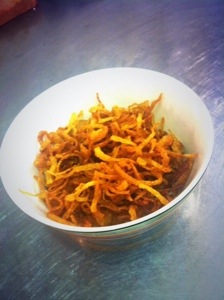
Egg, potato, onion

I think it’s fair to say that I am not generally a fan of fusion cuisines, especially when they are perpetrated unthinkingly. Culinary traditions are rich cultural artefacts, developed over hundreds or thousands of years; to interfere in that simply for the sake of dinner seems trivial, insulting. Pasta used as a dumping ground for leftovers, bacon flung irresponsibly into couscous; worst of all, fashionably exotic food terms flung around menus, misapplied until they lose their meaning (a ceviche of shallots, a carpaccio of pretty much anything), seem like cultural vandalism, a colonialist looting of an alluring past. (Yes, I have been told that I take things too seriously).

Having said that, everyone needs a go-to dish, a vehicle for the current contents of your fridge, a base around which to build supper or a lazy lunch when the shops are too far away or too closed and you don’t give a damn about culinary traditions. Brunch is a good occasion for such dishes; the whole affair suggests a cheerful dissolution, and disparate ingredients can be brought together with the unifying influence of toast or egg. I’m a big fan of the hash in this context, and many differences can be resolved with a base of toasted bread, but my favourite catch-all dish is probably a tortilla. A sturdy structure of potato, onion and egg can be adapted to almost any cuisine, sharpened with chilli or spice, warmed with chunks or strands of cheese, enriched with little nuggets of sausage or black pudding or ham, freshened with clean herbs and vegetables. I’m sure the Spanish would be outraged, and when I’m feeling particularly high-minded I try to justify this bastardisation, pointing to the tortilla-equivalents across the world – the markode of Algeria, the Arabic eggeh, the Italian frittata, the Persian kuku – but fundamentally I don’t really care. Tortilla are pretty much universally delicious, the sweet, umami-rich combination of potato, onion and egg hiding any weakness in the rest of the ingredients.

i’m not going to give a recipe for tortilla, as that is not really how something like this is cooked – quantities depend on what else you want to throw in, which in turn depends on mood and resources. Even the basic method is up for debate. I will, however give a few general observations on tortilla-making. I’ve eaten a lot in my time.

ESSENTIALS

onion

potato

egg

For your own sake, the onion and potato should be cut as fine as possible. I like the onion diced, and the potato first halved lengthways and then sliced across, but that is a personal preference. Sweet Spanish onions and small waxy potatoes are the way to go, I think; the potatoes need to hold their own in the cooking process.

Never boil the potatoes first – you lose so much flavour (yes, potatoes have flavour) and so much of their protein-enhancing umami that way, as well as missing out on the beautiful, fudgy texture they get from a purely oil-based cooking. Chips are tastier than boiled potatoes. Learn from this. Sweat the potatoes together with the onions in plenty of olive oil (nice olive oil – you can always reuse it) and a good amount of salt until they are tender. If you’re adding meat you might want to put it in now so everyone gets to know each other.

You want to eat this delicious combination as the main event. The egg should be the binding agent, not the star of the show; it’s not an omelette in that sense. Two or three eggs to a 10-inch pan is fine. Let the onion-potato mix cool a bit before you stir in the eggs, to avoid weird lumps. Add other bits like fresh herbs and cheese at this point too.

I know it’s wrong, but I always start my tortilla on the hob and finish in the oven – it skips the whole messy hassle of flipping it. If you do this, let it set and colour on the bottom before putting it in the oven, which will help it slip out of the pan later. If you must flip the tortilla, on your own head be it. Don’t have the oven too hot. Let the whole thing cool a bit before you take it out of the pan, and then some more before you eat it.

EXTRAS

I’ve got a Turkish-style tortilla in the oven at the moment, with bits of halloumi, sucuk sausage, green chilli, and plenty of herbs. Other things I have added in the past include –

ham hock

black pudding

pork sausage

merguez sausage

chunks of manchego

grated manchego

grated Dapple

roasted peppers

pickled chillies

marinated artichokes

handfuls of dill

paper-thin courgette slices

tiny broad beans

frozen peas

and probably loads of other things I’ve forgotten. 

Have a go.

Artichokes and Lies

No one likes being lied to. Working in a restaurant, it’s easy to forget that, while this may be the hundredth plate you’ve sent out today, for the customer it might be a rare treat, a special meal – depending on the restaurant, it could be a once-a-month or a once in a lifetime thing. Get it right. Still, you can excuse minor inconsistencies. Eating at St John Bread & Wine, I had a dish of oxtail, turnip and watercress, which turned out to be a dish of oxtail, turnip and spinach. They had clearly run out of watercress, which they neither apologised for or even mentioned; pretty shoddy for such an establishment, perhaps, but I didn’t really care. It was a delicious, unctuous bowl, with the peppery bite of the turnip and, well, pepper, making up for the lack of the watercress. It certainly didn’t spoil our meal, which was one of the finest I’ve ever eaten. Still, with a short, ever-changing menu, and the brutal simplicity of the St John school of menu-writing (dishes are generally just written as “Ingredient, Ingredient, and Ingredient” – we had Rabbit Offal, Back Fat, and Dandelion, for example), they should be able to get it right.

A worse problem is when restaurants have such mistakes/lies built into their menus. I recently had a meal at a favourite cafe-bar in Norwich – our local, basically, and one I go to very often. It has an extensive menu of small mezze items that changes daily, and they make an effort, I think, to educate their customers, introducing unfamiliar words and ingredients. I’m told the owner makes frequent trips to the Turkish markets in London, giving him access to a range of produce not easily available in Norwich. All very laudable. Anyway, our meal was, for the most part, lovely – we had a beautiful braised chicken dish, a leg in a rich and shimmering broth shot through with Turkish pepper paste. One of our dishes was described as “roast Jerusalem artichokes with marinated feta and parsley and preserved lemon gremolata”. I had a problem with this from the description; I don’t particularly like the habit of shoehorning new ingredients into traditional recipes. Gremolata is a thing, and if you make it with preserved lemon it is a different thing entirely. Still, I can see why it’s done, as a form of shorthand or a shared reference point, and I’ve probably done it myself. In fact, I’ve done it myself on this blog. It’s a forgivable sin, anyway, and the dish sounded nice, so we ordered it. 

What arrived at the table was, yes, roast Jerusalem artichokes. They were perfectly cooked, soft and fudgy and just starting to char around the edges. They were covered in a thick paste of parsley, bound with olive oil, that might have featured a little preserved lemon – it was hard to tell – and sprinkled with a soft, fresh, mild cheese. It was quite a nice little mezze, if a little underpowered and underseasoned, and much of a muchness texturally; it was all squidge and no bite. What it wasn’t was roast Jerusalem artichokes with marinated feta and parsley and preserved lemon gremolata. Gremolata is a traditional Italian garnish, used to finish and cut through rich stews and seafood dishes; it is properly made with lemon zest, garlic and parsley. To quote Russell Norman, who is something of a pedant after my own heart and also knows what he’s talking about, “gremolata is a dry crumbly dressing and so requires no oil or other liquid”. So. A parsley and preserved lemon gremolata, if it must exist, should be parsley, garlic, and the rind of preserved lemon, finely chopped. That it wasn’t was offensive for two reasons. Firstly, the establishment in question makes a big deal about educating their customers; they have a (barely) passive-aggressive sign up by the till explaining the concept of a ‘sandwich’ or ‘wrap’ and why you shouldn’t need cutlery to eat it. If you’re going to do this, you really need to get things right. To make some kind of bastardised Middle-Eastern salsa verde and call it gremolata is rude both to people who know what gremolata is, as they will feel they’ve been lied to, and to people who don’t know, as they will now go around thinking that every other restaurant is wrong about gremolata, and be embarrassed in front of their supper club when they get it wrong. Secondly, the dish would have been nicer with actual gremolata on it, providing a freshness and a welcome textural contrast to the soft artichokes and ‘feta’. Oh, the feta. If the gremolata made me angry, the feta was just disappointing. More like ricotta than any actual feta I’ve ever eaten, I’d guess it must have been that insipid ‘salad cheese’ you get. At the time I assumed they must have just run out of feta, but I’ve since eaten the same parody of cheese in other mezze there. As for the ‘marinated’ part, it just wasn’t, unless it had been soaked in milk. It didn’t taste of anything beyond a mild lactic tang. Again, none of this would be relevant if it had made the dish nicer, but it didn’t. The salt and acid of a good feta, perhaps with a few aromatics in the marinade, would have been lovely. Did I complain? No. I don’t like complaining unless there is an actual mistake by the kitchen – under- or over-cooked meat, for example – whereas this dish was made with malice aforethought. Will I go back there? Yes, definitely. It’s still one of the nicest places to eat in Norwich, and this blog is something of an overreaction to a minor complaint. But I love it less, and I find their patronising signage more annoying, than I did. Here is my recipe for the same dish, by way of closure. 

serves a few, depending on what you’re serving it with

ROAST JERUSALEM ARTICHOKES

500g jerusalem artichokes

4 lemons

olive oil

thyme

Give the ‘chokes a scrub, cut into equal-sized pieces, and put in a pan of salted cold water with two of the lemons, halved and squeezed. Bring to a boil, then simmer for about ten minutes to parboil. Drain, then put in a roasting tin with some thyme sprigs, the other two lemons (also halved and squeezed) and a good glug of oil. Toss well. Season, then put in a medium-to-hot oven for around 20-30 minutes, until brown, fudgy, and starting to catch.

PARSLEY AND PRESERVED LEMON GREMOLATA

small bunch of parsley

2 preserved lemons

1 clove of garlic

Quarter the lemons and cut out the flesh. Peel the garlic (obviously). Finely chop everything, using your sharpest knife (the top, not the heel) and a little patience. Mix together.

MARINATED FETA

200g good feta cheese

100 ml extra virgin olive oil

1 tsp cumin seed

1 tsp coriander seed

1 tsp fennel seed

Pinch chilli flakes

zest of half a lemon

Put the oil in a bowl with the chilli and lemon. Separately toast all the seeds in a hot pan, then add to the bowl. Carefully cube the feta, then put that in the bowl too. Mix carefully, trying not to mash the cheese up. Leave to marinate for as long as you can be bothered.

Hot artichokes on a plate, cheese, gremolata. 

Kushari and Karkaday

20140131-200612.jpg I spent a month in Egypt when I was 18. Enthusiastic if not particularly knowledgable about food, I knew a little about Middle Eastern cuisine but nothing at all about Egyptian food; then and now, it is not much written about. Surprisingly, Claudia Roden, a native of Cairo, has never devoted a book to the subject. Perhaps history is too close to memory for her; perhaps she simply finds it boring. Anyway, my ignorance gave me a sense of exploration, of discovery – I found and knew less than if I had pored over guidebooks, but everything I did find was mine. Vegetarian at the time, idealistic and foolish, I regret not trying the brain kebabs that were sold on the corner of every block in Cairo, but everything I did eat still sticks in my mind – the Mubarak brand cheese (the former president was known as The Laughing Cow, for some reason) with milk rolls and eggs for breakfast, rice and black tea to get over a stomach bug, juicy papayas and sticky basbousa from the market below my hotel, tomato stews enriched with yoghurt, cumin-spiced lentil soup… Egypt has a good tradition of vegetarian food, largely from the Coptic Christian population and their elaborate calendar of fast days, and I was spoilt for choice. This was my favourite, though, and something I make all the time. A street food classic, there are diners all over Cairo serving this and nothing else, except maybe some rice pudding for afters. KUSHARI This has a few elements, but they’re all pretty easy, and some can be done in advance. To serve four. CRISPY ONIONS 3 large Spanish onions sea salt extra virgin olive oil Slice the onions into half moons, as thin as you can manage. You should be able to see through them. Put them in a colander, sprinkle over about a tablespoon of salt, and rub it into the onions. Leave for about half an hour. Rinse the onions, then squeeze out as much moisture as you can. Heat a couple of inches of oil in a deep pan, and fry the onions in batches, swirling and turning often with tongs. They won’t seem to be getting anywhere, but will eventually (15 minutes or so) turn a lovely golden brown. Remove, drain on kitchen roll, and repeat with the rest of the onions. SPICY TOMATO SAUCE 2 tins chopped tomatoes 4 cloves of garlic, crushed 100ml red wine vinegar 1 tsp chilli flakes Put everything in a pan, bring to a simmer, and reduce until thick and intense. Season. It should be almost unpleasantly tart and hot. LENTILS 200g green lentils 2 bay leaves 1 head of garlic, halved Stick everything in a large pan, cover with twice the volume of cold water, bring to a boil, then simmer for half an hour or so until tender. Al dente lentils are disgusting; veer on the side of too soft. Drain and keep warm. MACARONI 100g macaroni Cook the macaroni. You could use another pasta if you like; I’ve used vermicelli, which works well. Macaroni is authentic, though, at least to the diner I went to. RICE 1 large onion, diced 1 tin chickpeas, drained and rinsed 1 tsp ground cinnamon a little fresh grated nutmeg a couple of cloves 500g basmati rice 1125ml of vegetable stock (knorr stock pots are good, but most other cubes and powders taste of dried herbs and salt – plain water would probably be better if you can’t go fresh) oil Heat a little oil in a large pan, and sweat your onion until good and soft. Add the chickpeas and the spices, and cook for a minute more. Stir in the rice, making sure it’s well coated in oil. Add the (hot) stock, and boil hard until well reduced, with a few pits starting to appear in the surface of the rice. Stick a lid on the pan, turn the heat right down, and leave for about ten minutes. Different brands of rice take different times, and the size and shape of your pan will make a difference too, so it’s difficult to be exact – just leave on the low heat until the rice is nicely cooked through. ASSEMBLY fresh parsley fresh coriander chilli oil or chilli vinegar or both Stir the lentils and pasta into the rice, serve up into bowls, and top each portion with spicy sauce, crispy onions, and a good scattering of herbs. Add chilli condiments if the sauce isn’t hot enough for you. KARKADAY They love hibiscus in Egypt, and drink it all the time as either a tea, or here, as a cordial. This recipe is adapted from Thomasina Miers, as they apparently drink something similar in Mexico. Makes a fair bit, but it keeps. 50g dried hibiscus flowers 300g caster sugar 1125ml water (that number again, strange) 2 lemons Put the flowers, sugar and water in a pan, bring to the boil, then simmer for about half an hour. Cool, then stir in the lemon juice. You might not want all of it, but it should be good and tart. This makes a cordial which is good with water, soda, and I imagine prosecco.

Corpse Of Milk

I love cheese. I don’t think I know anyone who doesn’t love it, apart from the ethically- or physiologically-averse. One of my favourite things about travelling is eating different cheeses, the ones that haven’t made it to Britain – the aged peynirs of Turkey, the vast, stinking cohorts of France, even the bizarre aberrations the Americans are pleased to call cheese – and one of the first things I crave on returning is a good cheddar.

I genuinely think British cheeses are some of the best in the world, with an astonishing variety and depth of tradition that is missing from much of our current food culture, cobbled together as it is from a glorious mishmash of sources, and they are also some of the most magical. The making of fresher, curd cheeses,  for example, is fairly easy to understand – I’m halfway through making a white cheese at the moment, and it’s easy to see, once the separation of curds and whey has started, how the resulting mess could turn to feta, or ricotta, or whatever. To get from there to the fur-covered beauty of a Suffolk Gold, or the unctuous pungency of a Stinking Bishop, seems impossible. The alchemy of secret mould cultures, wraps of nettle or wax, aging in hidden caves… the transformation of the bacteria-riddled corpse of milk into a delicious sandwich component is pretty impressive.

That whole process is a mystery to me, but there’re a few cheeses that it’s easy enough to make at home. The first cheese I ever made was from the Weird and Wonderful Cookbook when I was about 8 or so – it was a fresh, soft cheese, and I think I was disappointed, having expected something like a cheddar to emerge from that muslin bag. I don’t have that book to hand anymore. This, though, is an extremely easy and satisfying recipe that provided my grown-up introduction to cheese-making.

SPICED LABNEH

I’ve read recipes that say USE GREEK YOGHURT and others that say NEVER USE GREEK YOGHURT, but as far as I’m concerned, using the strained stuff just does some of the work for you, so. I’ve made this literally hundreds of times, and it works for me.

1kg Greek yoghurt

6 cloves garlic

Sea salt

1 tspn chilli flakes

2 tspn sumac

1 tspn dried oregano

Chop the garlic finely then crush with a good tablespoon of salt. You want a smooth paste, with no rogue bits of garlic in your cheese. Add to the yoghurt with the rest of the ingredients and beat until well combined. Taste for seasoning, then spoon into a jam bag or similar arrangement – you could use muslin or a clean tea towel or probably even a t-shirt if you like. Whatever you use, you need to be able to hang it over a bowl in the fridge and leave overnight.

What you do now is up to you. After a day, you’ll have a lovely cream cheese that is good as a dip, spread on toast, or dolloped on any stew where you might put yoghurt. After two or three days it should be good and firm – at this point you can roll the cheese into little balls, which can be rolled in herbs or spices, kept in oil and used as a mezze… That’s all a bit of a faff though, and I tend to just eat it at the soft stage.


Turkish-American Beef Dinner

I think some of the best restaurants exist within imagined worlds. Sometimes this is simply the idealisation of memory – Russell Norman’s Polpo, for example, creates a version of Venice surpassing the original, largely from the raw materials of his own rose-tinted memories. Taken a little further, restaurants can provide an idealised version of something which never existed in the first place – to stick with Norman’s group, his Spuntino creates the perfect Italian-American neighbourhood bar, all bitter cocktails, mysterious shellfish, rich pasta and deep-fried treats, which would be unrecognisable to anyone who has endured a red-checkered red sauce joint in the wrong part of town.

These restaurants, and others – Pitt Cue being a good example – are prime hipster locations, where context is an important as content. The food, while always strongly themed and very well executed, does not need to be groundbreaking as it is not the whole of the story. When you dine at Pitt Cue Co., you aren’t just eating pulled pork – you are imbibing a whole culture, of PBR, snap-back caps, beards, plaid and Southern rock – a fantasy of US barbecue culture that has already been filtered through East Coast hipster culture before it arrives here.

Other, more interesting restaurants manage to apply this sleight-of-hand to an entire cuisine. Look at St. John and its subsidiaries. “A Kind Of British Cooking”, the recipe books tell us, and Fergus Henderson’s writing emphasises this, highlighting the skills and recipes he learned from his parents and grandparents while ignoring his own background in French classical cuisine, as well as the then-fashionable southern European influences he imbibed at the Eagle. The result, particularly, I think, at Bread & Wine, is a delicate fusion that dare not speak its name, a recreation of a traditional British cuisine that never actually existed.

With all this in mind, I was thinking about the similarities – briefly mentioned, but never fully explored, in the Pitt Cue book – between American barbecue and Turkish cuisine. Both are cultures of pickle and smoke, of intense meat and charcoal cut through and balanced by crisp vegetables and sharp, sweet liquors. They even drink pickle juice as a pick-me-up in Turkey – although without the bourbon first. Imagine the perfect Turkish-American diner … the short-order cook a moustachioued usta, the hashes spiked with biberi pepper, the chopped salad laced with sumac … This dinner was the result of these imaginings.

SMOKED PASTIRMA BEEF, FETA POUTINE, TURKISH SLAW

for 3 or 4 people

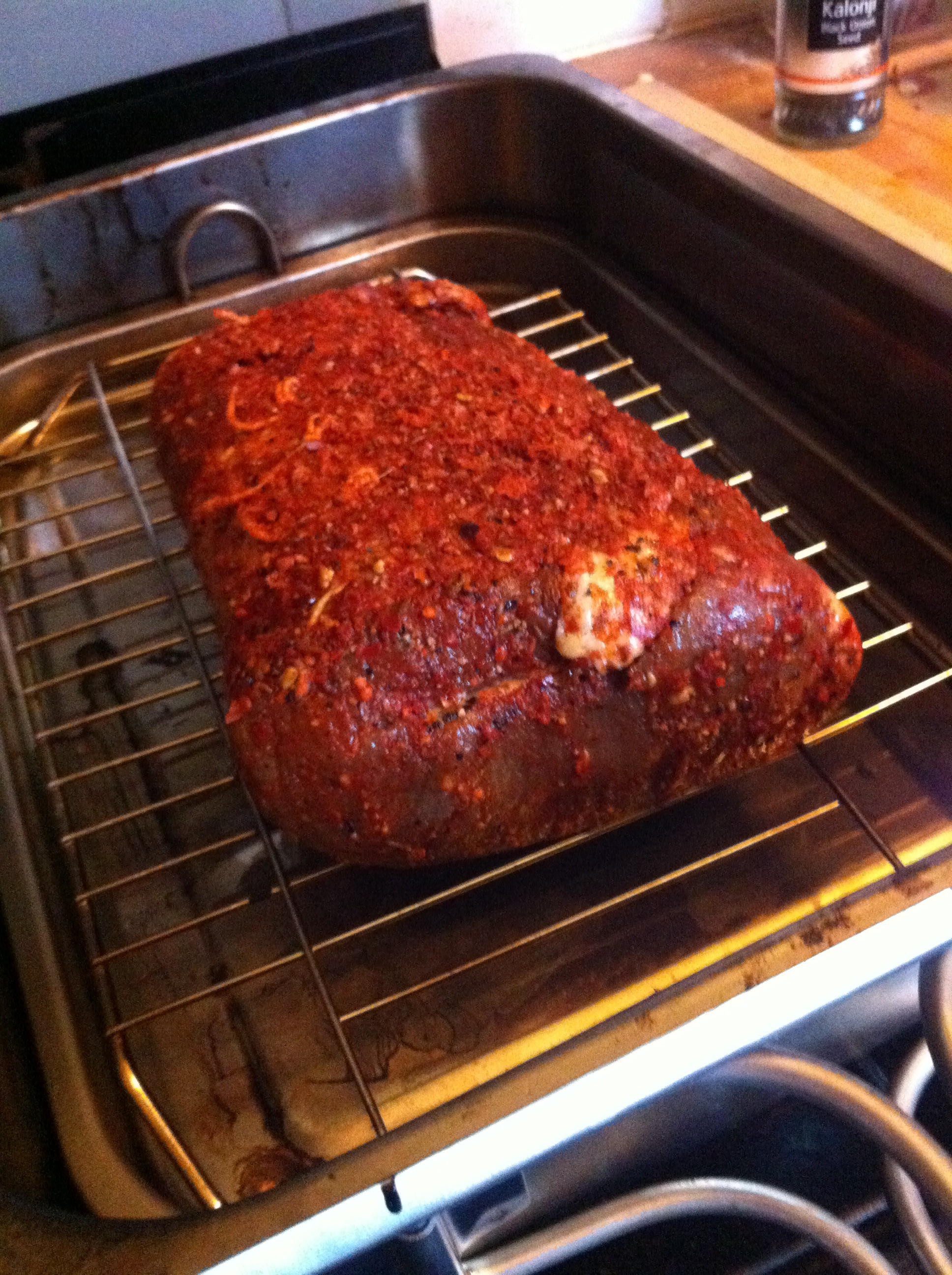
Pastirma is a Turkish dry-cured beef, similar to bresaola, but coated in a clay-like spice paste for the final stage of the curing process. Here, the same spices are turned into a barbecue dry-rub.

BEEF – STEP 1

1kg brisket

salt

sugar

Make up a brine with 1 litre of water, 120g of salt, and 15g of sugar. Immerse the brisket in this for three days. When it’s ready, dry it off with kitchen towel and leave in the fridge, uncovered, for six hours or so to dry further.

STEP 2

2 tblspn fenugreek

4 tblspn hot paprika

2 tblspn black pepper

2 tblspn cumin seed

1 tspn allspice

1 tblspn garlic powder

3 tblspn Turkish pepper flakes

handful of Maldon’s salt

Grind the whole spices and mix with the rest. Rub liberally all over your brisket, wrap in clingfilm, and leave in the fridge overnight.

STEP 3

This entirely depends on your cooking arrangements. I used a stovetop smoker, which I loaded with a mix of hickory and apple, and smoked the brisket for 2 hours before finishing in a low oven, covered, with a little liquid. If you have a decent barbecue you could do the whole thing on there; alternatively, you could do it entirely in the oven. It won’t be quite as tasty, but you could add some urfa chilli or even some smoke powder to the dry rub to approximate the flavour. Whatever way you choose, it’s going to take a long time, so you’ve got a while to get on with the sides.

image

FETA POUTINE

The Québécois pretend to a sort of European sophistication which eludes their dip-chewing, denim-clad, beard-sporting compatriots. Poutine, however, is their national dish. Make of that what you will. This is a happily bastardised version.

1.5kg new potatoes

1 heaped tblspn flour

a knob of butter

1 pint of liquid (I used a mix of the meat juices, wine, and bought stock)

a big handful of feta cheese

Parboil the potatoes, then cut into whatever shape you like. Proper poutine is made with fries; I went for chunks. Oil, season, and stick in a hot oven.

While the potatoes are roasting, make the gravy. Melt the butter (in a pan, obviously), stir in the flour, and cook until it smells nice and biscuity. Add your liquid a bit at a time, stirring, and simmer until thickened. When you’re ready to eat,  pour the hot gravy over the hot potatoes and crumble over the feta.

TURKISH SLAW

This is adapted from Rebecca Seal’s lovely book Istanbul.

1 small red cabbage

1 celeriac

2 carrots

1 red onion

vinegar

sugar

salt

1 tblspn tahini

juice of one lemon

1 crushed garlic clove

2 tblspns yoghurt

Slice the onion in half moons, then place in a small bowl, cover with vinegar, and sprinkle over a big pinch each of sugar and salt. Leave to macerate. Shred the rest of the vegetables. (If you’re doing this in advance, squeeze some lemon over the celeriac to stop it discolouring).

Whisk the tahini, lemon juice and garlic together with some salt until it turns creamy. The tahini will stiffen and split; persevere. Stir in the yoghurt.

A bit before you want to eat, mix together all the vegetables and dress with the tahini yoghurt. Let it down with a little of the onion vinegar if it seems claggy, and season appropriately.