Brownie Points

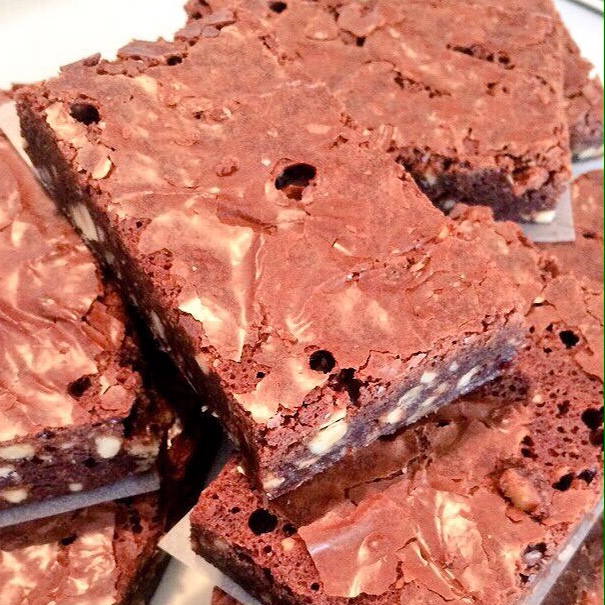
photo (1)   Not just another cake recipe, but another chocolate cake recipe. I don’t know what’s happened to me. In my defence/aggrandisement, several customers have said this is the best brownie they’ve ever eaten, so see this as a public service announcement. I know, I’m too kind. Brownies are one of the easiest but also one of the most abused of cake recipes. Relying not on aeration and raising agents but on obscene amounts of butter and chocolate, they really are just as good as their ingredients. Unfortunately, not having the cachet of the Frenchified chocolate mousse cake, people seem more inclined to mess around with them. Start adding too much flour, add any baking powder, or worst of all, cook it past the point of gooeyness, and you’ve got a cake. Maybe a very nice cake, but definitely not a brownie. Their construction means they aren’t cheap to make, but neither should they be – if they were, we’d all be fat as houses. So. Your basic brownie is chocolate, butter, sugar, eggs, and generally nuts, held together with a whisper of flour. As you’re using the latter in such small amounts, and only for its binding properties, this is an ideal opportunity to go gluten-free, and make the coeliac in your life very happy. See this, however, not as some Hemsley-esque deprivation – I’m not going to start wittering about superfoods and broth – but as a chance to pile in more flavour. Your basic flour doesn’t really taste of much, which is rather the point, and neither do a lot of gluten-free flour blends, being made of ground rice and other tedious things. Buckwheat (not a wheat), however, has a pleasantly hoppy bitterness which cuts through the richness nicely. I used to have a very good brownie recipe gifted to me by my first head chef, but I lost it a couple of years ago, so the basic amounts here are taken from Justin Gelattly’s excellent Bread, Cake, Doughnut, Pudding, which I freely recommend to everyone.

DARSHAM BROWNIES

Makes two small trays.

400g good dark chocolate, in drops or chunks

300g butter, cubed

5 eggs

500g light muscovado sugar

a pinch of fine sea salt

300g hazelnuts, roasted and skinned

100g buckwheat flour

Heat the oven to 180C/Gas 4 and line two small trays with parchment. Set the chocolate and butter in a heatproof bowl over a pan of simmering water, and leave to melt. Whisk the eggs and sugar together with the salt until just combined. Blitz the nuts with the flour (this’ll help stop the nuts from breaking down into butter), pulsing to keep the nuts mainly in discernible chunks. Whisk the chocolate mix briefly into the egg mix, again until just combined, and then fold in the flour mix. Pour into trays and bake for 25 minutes. The surface should be cracked and glossy, the whole not quite set. Leave to cool before attempting to slice. These are good from the fridge or even straight from the freezer.
Stolen Cake

I read with interest about Jonathon Meades’ (hopefully) forthcoming cookbook. (Go on, have a pledge.) I’ve written before about the misplaced focus on originality and ‘art’ in cooking, the bizarre idea (heavily encouraged by the publishers and writers of cookbooks) that everything must be new, groundbreaking, never-before-seen; the idea that recipes follow something like the folk process of fairytale and ballad is one that I’m interested in. After all, amidst all the clamour for bigger and shinier cookbooks, the absurd contortions of Masterchef contestants, a love of food can be fostered, at least partly, by childhood eating experiences, from Mum’s or Dad’s or Grandma’s recipes, passed down in turn. This alternative narrative, of food as a link of an unbroken chain to the past, is what we claim to admire about the ‘peasant’ cuisines of France, Spain, Italy; a link they manage to maintain, perhaps, because their cookbooks aren’t stuffed with new and exciting recipes for potato salad.

Leaving aside romantic notions about Continental cookery, it is interesting to see the ways in which dishes are passed around and down, with a tweak here, a misremembering there making each iteration slightly different. An attempt to recreate flavours without the slightest notion about technique, or with only rough approximations of ingredients, can yield something subtly altered; this is how cuisines are formed. No one is ever trying to do anything ‘new’, yet everything changes all the time.

All of which is a long-winded way of introducing this cake recipe. My Mum made this often when I was little; remembering it recently, I asked her for the recipe; in the course of finding it, she mentioned, in passing, to my brother, that it was based on one she had eaten somewhere, which he told me; there’s a little folk process for you. So, for anthropological purposes, I give you the recipe as she gave it to me, with my own notes and further alterations. It’s yours now – make it new.

CHOCOLATE HAZELNUT LOAF

“I went to lunch years ago with Therese Sellen, who had two daughters at Wincheap [Primary School] around the same time as Joseph and James [my older brothers]. (I think Helen Chandler was there as well [utterly irrelevant detail provides verisimilitude] .) Therese – who was Swiss – made this chocolate hazelnut cake for dessert. Before tasting this, I hadn’t been aware of the potential for replacing flour by ground nuts, but went home and later experimented with a madeira cake recipe from THE book (ie the battered radiation cook book, the source of all wisdom about domestic British cooking in the 1950s.”

We assume the original cake is a Swiss recipe, but who knows? Perhaps Therese based it on one she’d had at Helen’s house. Nowadays, of course, you’d just Google “swiss hazelnut loaf recipe” when you got home.

“The cake in question is an adaptation of mine of a madeira cake recipe. The standard recipe is:

6oz butter (though I used to use soft margarine, something I would no longer do)
6oz sugar (soft light brown muscovado for flavour)
4 eggs
9oz flour
1 teasp baking powder
A little milk if necessary
[the recipe pre-dates grams, obviously; it’s so easy to reset digital scales that I didn’t bother converting it]
To make the chocolate hazelnut cake replace the 9oz of flour with:
4oz plain wholemeal flour (not bread flour) [actually, I used a mixed granary bread flour, and it was great]
4oz ground hazelnuts
1oz coca powder (actually cocoa, NOT drinking chocolate!)
Make in the usual way [cream butter and sugar, add beaten eggs a bit at a time, fold in dry mix, beat in a bit of milk if too thick], and bake (in a loaf tin) for 1 hour 45 minutes, in the middle of the oven at Gas Mark 3.
I haven’t made this for ages because nowhere locally sells ground hazelnuts anymore [I couldn’t find them either – blitz whole hazelnuts with the flour and cocoa to stop them grinding down into butter]. I would probably use wholemeal spelt flour now – I like its taste.”
Note that my mother assumes I know how to make a cake but also that I need telling to use proper cocoa; she doesn’t specify whether to use dutched cocoa or not, though.
Timing is for a classic loaf tin; I used a long, shorter one (more like a terrine mould), timed the recipe by 1.5, and cut the cooking time by half an hour. Omnia mutantur, nihil interit.


Starch and Lard


  I think pasta was the first thing I really learned to cook properly, graduating from Super Noodles to the real stuff via those powdered-cheesy-sauce-in-a-packet ones (c’mon, they’re delicious) and taking notes along the way. (Disregarding the packet instructions, I would quickly reduce my barbecue beef sauce to a rich coating consistency, or mess around with butter:milk ratios – a foodie even then). I ate a LOT of pasta, perfecting the basics – the deep boil of the water, the cupped palmful of salt needed, the slick of oil or butter at the end – and still really like it for itself, rather than just a vehicle for sauce. A bowl of spaghetti with plenty of black pepper and cheese is one of my favourite meals.

Although I’m less inclined to eat huge expanses of starch these days, pasta is still my go-to quick dinner, my need-to-line-the-stomach-but-there’s-nothing-in-the-house fix, and as such I have a small but honed repertoire of very quick dressings for it. (I think pasta sauces should be either ridiculously long-winded – ragus of rabbit / ox cheek – or ready in the time it takes the pasta to cook. Anything in the middle isn’t really worth messing around with). The classic here is spaghetti with garlic and chilli, but I’m not going to sit here and give you a recipe for that; I’m also a big fan of the Sicilian sautéed brassica school. This, though, is my current favourite, born of the few oddities I had in an otherwise empty kitchen. There’s nothing worse than food writers talking about their ‘store cupboard’ dishes, assuming you have salted anchovies and the rinds of fine cheeses knocking about the place, so I won’t call it that. It was, though.

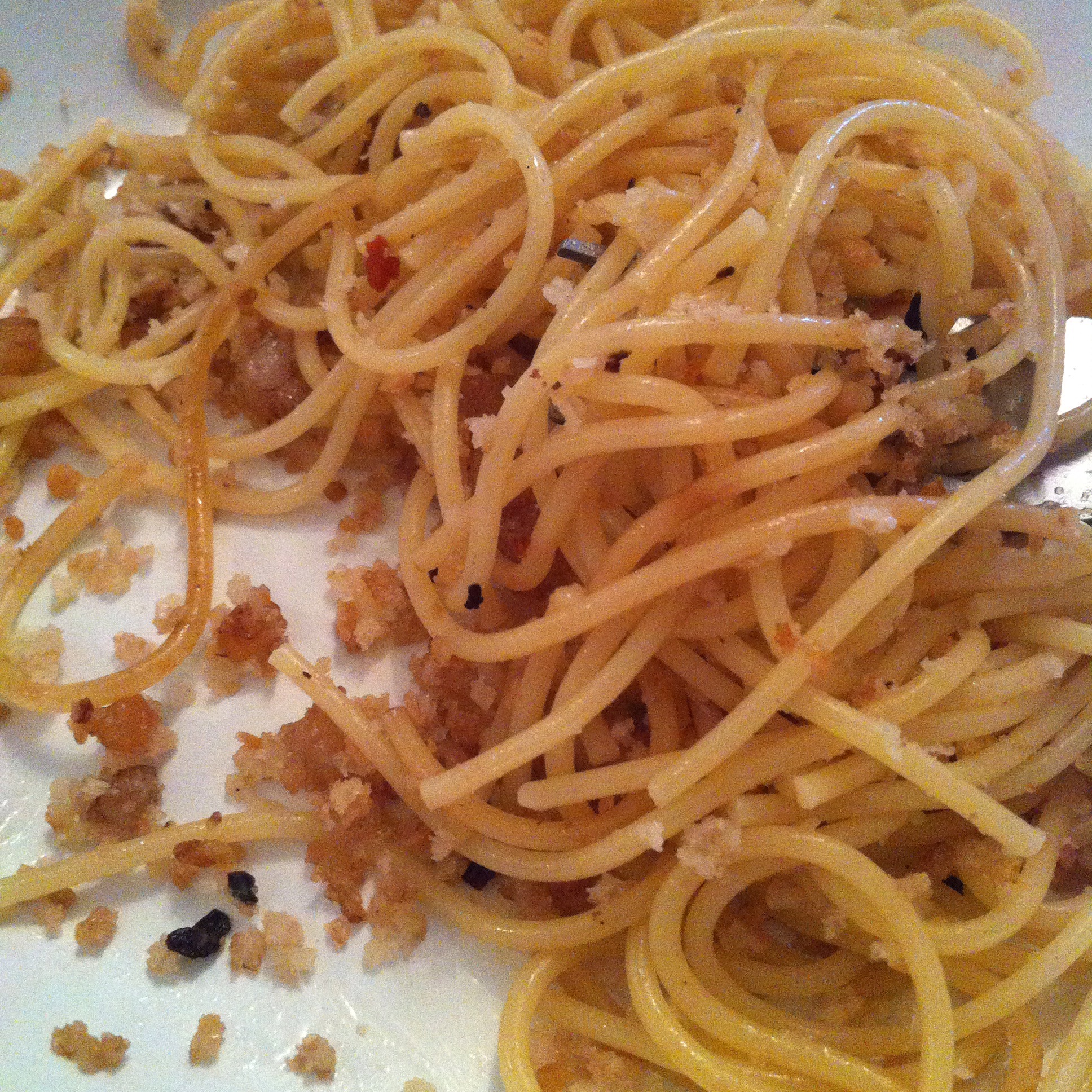
SPAGHETTI, PIG FAT, PICKLED GARLIC & BREADCRUMBS

For one

100g spaghetti

75g salted pork fat, diced (lardo or salo, depending on where you’re shopping)

2 cloves pickled garlic, sliced

a pinch of chilli flakes

a splash of balsamic vinegar

a handful of dried breadcrumbs (pangrattato, if you’re buying them)

salt and pepper

I assume you know the pasta drill; a deep pan of water, a good teaspoon of salt, a proper rolling boil. If I’m cooking spaghetti for one and therefore not in a huge pan, I like to break it in half before adding it to the water. You might feel that defeats the point of spaghetti, though.

When that’s on, put the pork fat in a cold frying pan and heat gently. When some of it has rendered out, add the garlic and chilli, and increase the heat, tossing it around to get colour on both the garlic and fat. When they’re nicely sautéed, add a splash of vinegar and let it reduce slightly. Put aside til the pasta’s done.

When it is, drain it, keeping a bit of the cooking water, and tip back into the pan with the fat and bits, and a spoonful of the reserved water. Give a good stir, and add the breadcrumbs, a load of pepper, and some salt if it needs it. Some parsley might be appropriate here too, but I didn’t have any.

Rabbit, Rabbit

photo Apologies for the rather long break (I’m sure you’ve all been on tenterhooks). I’ve just started a new job and have been rather busy testing dishes, writing menus, and pickling lots of things, so while I’ve had plenty of new recipes to share, I haven’t had the time to write anything about them. Even if I did, I’m not sure a lot of them would translate that well into the home-cooking format – like a lot of professional recipes they are broadly split between “take a lot of expensive and hard-to-source-ingredients and put them on a plate” and “subject cheap ingredients to a three-day process of dismemberment”. Still, I feel I’ve got to write about something, and putting things on a plate wouldn’t be very interesting, so dismemberment it is. This recipe uses one of my very favourite meats, and is one I’ve been working on – I don’t like to say refining, but certainly improving – for the last few years. Despite the increasing fashionability of game, rabbit is still pretty cheap to buy, and is a plentiful and guilt-free meat, the things being a pest in most of the country. Like most wild meat, though, it does need careful cooking, and can be a stringy and unpleasant eating experience if handled badly. This recipe is designed to minimise that possibility. People seem to treat the cooking of game as if it’s some great mystery, requiring an almost magical touch in the kitchen; basically, though, the meat is both hard-working – think how much a rabbit runs in its short life – and lean, and requires a healthy dose of moisture and fat to help it along. In this, as in so much, pigs are your friend. So. This is a lengthy process, but none of it is particularly hands-on, and is, I think, worth it. (I would say that though). To shorten things a little I’ve assumed that you’ll get the rabbit jointed, although as this is a satisfying procedure in its own right, I do suggest you give it a go sometime.

RABBIT RAGOUT

Happily serves four.

DAY ONE

All this can be done some time in advance.

TROTTER JELLY

3 pig feet (you’re not using the flesh for this, so don’t worry about shaving them)

2 onions

2 sticks of celery

2 fat carrots 2 leeks

1 head of garlic

A few cloves, peppercorns & juniper berries

Put the feet in a large pan, cover with water, and bring to a boil. Blanch for about 15 minutes, to drive off some of the scum. I’ve skipped this step before and ended up with a pan of sickly green, so please do it. Chop the veg into chunks, washing the leeks, and halve the garlic along its tummy. Drain the feet, rinse off any clinging scum, then put all in the pan and cover with fresh water. Bring to a bright simmer, and leave there for at least three hours, maybe more, until the trotters have completely collapsed, with bones poking all over the place. Drain the stock into jars or tubs, and discard the solids somewhere that won’t attract rats. Leave to cool, then refrigerate.

BRINE

300g fine sea salt (not table salt; it’s got stuff added to it)

200g granulated sugar

2 cloves of garlic, lightly squashed

A few cloves, juniper berries and peppercorns

Put everything in a pan, cover with two litres of water, and heat gently, stirring until the sugar dissolves. Turn up the heat and boil for a couple of minutes. Leave to cool, then refrigerate this too.

DAY TWO 2 wild rabbits, jointed

The brine

Put the rabbits in the brine, or the brine on the rabbit. Weigh down with a plate or something, and put in the fridge.

DAY THREE RABBIT Brined rabbit (you don’t need the saddles for this; they are much more tender and quick to cook than the legs, so save them for something else)

1 onion

1 fat carrot

1 stick of celery

1 leek

trotter jelly

chicken stock (if you have some)

Again, chunk the veg, and use them to make a rabbit bed in a suitable pan. Drain the rabbit, and rinse under running water for a good few minutes, then arrange the joints on their bed. Add enough trotter jelly to cover the rabbit once melted; it might need a top-up with stock or water. Cover and braise gently for a couple of hours, until the meat starts to fall off the bone.

SAUCE

1 large onion, finely diced

1 carrot, finely diced

1 stick of celery, finely diced

1 lemon, zest only

2 sprigs of thyme, stripped

2 tblspn tomato puree 100ml full-fat milk

50ml white balsamic or other nice vinegar

Extra virgin olive oil

Sweat the vegetables in a good slosh of oil until very soft, then stir in the zest and thyme leaves and cook for a minute until fragrant. Add the puree, increase the heat, and fry for a minute or two. Turn down again, add the milk, and let it bubble away to nothing, then do the same with the vinegar.

TO FINISH

rabbit sauce

a handful of chopped parsley Shred the rabbit meat of the bones and add to the sauce, then strain in enough of the braising liquid to just cover. Simmer until everyone seems happy together, then serve with something bright and green, and polenta or pasta.

Whisky On A Sunday

This was dessert for my Burns Night supper, and I originally intended to post it before then so you could enjoy it too – it made a fine, boozy end to a fine boozy meal. Apologies for that, then; but you shouldn’t need such an excuse to eat this. Winter is made for such small indulgences, and this is definitely a winter icecream, perfect for a warm house and a slightly over-full stomach. I prefer my summer ices a little less alcoholic.


A good, rich icecream made from scratch is one of the finest of simple luxuries, and – as with most things – is immeasurably improved by two fingers of whisky. Leave out the extras, though, and you have a very lovely basic recipe that is ripe for experimentation. If you make the custard carefully, you shouldn’t even need an icecream maker – the old whisk-and-freeze will do well, although it does take significantly longer. A word of warning – you might think ‘the more booze the better’, but too much and your mixture will not freeze. A double per pint is about the sensible limit, as in life.


WHISKY ICECREAM WITH SALT OAT PRALINE

Makes about 800ml

300ml whole milk

4 large egg yolks

130g caster sugar

300ml double cream

50g jumbo oats

A pinch of Maldon salt

50ml single malt (I used Macallan 10)


Gently warm the milk and cream to just below boiling. Meanwhile, beat the yolks with 100g of the sugar until thick and very pale. This is perhaps the most important part of the whole process – use an electric whisk, or you’ll get bored too quickly. When you’re done, the mixture should have doubled or even tripled in volume, and will be the kind of pastel yellow that gets called something like ‘chantrelle’ on colour charts. If in doubt, whisk a bit more. When you’re happy, whisk in the warm dairy.


Scrape the mix into a heavy-bottomed saucepan and heat very gently, stirring constantly with a wooden spoon. (A lot of recipes recommend a bain-marie for custard, but it takes forever. Just be careful). As soon as it thickens, take off the heat and strain into a clean bowl. If you can be bothered, place in a sink of cold water or ice and stir until it cools down. You don’t want scrambled eggs, although a certain amount of curdling can be strained out. Leave to cool, and preferably refrigerate overnight.


For the praline, toast the oats in a dry pan until they’ve darkened a shade (you could get that colour chart out again here), then add the remaining 30g of sugar and a pinch of salt. Stir and toss until nicely treacle-toffeeish, then pour onto a sheet of greaseproof. When cold, smash up.


Ok. Either churn the custard in an icecream-maker, adding the whisky and praline when it’s frozen, OR pour it into a large tub and freeze, uncovered, for an hour. Take out, whisk the edges into the middle, and freeze again; repeat until nearly done, then stir in booze and oats. Either way, a spell in the freezer overnight will finish it off nicely. Some shortbread and the rest of the Macallan would do very well here.


Whisky & Soda

IMG_5569


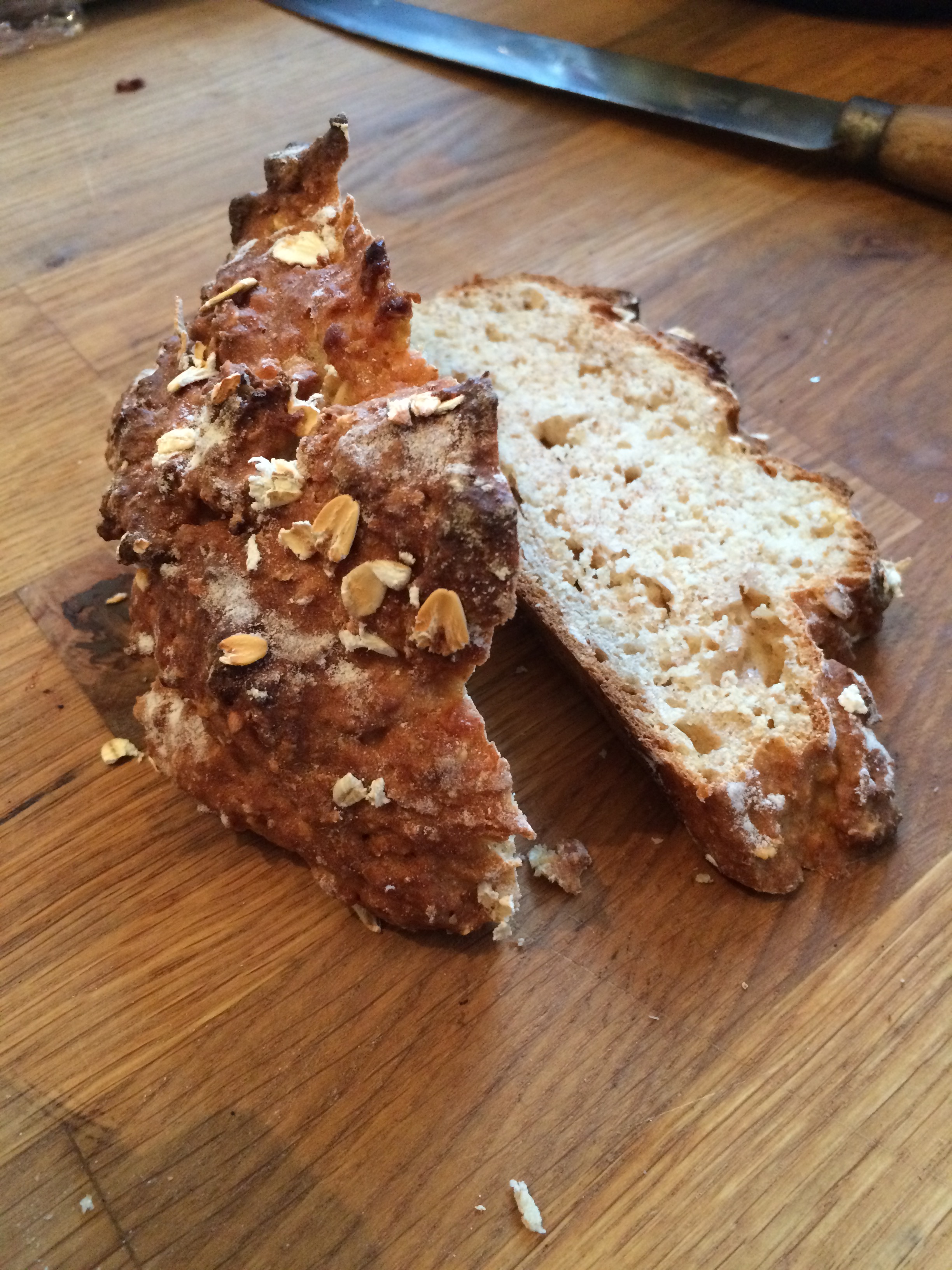
Soda bread is great. Not relying on organic, temperamental yeast, it is incredibly quick and easy to make, and forgiving of mishandling. Leavened with bicarbonate of soda, it can also take much more in the way of flavouring than regular breads – yeast can be killed or severely retarded by salt, sugars and fats, which can all be thrown merrily into soda bread. It perhaps doesn’t last as long as a well-nurtured sourdough, but the day-old loaf makes fantastic toast – and anyway, you can just make another one, as it doesn’t take two days to prove. The whole process should take little more than an hour.

I’m making this to go with my Burns Night supper – more Irish than Scottish perhaps, but I’m working on a whisky butter to go with it (although I might just add a tot to the dough). Anyway, the flavours – sweet and salty, rounded, nutty and wholemeal – go well with anything cured or meaty or rich. Ideal for dunking in soups and stews, especially when topped with a snicket of cheese.

SODA BREAD

Makes one small loaf.

140g strong wholemeal flour

140g strong white flour

20g jumbo oats, plus a few extra for sprinkling

1 and a half tsps salt (or a little less if you’re going to eat it with Marmite)

20g/1tbspn golden syrup

2 tsp baking powder

125ml water

125g yoghurt

20ml milk (or whisky, maybe)

Heat the oven to Gas 6/200C/400F. Yes, preheat it before you’ve started making the dough; that’s how quick soda bread is. Mix all the ingredients together in a bowl, and leave to rest for five minutes, during which time it will absorb a little more liquid – although this is still a very wet dough.

Form into a rough ball, and flump this onto a floured baking tray. Sprinkle with oats and a little flour, then cut a deep cross in the loaf (like, halfway through deep). Rest for another ten minutes, then bake for 30-35 minutes -like most bread, it’s done when it’s good and brown and sounds hollow when you tap it on the bottom.

Leave to cool most of the way before you eat, or it’ll be a bit gummy. Slather with butter, whatever else you do with it.

Great Chieftain o the Puddin’-Race!

I’m preparing for Burns Night, the real foodie winter festival. It’s not that I don’t love Christmas (I’m deeply suspicious of anyone that doesn’t), it’s just there’re so many distractions – presents, decorations, family, carols – that it’s hard, sometimes, to just get stuck in. For Burns Night, on the other hand, there is just enough ceremony to provide an excuse for the meal, and no more – which is as it should be. Furthermore, as we’re not subjected to haggis sandwiches and three-courses-for-£25-office-Burns-Night-meals for a month and a half beforehand and are therefore not bored sick of the whole affair, no one has yet seen fit to mess around with the meal. Instead, we are bound by iron, delicious, tradition – and the fact that it involves offal and whisky makes it all the better.

Of course, such a limited menu gives you little scope for showing off – so what do you do? You make your own haggis. I should warn you in advance that it is quite an undertaking, at least in terms of sourcing the ingredients; Fergus Henderson, whose recipe I adapted, seems to assume you won’t even try to make it, as he neglects to mention how hard it is to get a sheep’s pluck. I asked a couple of butchers, and scoured the internet, with no luck, but reasoning that the lungs probably don’t taste of much, I went with what I could get. Accordingly, this recipe assumes you will use sausage skins rather than one whole stomach; a less impressive spectacle, perhaps, but still very satisfying to make.

HAGGIS SAUSAGES

Enough for 8.
Large branches of Tesco are good for lamb offal if your butcher can’t oblige; places like Lakeland normally stock sausage skins. The oatmeal might be hardest to track down – you don’t want rolled, porridge or jumbo oats, which are steamed. Try health food shops.

3 lamb hearts
400g lamb liver
Bay leaves
Peppercorns
1 carrot, roughly chopped
Half an onion
A leek, roughly chopped
2 large onions, finely chopped
A little lard or butter
100g coarse oatmeal, toasted in a dry pan
100g dried breadcrumbs (buy panko or pangrattato, or make your own)
200g beef suet
4 tsp coarse ground pepper
2 tsp ground allspice
A pack of sausage skins or similar

Rinse the offal, then place in a large pan with the whole spices and stock veg. Cover with cold water and a big pinch of salt, bring to the boil, then simmer for two hours, skimming off the scum (there will be a lot) and fishing out the liver half way through. Meanwhile, sweat the chopped onion in lard or butter until very soft and sweet.

When the lights are cooked and cooled (save 500ml of the stock), dice roughly then coarsely blitz in a food processor, using the pulse button – you don’t want a smooth paste. Tip the result into a large bowl, then add the cooked onions, the reserved stock, and the rest of the ingredients (apart from the sausage skins, obviously). Mix thoroughly with your hands, and salt to your liking.

When happy, stuff or pipe into your skins or whatever; I used a sausage gun designed for the purpose, but a piping bag, bought or improvised, would do. If you can’t be bothered with any of that, just bake it in a flat tray like Paxo stuffing; it won’t be as fun, but will still be delicious. Leave your sausages in the fridge overnight to firm up.

When you’re ready to eat, heat the oven to gas mark 5/190C/375F. Put the haggises in a deep, oven-proof frying pan, and just cover with water. Bring to a boil on the hob, let them bubble until the water’s half gone, then stick in the oven to brown up and finish cooking – another 15 minutes or so.
Serve with neeps and tatties , a wee dram (mandatory) and perhaps some greens and mustard. Get someone to recite ‘Address to a Haggis’ in their silliest Scots, and plunge your knives in at the third stanza. Enjoy!

The Magic Pudding

photo(1)


Sometimes it’s nice just to follow a recipe. I own a LOT of cookbooks and eagerly await new ones, although I rarely follow them directly. There are a few exceptions, of course; technical procedures like baking or pickling, or dishes from cuisines that are entirely outside my understanding. In general, though, I (and I imagine a lot of people) use cookbooks chiefly for inspiration, the more so the more complicated the book is. I have never, for example, followed an Ottolenghi recipe through from start to finish; the number of ingredients alone is enough to put me off, even though I’d happily use that many myself when improvising. Fergus Henderson’s books are a joy to cook from, but the sheer effort involved can often be dispiriting – if it doesn’t need ordering in advance from a butcher, it probably needs brining for 5 days or (the most extreme, if tongue-in-cheek, example) cooking on driftwood in the Hebrides.


Give me an Elizabeth David or a Claudia Roden, though, and I’d happily cook every dish. You look at the short ingredient list and think “How could that be nice?” – but it always, always, is. They are vague where they should be vague, and precise when they need to be, forgiving of substitutions and geographical issues with sourcing ingredients. Although they have both since been coffee-tabled up with hardbacks and photos, in their original editions they are perfect to work from, small enough not to take up half my work surface, cheap enough that I don’t worry about getting wine all over the pages… And with no varnished, styled images to compare the end product to, I’m generally happier with the result.


Another fine food writer who seems to have resisted the coffee-table trend is Elisabeth Luard. Her European Peasant Cookery has the authoritative and pleasingly wordy air of a well-written reference book, a Brewer’s or similar; you can dip in and out whether cooking or not, and find solid, time-tested iterations of traditional recipes free from authorial meddling. If you want to know how to make, say, a pork pie, without Tom Kerridge or whoever faffing about with it, this is the place to go. So, I had some ox kidney, a steak in the freezer, and half a pack of suet in the cupboard; where else to look?


STEAK AND KIDNEY PUDDING

A pudding for two. You’ll need a little pudding dish.

The only deviation this involves from Luard’s recipe is in halving the quantities, and in the manner of arranging the meat; she slices the steak into little fillets and wrapping these around the kidneys, which seemed like a waste of time.

PASTRY

125g self-raising flour

1 tsp salt

80g shredded suet

up to 100ml of cold water

Sift the flour and salt into a bowl, then stir in the suet. Gradually mix in the water until you have a nice smooth dough. Roll out two-thirds to line your buttered pudding basin, roll out a lid, then get on with the filling.

FILLING

250g stewing steak (I used 1 flat iron steak, which was ideal), cubed

125g ox kidney, trimmed, cubed, and soaked in water and a little vinegar

about 6 button mushrooms, sliced

half an onion, diced

1 tbspn chopped parsley

50ml red wine

salt and pepper

Put a pan of water on to boil, big enough to house the pudding. Mix everything except the wine with a generous amount of seasoning, then pack into the pudding case (I know it seems weird to put in a raw stew mix, but it cooks beautifully in its pastry home). Pour the wine in, then dampen the edges of the pastry, cover with your lid, trim and crimp. Make a slit for steam, and cover with a disc of greaseproof and some foil, with enough give in it to let the pastry rise.

Place a folded tea towel into the boiling water, to protect the pudding from direct heat, then place the pud carefully on top. The water should come two-thirds of the way up the basin, so adjust as necessary. Cover the pan and boil for three hours, making sure it doesn’t go dry. When done, take it out and let it settle for a few minutes before turning out. Serve with greens and mustard.

Fish/Fruit

photo(5)


I’ve never been a particularly keen fish-eater. Fish depends, I think, more than any other food, on a sense of place for its enjoyment, and while some of my favourite ever meals have been simply- or barely-cooked white fish or shellfish, eaten within pissing distance of the sea, I have never felt much of an urge to recreate them at home. Grilled cuttlefish or prawns, sea urchin scooped from the shell, lose their piquancy without the seasoning provided by the crash of waves and the tang of the salt air.


The flavours of oily fish, on the other hand, seem to travel a little better. (Although their flesh does not – the meat is really only good for one day; mackerel fishermen, in times when such things mattered, used to have special license to trade on Sundays so they did not waste their catch). They are more robust, and will stand up to bigger flavours, – smoke and vinegar and punchy fruit – than the vague wisps of fennel and lemon which so often accompany more delicate creatures; this also allows for a little more leeway in the quality of the fish itself. You will never recreate that beautiful bream you ate on the beach, with a squeeze of lemon and a glass of something cold – not with a supermarket specimen, anyway. With oily fish, though, the spices and sauces carry the burden that the flesh can not.


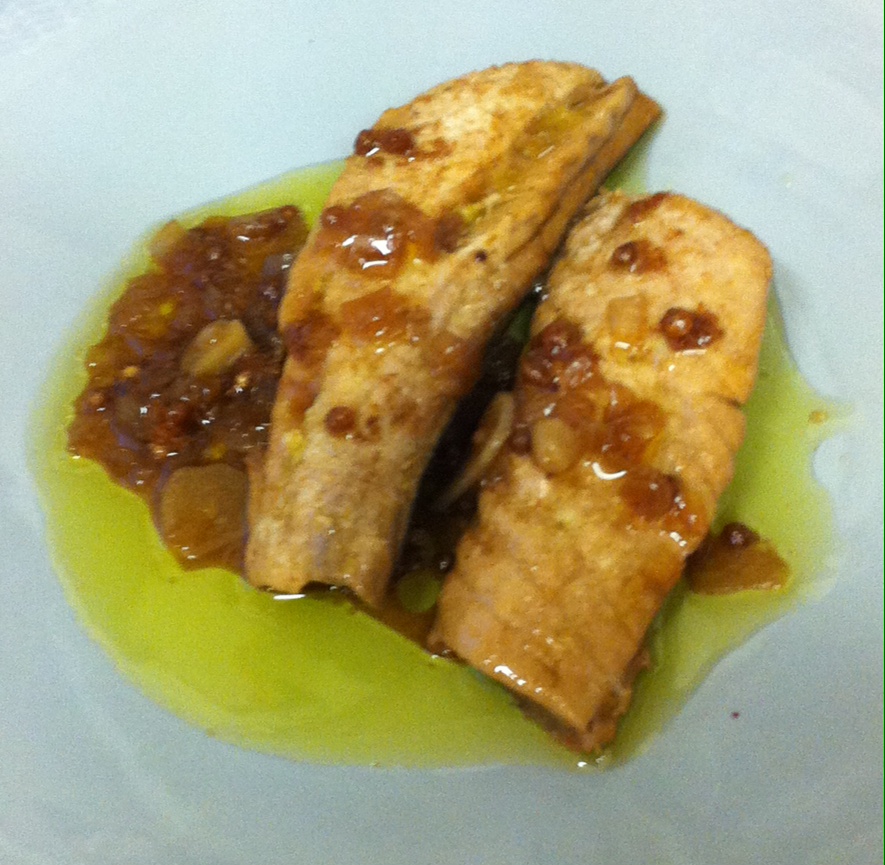
Some of the nicest seafood I have ever eaten has been in Turkey, but very often in the form of the fresh, the white, the inimitable. Fish are everywhere, live in buckets or slithering on ice, twisted with rigor, in varieties unobtainable in Britain, and are often very simply grilled or fried. Sometimes, though, for mezze dishes, the treatments are a little more complex. The following is based on a dish we ate in Kadikoy, the Asian side of Istanbul, a very unusual preparation of mackerel, almost confited in a spiced, syrupy oil.


POMEGRANATE MACKEREL

For 8 as a mezze, perhaps 4 as a starter, with some bread and salad

8 mackerel fillets, pinboned

2 tsp coriander seeds


200ml pomegranate molasses

100ml red wine vinegar

8 cloves of garlic, thinly sliced

grated zest of one orange

6 banana shallots, thinly sliced

500ml good olive oil

salt

You can leave the fillets whole, or slice them in half widthways and then again lengthways for ease of eating as a mezze, either way, salt lightly and set aside.

In a wide pan (ideally wide enough to fit the fish in one layer, and deep enough to hold all the ingredients) gently toast the coriander seeds until they start to give up their aroma, then pour in the molasses and vinegar. Stir them together, then add the garlic, orange zest, and shallots. Let the mixture simmer for a bit, although you don’t want it to cook particularly.

Lay the fish in evenly, and then pour the oil over it. Warm it over a very gentle heat – you will see bubbles coming up through and from the fish – until the pieces of mackerel are just, just cooked, having lost their translucent grayness. Remove the pan from the heat, cover, and set aside – the mackerel will carry on cooking as they cool.

Serve with some of the juices and some appropriate accompaniments.

Eggs Dracule

photo(4)

Reading food writing all the time, it’s easy to think that recipes spring, fully-formed, from nowhere; that other people’s lives are parades of perfect meal after perfect meal, crafted and styled. Even leftovers are never chucked in a sandwich or in the bin, but instead reimagined, ‘upcycled’ into hashes and pilafs, fritters and arancini. “I always make extra, just for the leftovers!” they cry, and you curse them from your pit of crisps and shame.


Of course, no-one lives like this in reality, or at least no-one who has anything else to do with their time. The lifestyle we are shown in cookery books, blogs and TV shows is a fantasy, even for those who espouse it; Nigel Slater recounts, in the middle of his Kitchen Diaries (otherwise full of farmers’ markets, trips to Chinatown, odes to his herb garden), being publically accosted while carrying a bag of frozen peas, and fleeing in shame. Nothing wrong with frozen peas, of course, but the message behind this careful lifting of the mask is clear. “I am like you”, he says. “I am human too.”


In the interests of transparency, then, I feel I should say that my breakfast yesterday consisted of a co-op ham and cheese sandwich and some crisps. The gas was off, the house was freezing, and I stayed in bed until hunger drove me out; there was nothing to eat in the house that didn’t need cooking. That, however, doesn’t make for a very good blog post, at least not on a food blog. Brunch today, then, is what I will write about. While a little fancier, it was still born of necessity, surplus, and experiment, an off-the-cuff meal that turned out quite well.


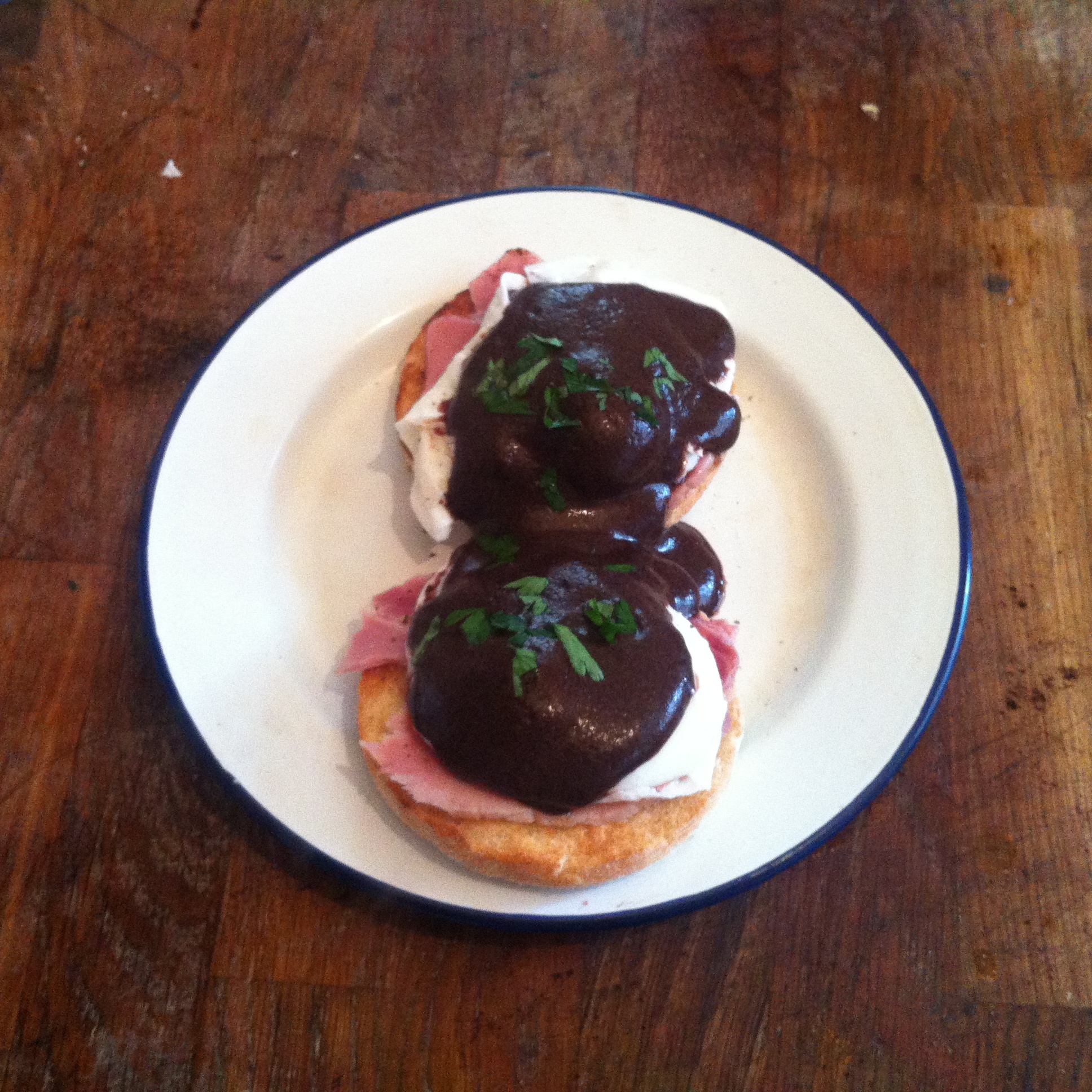
I have a lot of dried blood left after making black pudding, and had been searching for things to do with it. I remembered reading about some research done by the Nordic Food Lab, in which they had discovered that blood has a very similar make-up to eggs, and so this dish was born.


EGGS DRACULE

a fine romantic brunch for two

4 eggs

2 English muffins

4 slices of good ham

a little chopped parsley or chives

PIG BLOOD HOLLANDAISE

50g butter

2 tblspn dried blood

50ml water

25ml red wine vinegar

salt and pepper

Melt the butter in a small, lipped pan, and leave to settle a little. Put a pan of water on to boil. In a heatproof bowl, whisk together the blood, water and vinegar with a pinch of salt until the blood is dissolved.

When the water comes to a boil, put the bowl over it, turn off the hear, and start whisking. When frothy and thickened slightly, start adding the butter in a slow stream, whisking as you go. When it’s all added (leaving behind the white solids) you should have a light, glossy sauce. Season, and leave over the hot water while you construct brunch.

Poach the eggs according to your usual method, unless your usual method is terrible, in which case get someone else to do it. Split, toast, and butter the muffins, and put a slice of ham on each half. A poached egg on that, a blanket of sauce, and a sprinkle of herbs, and there you go.