With Relish

Despite repeated resolutions to the contrary, I don’t really use cookbooks. I own a lot, and I read them all and often look at the pictures; apart from a select few, covered in cake mix and butter and blood and tomato, which I know and love and trust, I don’t really follow their recipes. I think I do, though. “That sounds nice”, I say to myself on the sofa, “I’ll try making it sometime.” When that time comes, of course, I don’t have the book to hand – and if I did, I wouldn’t have half the ingredients – so I cook from memory, which is to say I make it up. Only after months of cooking a dish do I look back at the book at realise that my recipe has become something entirely other, related to the original book only in the manner of folk songs or language – tangentially, driftingly.

If, sometimes, this can be limiting – it means that you rarely stray outside your own idiom and technical comfort zone – then it can also be liberating. It is certainly convenient; few cookbooks are actually easy and pleasant to use for their intended purpose. Anyway, here is a recipe I remain convinced comes from Diana Henry, despite her original (itself an imagined version of a never-tasted Turkish dish) containing, it turns out, coriander (don’t much care for it) and green olives (totally forgot about them). That, I suppose, is how cooking works. Conveniently, this goes extremely well with octopus.

GREEN CHILLI RELISH

15 green chillies (or a mix of red and green), thinly sliced

6 cloves of garlic, crushed with salt

about a tbsp caster sugar

a slosh of sweet white vinegar

a big handful each of mint and parsley, chopped across a couple of times, to encourage them to join in

Mix together everything except the herbs, scrunching a bit to dissolve the sugar. Add the herbs and toss and scrunch some more. WASH YOUR HANDS. An hour or so hanging around mellows things out, but much longer and it’ll go a bit manky.
Eight Legs Better


 I’m fairly comfortable with my meat-eating, generally speaking. I don’t buy a huge amount, and when I do it’s often game, or odder cuts from well-reared animals; having been vegetarian for 10 years, I’m conscious of the ethical arguments, but feel that informed meat-eating is a better choice than the outright protest of vegetarianism, quite apart from the ecological ramifications of removing the entire meat industry (and I’m conscious there’s a counter-argument to that, thank you). We’re lucky in this country that animal farming is comparatively well-regulated, and that while the horrors of battery farming still continue, its products are easy enough to avoid; if we keep making informed decisions, perhaps it will wither away – although that may be a trifle optimistic.

Fish-eating, in comparison, is a bloody minefield. Although we have the MSC certifications and so forth, the actual state of fish stocks change so frequently and vary so much from sea to sea that the best of intentions often go astray. I get round this by almost never buying fish – something of a copout. At the restaurant we’re lucky in having a small fishmonger (his operation, I mean – he’s of average size) who deals only with dayboats and sustainable sources; he makes the informed choices so we don’t have to, which is good, and means we often use things we might not have otherwise tried, such as sand soles, cuttlefish, and fresh, British octopus.

Now, I don’t have a lot of time for the argument that we shouldn’t eat the more intelligent animals. The intelligence of dogs is, I think, highly overrated, and while I’d happily eat them I don’t think their meat would taste very nice. There’s a reason we don’t generally eat carnivorous mammals. Pigs, while smart, are also quite smart enough to up and leave if they aren’t happy with the situation; there’s a good argument that their ‘domestication’ was something of a reciprocal arrangement in the first place. At any rate, pigs are quite happy to eat their own young if the situation requires it, so I don’t think they’re squeamish about such things. So much for pigs.

The intelligence of the octopus seems of a quite other order. The more I read about them, the more chillingly intelligent they seem. When captured, they refuse to participate in research which could teach us more about them; they escape from their tanks in the dead of night through holes the size of their beak, walking on dry land if necessary to reach their goal; in the wild, they decorate their homes, they use tools, they communicate. They are an intelligent alien life form, and when they rise up out of the sea with their stolen weaponry, I fully expect to be held to account. The problem is, they’re just so tasty. 

Maybe it’s their intelligence that makes them so delicious. Just as pigs are, objectively speaking, the tastiest of animals, so the flesh of the octopus is nicer by far than that of their dumb, brutish cousins the squid and the cuttlefish, really rich and sweet, capable of standing up to the thick, beefy flavours of stifado as well as the subtle astringency of a celery and potato salad. If we don’t get them much here, I think it’s because people are rather afraid of cooking them. There’s all kinds of nonsense about how to tenderise their flesh – beat with a hammer, dry on a clothesline, add corks to the cooking liquor – but the best way to do it is just to stick them in the freezer as soon as you get them, and leave them at least overnight. The violent effect this has on their cells, undesirable in delicate white fish, tenderises them perfectly.

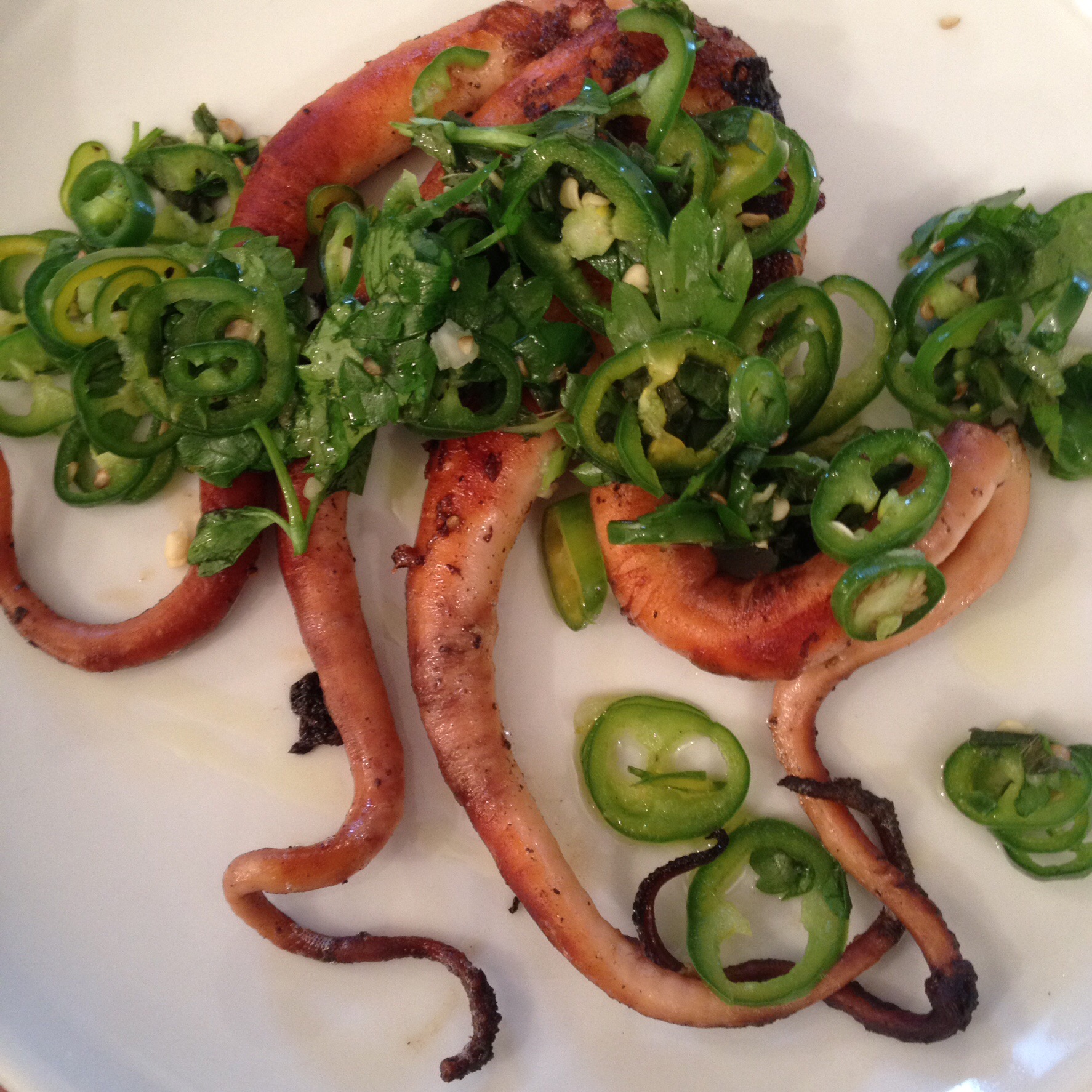
The next day, I normally braise them in oil, wine and herbs before chopping their tentacles and adding to salads, or leaving them whole and blackening on a hot grill; if you clean them properly (brains out, beak off) you can cook them directly in your tomato and purple olive ragu, and so much the better for everyone. Just be prepared for the day when the sea-spiders rise up and come seeking revenge.


I contain multitudes 

The kitchen is alive at the moment. Better than alive; it is thriving. Under the sinks, in a space just high enough for the airlocks, there are two demijohns of bubbling honey-water; on the warm shelf on top of the pass are jars of carrots, asparagus and turnips, each brined with its particular citrus and spice, and murkier pots of peel and trim, ageing into edibility. A bowl of plain water and strong flour teems with fungus and bacteria. Today it smells good and sour, reminiscent of rye and pickle and milk – tomorrow it will smell of yeast, of warmth and buns and baking. In the hot dark, squid entrails slowly change.

We chop and pound dead matter, sow it with salt and starve it of oxygen – and life springs up from these airlocked graves. It’s like bloody Dracula. Maybe the whole coffin-full-of-native-earth thing was to keep him stocked up on the bacteria and fungi which supported his particular microbiome; perhaps a vampire is merely a highly advanced form of pickle. There is certainly something (as they say) of the night about the whole process – if you want to look at it that way. I prefer to see it as a creation myth. Various cultures have given us worlds birthed from the brains of giants, the testicles of elder gods, raven shit and living clay; we create a squawling life from compost and salt – our breath moving over the cabbagey waters.

Chop stalks of kale, broccoli, or kohlrabi; mix in 100g of salt and 50 of sugar to every kilo of vegetable. Squeeze and crush it in, and leave overnight.

Tomorrow, make a paste of green chillies, garlic, spring onion, mint, and fish sauce or seaweed; mix and pound that in, too. Pack into jars, seal tight, and leave for a week. It lives!

Cabbages (and things)

  
Dinner last night, after a weekend of fairly gluttonous feasting, was a nearly meat-free dish of white cabbage wedges, thickly pot-roast on a bed of beans, bacon and leeks; taking around an hour and a half of hands-off cooking, it was reasonably delicious, although it would have been more so if the cabbage had been fermented first. The deep umami flavours of sauerkraut cooked with cured pork are quite extraordinary, something the Poles, the Germans, the Alsatians and indeed the Luxembourgeois know full well.


The week before we had eaten a pot-roast red cabbage, simply browned in lard and then cooked slowly in its own juices; served with stewed apple and a heaping dollop of creme fraiche, it was a revelation, with meaty, giving textures and a real depth of flavour, from charred and peppery to rich, sweet mustard – but what else would you expect from Stephen Harris? The Sportsman head chef’s recipes, which express the elegant precision of his cooking in simple language and accurate instructions, are a great gift to both the lay and the professional cook; almost as great as his grotty, rundown pub by the sea.


One of the reasons Fergus Henderson has become such a towering figure, aside from his revolutionary cooking, his unimprovable restaurants, and his remarkable dress sense, is the work of his acolytes across London and beyond. Justin Gelattly, James Lowe, Claire Ptak, Lee Tiernan; if these were the only cooks to have passed through his kitchen his legacy would be assured. They aren’t, of course. Noble Rot, a dark and odd wine bar in Bloomsbury which approaches, between the colfondo prosecco and the violent espresso, its own particular perfection, has a kitchen headed up by one Paul Weaver, who has done time under both St Fergus and Stephen Harris, who also consults on the menu.


Now, I’m not a restaurant reviewer, and possess neither the patience nor the vocabulary to be one; look elsewhere for a fuller appreciation of this excellent, terse menu, which raises a brasserie menu du jour to a particular, vibrant beauty. I’m still thinking about the Comte tart, warm and quivering, with a custard that offers no resistance to the edge of a fork and a pastry which crumbles in all the right places; of the salad of red chicories and pickled walnuts, sweet and bitter and razor-sharp. It is the sort of thing that you eat in an anonymous station bistro with a glass of rose and dream about for the rest of your life; to have it easily available in West London seems cheating, somehow, but also glorious.

Tears and Memory


Fermenting sprouts, it turns out, smell exactly as you might expect them to smell; they will convince no-one of that brassica’s deliciousness. The chopped stalks of cavolo nero, on the other hand, fermented kimchi-style with green chilli and garlic, after an initial period of cabbagey pungence, enter a sort of late imperial phase during which they smell strongly of truffles (or at least of truffle oil), which, as everyone knows, in turn smell strongly of pig testicles.


Smell (and therefore flavour) is, like poetry, composed of a set of seemingly abstract and subjective connexions which turn out, on closer inspection, to be absolutely concrete and precise. Truffles do not just happen to smell like pig testicles; they have evolved that way to attract the rooting attention which, buried underground, allows their spores to spread. Nor, really, do they just smell like pig testicles; they smell of them, evolution having precisely replicated the chemical component of that heady musk. Remember that when some gourmand invites you to sniff his knobbly fungus.


It is a common piece of inverted snobbery to laugh at the descriptors on wine labels, with their vanillas and leathers and fruits; “it smells of red grapes to me!” is, to be sure, a fine and time-honoured dad joke, and if it keeps him out of the good stuff then all the better, but it ignores the chemical complexity of fermentation and aging, the interplay between grape, yeast, bacteria and wood which makes wine smell, in fact, almost nothing like grape juice. The reason, for example, that this particular red has a strong taste of vanilla is because it contains quantities of vanillin, the same ingredient found in the bean and synthesised for the flavouring, which is thrown up by the wine-making process.


More readily understood is the fact that similar-tasting plants often contain amounts of the same chemical flavourants; the mustardiness of cabbage comes from the same source as that of mustard; anise, aniseed, fennel, dill, tarragon and chervil all have a similar make-up. This might seem obvious, but it is only recently being understood. It’s what leads Heston to things like salmon in liquorice; at a less exalted level, it’s behind the current-ish fad for herbs in desserts, as well as the precise amplification of flavours which marks a lot of good modern cooking.


So what, you may well ask; well, I thought it was interesting, but what I’d really like to know is –

a) what made that kimchi smell of truffles?

b) will the smell ever come out of the jar?

c) can I use it to attract pigs, like the Pied Piper of Hamlyn?


Act Natural

I’ve been reading a lot about natural wines recently. This style, as distinct from organic winemaking, which bars chemical intervention in the vineyard, requires a more or less additive-free approach to the brewing process itself, barring added yeasts, sugars, and various other chemicals and techniques which have become standard in the industrial wine trade. While I wouldn’t call myself a fanatical convert – for one thing, I’ve barely tried any natural wines – it’s certainly been interesting to learn about the various practices which are allowed, and frequently used, in even very high-end wine making.

The wine industry, more, perhaps, than any other part of the food industry, is a large, efficient, modernised engine which still masquerades as small-scale, artisanal, somehow, in essence, natural. Much is made of terroir, of vintages, of the vast differences which aspect and soil and wind make to each bottle; but when yeast can be added to practically guarantee a certain body and mouthfeel, when wine can be physically ripped into its component parts to correct levels of sugar, water, alcohol, how much can terroir matter? The various DOP groups exist more to guarantee a certain quality and adherence to a sort of imagined local style than to actually ensure local individualism.

The real triumph, in fact, of modern winemaking – as with industrially brewed beer – has been the slow annihilation of variance from the norm, the sad reliance on weather and air – in other words, quality control. Even bad wines, now, aren’t really bad. They might be bad for you – the high levels of sulphites allowed in industrial wine can cause health problems – and they are certainly bad for the environment, especially in France, where their natural tendency to shoot or poison anything that moves is given free rein in vineyards; then again, they never claim not to be. The assumed ‘natural’ component of winemaking is much more nebulous than that.

Part of the current ‘clean’ ‘natural’ eating movement is a railing against processed foods, which is patently ridiculous. Nearly everything which ensures the continued existence of our species is processed in some way. As yer man (citation needed) found when he tried to live like a chimpanzee, we simply aren’t good enough at chewing to live off raw foods; without cooking and further processing, we would die. Bread, for example, is heavily processed, the base ingredient dried, ground, fermented, and held at various temperatures before consumption; because of this, it is pretty much a complete food, the staff of life, rightly holy to various cultures. The problem with industrially-produced bread is not that it has been processed, but that it has been processed very badly, with little reference to taste or nutrition.

The same could be said of wine, of cured meats, of cheese and of pickles. All of them have undergone a heavy process of industrialisation, resulting in a product which is much worse for you than it should be; but I don’t think that necessarily means the idea of industrialisation is bad. Cheaper, larger scale food production can only be a good thing, right? Maybe not. Maybe it’s inevitable that industrialisation throws out the good parts, the ferment, the yeast, the bacteria; perhaps, though, the success of natural winemakers, of raw-milk cheesemakers, who combine traditional techniques with a scientific understanding entirely born of industrial food processing, points a way for today’s artisans to feed us all.