Another Man’s Poisson


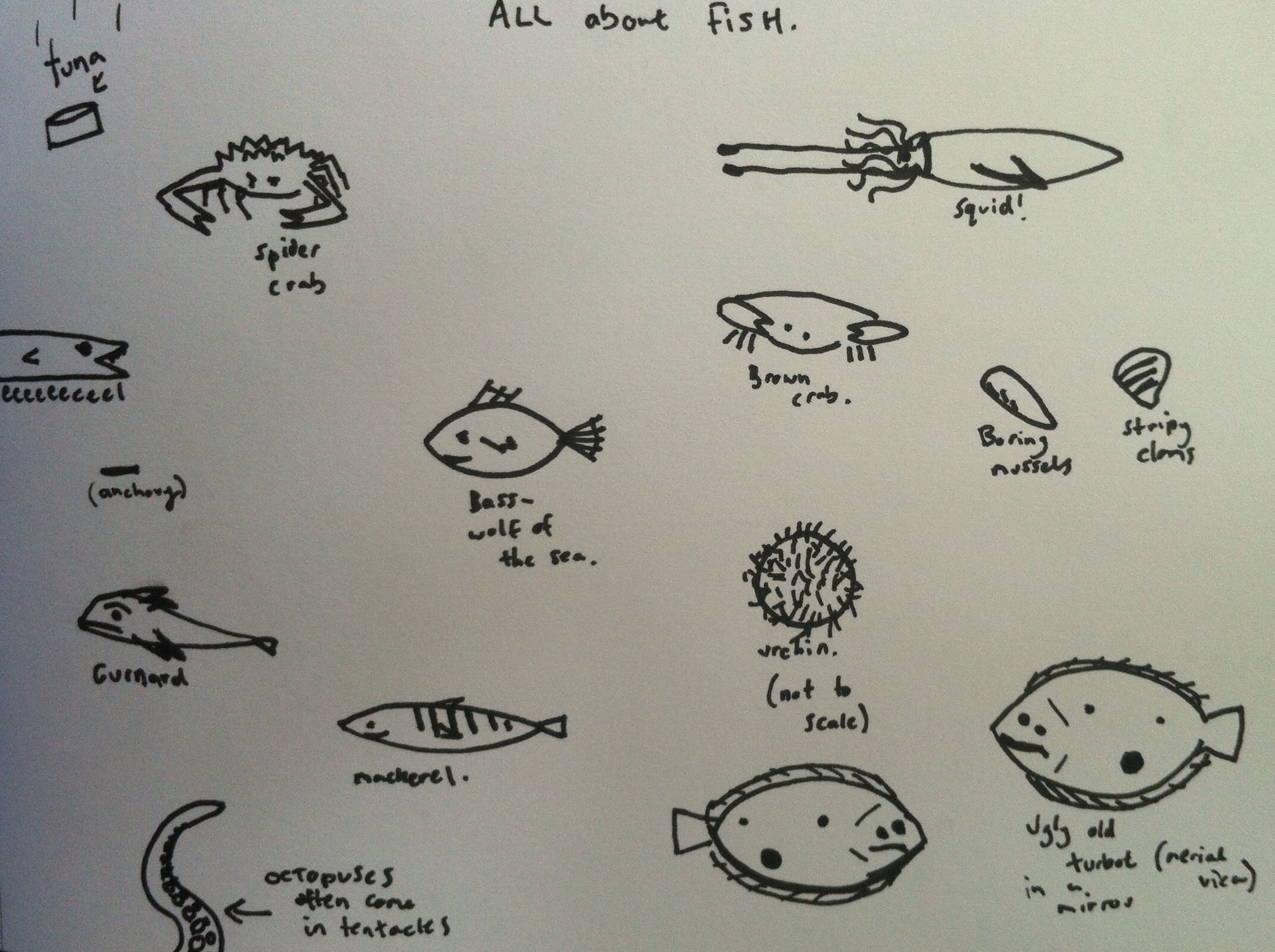
Fish and the sea remain deeply mysterious to me. It would seem that fish has always been regarded as something quite different from meat, from the ancient Greeks – who kept their land animals for the gods – to the Catholic church, which, most notably in medieval times, set aside a great many days for fasting and fish-eating. The implication there is that all eating is more or less sinful, on a sliding scale down from red meat; we might remember that the eating of animals was a sop to the debased postdiluvian world, as Jahweh realised that his creations would never quite be able to control themselves. Anyone who has worked in a restaurant will have noticed that a lot of people, devoutly or not, still eat fish on Fridays (the chippy is usually heaving then too) – abstention has become a treat. This is not, I think, how the ban would have been experienced originally, at least by the rich, monks and the priesthood included, whose meals consisted not of a main protein and trimmings but of a number of different dishes and delicacies, fish, fowl, fresh and salt meat, cakes, pastries and so on; the injunction to eat fish would, rather than involving a straight swap between creatures, have meant the loss of a great deal of variety at table – though I doubt anyone (I’m still talking about rich people) went hungry because of it. At any rate, although fish may now be eaten as a pleasurable rarity rather than under duress, the distinction between it on the one hand, and birds and mammals on the other, is still maintained. Personally, I almost never cook fish at home. The difficulty first in sourcing it (fishmonger’s can be wretched places, reeking and dripping – when you find a good one, hold on to it) and then in cooking it, which seems to need pans of an impeccable non-stickness, or fish kettles and racks of a different size and shape for every species, always appears insurmountable.

It isn’t, of course, as I rediscover every time I actually do it. Most fish cooking is actually very easy, an excellent vehicle for bold simplicity. As I think Hugh FW points out on a few occasions, all you have to do to cook fish, with a few exceptions, is get it hot. None of the angst of rare beef, medium-rare lamb, slow-cooked, melting pork – just get it hot, but not too hot. To cook a fillet of bass or bream to crisp-skinned, melting perfection, just oil and salt a cold frying pan, and put the fish, skin-side down, into it. Place over a low-medium heat, and leave there. If you’re worried about the skin sticking, use a lot of oil. By the time the flesh is cooked – opaque, flaking – the skin should be a lovely golden brown. If you’re bothered about such things, then you can fry it on the other side for a minute to sear the flesh. Spoon some butter around it at this point, perhaps some herbs and black pepper, and the fish is done. Poaching fish is even easier, but seems to have fallen out of fashion somewhat.
Despite all this, you might still prefer to eat your fish out of doors. Fair enough. Fish, as is well known, tastes significantly better by the sea, the spray of which provides an elementary seasoning to the tongue, as well as a not-entirely-reliable guarantee of freshness, and in the dying stages of extreme sunlight, accompanied by a glass of something very cold and quite possibly fizzy – Bass shandy, at a pinch. Experts differ as to whether the best seasides for fish-eating are found in North Norfolk, pebble-strewn Kent, urban Barcelona or Palermo, the cruel beaches of Yorkshire or the softer ones of the Suffolk heritage coast, the Greek Islands, the rocks of the Hebrides, the drunken evenings of adulthood or the gentler exhaustion of childhood; this is surely just a matter of taste, though, and any opinion is necessarily partisan. Everyone agrees, however, that while white fish is best by the seaside, the flavours of oily fish and shellfish travel a little better – though since their flesh does not, they must generally be preserved in some form or another for their journey.

Time was that every fishing town would have had their specialities, and many still survive in odd little cafes or the right kind of gastropub – roll-mops (although the Italians are the undisputed champions of food-related insults, ‘roll-mop’ as a term of abuse for someone with ‘no guts and no spine’ is a particularly excellent British one), kippers, bloaters, smoked and jellied eels, hot- or cold-smoked salmon, mackerel, herring, pickled winkles, cockles, and mussels in little pots or bags; although we still tend to keep these molluscs for seaside treats, you see them in jars at the supermarket, and I presume people eat them. Although heavily smoked fish makes a pungent addition to the breakfast table, the only sea-creature to really cross over into the day-to-day meat-eating world is the tiny anchovy. I don’t think I’ve ever seen a fresh one, which are to be found in great heaps in Mediterranean fish-markets, in this country, and although the soused ones the Spanish call boquerones are making inroads here, it is the salted fillets – brown, rottingly pungent, barely recognisable as fish – that found a real place in British cooking. The Romans left fish guts to ferment in the sun, bottled up the remains and called it garum; South East Asia has its intensely savoury fish and shellfish sauces; we have Worcester sauce, a deeply odd concoction containing, among other, secret things, anchovies. There are few things that are really, genuinely better to eat than Cheddar cheese, melted onto thick white toast, with a few splashes of Worcester sauce on top; add some pickled onions and you have a complete if smelly meal. Although you might, as you grow older, come to prefer a few anchovies spiked, alongside garlic and rosemary, into a Provencal lamb roast, or melted into oil that is to dress mustardy bitter greens, or hidden in slow-cooked onions, lending depth to a simple pasta sauce, the effect is always the same. By some alchemy, the aged fish lose what can only be called their fishiness – which, you’ll remember from when you opened the tin, was extremely developed – leaving only a profound savour which enhances the taste of almost all animals and animal products (apart from cheese, anchovies go extremely well with eggs, while the smell of them melting into butter is up there with onions for me), though it does tend to overpower the more delicate flesh of white fish. Having left the seaside long ago, they are not readily welcome back.

Red Terroir

There’s an odd idea – started who-knows-when but currently perpetuated by the incurable romantics of the locavore movement – that cuisines (regional, national, local) are (and, more dogmatically, should be) products entirely of place, sprung fully-formed from their unique surrounds, an expression of soil and flesh and air – of what is called terroir. This idea, originally applied to the particular makeup of wines, has been taken to its logical conclusion, with extremely impressive results, by restaurants such as Noma and its imitators, or closer to home, the Sportsman in Kent. In these kitchens, localism is treated less as an ethical imperative and more as an aesthetic challenge – an attempt to create masterpieces with a severely limited palette – and as such operates above (or at least separately to) anything as parochial as ‘a cuisine’; they aren’t what I’m thinking of here. The problem is in attempts to define and identify the ‘real’ or folk cuisines of countries, counties, regions, where such localism is either ignorant, or worryingly reactionary.
The problems here, I think, stem from a simple lack of historical perspective. There is a tendency to look on the peasant traditions of various countries (though especially Mediterranean Europe) as historical artefacts, still living in some parts but essentially static – we see what, say, the Sicilian farmer has for lunch, and assume that it is the same lunch he has had for centuries, torn from the harsh earth by his own sun-dried hand; then, lamenting the loss of our own peasant tradition, we try to recreate it, with our British vegetables, our British wildlife, our British climate. Some of this is admirable – there are many odd herbs and wild greens, old forgotten dishes, which deserve rediscovery – but some of it is just stupid. It leads to otherwise-respectable chefs espousing the virtues of rapeseed oil (a mass-produced, violently yellow vegetable oil with a marked aroma of cat’s piss – when it has any at all) and worse, taking the moral high ground in doing so. Local here is seen as intrinsically better, and the implication is that rapeseed is what the wise old Italian would be eating, were he to find himself transplanted to East Anglia. Well, probably, but only if it was all he could afford. There is a deliberate refusal here to acknowledge food as a global trade, and one with a very long history.
Take that olive oil. The best and most abundant producer of olive oil is Spain, and has been since Roman times; it was shipped to Rome because they liked it, and because the whole of the Empire was their locale. They could afford to source the best, and to move it around their whole territory – the Empire, in fact, was responsible for an astonishing movement of ingredients, without many of which our ‘British’ cuisine would be bereft. We all know that we have the Americas to thank for the potato, now seen as a very British provider of stodge – but imagine culinary life without asparagus, cabbage, carrots, onions, even, all picked up from around the Med and taken to the corners of Empire; Celtic Britain must have been either a prelapsarian paradise of now-lost abundance, or a flavourless pit. Take away the rabbit too (introduced and bred for eating by the Normans) and the English country kitchen is looking pretty poor. (Conversely – and this is odd because we think of Mediterranean cooking, if anything, as having deeper roots than our own – imagine the food of Southern Italy before Columbus. No chilli, no peppers, no tomato…) Perhaps I’m being deliberately obtuse to make a point. Of course our peasant tradition isn’t meant to be pre-Roman; we’re thinking of the sturdy medieval peasant of Merrie England, and his diet of beef, cheese, pickles and beer – except the beer would have been short-lived, one-dimensional ale, because the hops which flavour and preserve it hadn’t yet made it across the channel. And, of course, he couldn’t afford beef.
Meanwhile, the feudal aristocracy, taking full advantage of the reopened spice routes, were enjoying a systematic derangement of their cuisine, marked by a wild use of sugar, dried fruit, and what are now mainly dessert spices in dishes which have in them something of Morocco and something of a creative child in a gigantic sweetshop. Although the cooks calmed down eventually, a lot of this stuck, particularly in festive food, with traditional pickles, pies and cakes packed with dates, currants, ginger, cinnamon and pepper. Never being grown here, unlike the fully naturalised alliums and brassicas, these spices perhaps retained some of their exoticism; nevertheless, they form an important part of our national palate, a taste for contrast and spice which in ‘modern traditional British’ cuisine is all too often expressed only by semi-ironic curried dishes. Much, in fact, of what is thought of, both affectionately and disparagingly, as good old-fashioned British food – plainly boiled and roasted meats, dauntingly bland nursery puddings, as well as those bastardised curries – we owe to the Victorians, with their mix of an austere, Protestant Christianity and a general cultural inclination towards greyness. Looked at over a longer period of time, our cuisine becomes more interesting – if it can be seen coherently at all.
I’m focussing on Britain, but the same could be said of almost any world cuisine. Even insular, chauvinist France has the sun-drunk Italianisms of Nice, the borrowed luxury of vienoisserie; much more obvious are the rich collisions of Europe, Asia and Africa you find in Sicily and Turkey, where trade, migration and invasion have all played their part. The point, really, returning to that (very French) idea of terroir, is that we have a mistaken tendency to think of cuisines as inherently rural, of dishes as springing somehow from the soil and the quality of the light, passed down through generations – and we think of the rural in turn as essentially conservative, static or at least very slow and resistant to change. This is perfectly natural. Food (forgive me for stating the obvious) comes from the land – but the ability and the motivation to move it, to share it, comes from the city, crowded, mutable, filled with a thousand influences. Food, once you have more than a couple of pigs to rub together, is commerce, and commerce is movement, exchange, growth. It is the slow sea-change of North Atlantic cod into the rich baccala of the Mediterranean, the trip back of salted anchovies fermented into a splash of Worcester sauce, with its baggage of Empire, its echoes of the fish sauces of Asia as well as the garum of the Romans; it is the burgeoning spice trade that opened up the new world.
So? I’m not sure really. Just that I think it’s easy for chefs to become too chauvinist, too inward-looking; by all means, use foraged this and local that (I certainly do), but remember that great cuisines come just as much from diners and bars, little dockside cafes, as they do from grand country estates and secretive rural ritual – and please stop putting rapeseed oil on everything.

A Drop To Drink

  The first cookbook I ever bought, through the book club at my primary school, posits, across 13 recipes and accompanying poems, the idea of the cook as magician, of recipes as spells gleaned from witches, ogres and dragons; otherworldly, perhaps, in origin, but applicable to the day-to-day, The Weird and Wonderful Cookbook shows cooking as a mystery to be learnt, mastered. “When you’re cooking, you are the magic” is its closing, rallying cry, and the recipes it collects (being a children’s book, it doesn’t have to pretend to originality) – a simple yoghurt cheese I still make now, ginger beer – suit its transformative rhetoric entirely. We are shown here how ingredients can be rendered entirely other by the application of heat, the introduction of air or water, as Neil Gaiman has a character of his point out, making a case for cooking as one of the fine arts – which is the same, really, as saying it is magic. For myself, I would rather consider cooking as a craft, as the Renaissance painters saw their work – one capable, from time to time, of a powerful and nagging beauty, but rooted always in the work of many hands, capable of repetition without dilution, and always in some sense useful. Craft, focusing less on individual genius and more on gradually accrued knowledge, allows more space for hand-me-downs and for the folk artefacts, the products of time and history, which are the basis of most cuisine outside of the world of multiple Michelin stars.

The Weird and Wonderful Cookbook, then, with its collected recipes of aliens, monsters, and various beasts, was in a sense the precursor (for me, that is, not chronologically) to my most-loved cookbooks – Luard, Roden, Apicius and the like – the writers of which never put a “my” before a tedious salad but are keen only to give you the best, the truest, the most interesting recipe of a kind. It’s surely as much the fault of readers and editors, but the absolute worship of the new which animates a lot of modern cookery writers is something I find really astounding. As is the case with fairytale and myth, and indeed with learning of most kinds, the accumulated wisdom of generations is considered suitable only for children, while adults are fed on an artificial stream of stunted newness, blind to history and shallow of scope. The unique experiments of a lifestyle blogger from Chelsea are praised to the uncaring skies by people who struggle to slice a tomato competently, let alone master the patient skill of boiling water. The combination of encyclopaedic rigour and wine-eyed Romanticism which the French bring to food make them easy to mock, but the fact of their 17 words for stages of boiling does not deserve its share of disdain. We could do with a few more in English, and perhaps would lose the spectacle of otherwise intelligent adults pouring water from a kettle straight over pasta, or cracking eggs into roiling foam.

Life came up out of the water and loves to return, and it is one of the first ingredients most of us learn to manipulate, in mud-pies, in sandcastles and rivers, in cups of squash or tea, while boiling meat is perhaps as old a way of cooking as any, developing alongside roasting as taste or circumstance allowed; we say boiling, but stewing or simmering would be more appropriate words. Before casseroles, saucepans, skillets, or cauldrons, the stew-pot would have been a hole in the ground or suspended hide, the water heated, as Reay Tannahill explains in The Fine Art of Food, by fire-warmed stones. The result of this slow process, the author continues, would be the loss of a great deal of the meat’s flavour into the stock; like the good scholar he is, he holds his tongue on the matter, but I’m sure that these primitive chefs must have drunk their broth. The water in which meat has been slowly cooked – especially when salted or smoked, as ox tongue, ham hocks, or pig’s feet – is, like the oil from roasted tomatoes or chicken, the crisp skin you snack on as you pick through a slowly cooked lamb shoulder, one of those by-products almost better than the main event, well worth the price of admission alone. The process of poaching involves a gradual giving up of meathood into the water, in the form of collagen, gelatine, proteins, essence of muscle and tendon, until, if overdone, your ham hock a ghost form of watery strands, your water a dense, deep stock, the two ingredients entirely change places. This, of course, is the point of stock-making, an alchemical transference of flavour – and with it nutrition and strength, though not, perhaps, as much as the bone-broth advocates would have you believe – from a solid to a liquid form. Stock is one of those frugalities only really available to the professional or dedicated domestic cook – such an investment of space and time – and a lot of chefs seem to regard it as the ultimate form or perfection of water, using stock in soups, stews, and braises, as a poaching medium or the basis for further, stronger stocks, to cook pasta, polenta, rice or noodles, vegetables both green and underground; I’m sure people boil eggs in stock, but I haven’t met them. While a well-made broth gives essential body to a lot of dishes, its constant use, especially in the concentrated form of jus, can become a bit samey.

As I said, though, this is a luxury of storage space and labour time, and presumably the broth from poaching meat must have originally been used as a one-off, part of the meal, as it is in the pot-au-feu, the bollito misto, the New England boiled dinner, and the cucida of Spain, all of which make a virtue of plainness and depth. An older form of water max would have been seawater, still used by fishermen, fishing communities and Romantics as a cooking medium for fish and especially shellfish; although the Italian adage tells us that fish should be drowned in wine, the use of heavily salted water, as well as seasoning, helps to keep moisture from leaching into the shells of crabs and lobsters; wet, over-cooked dressed crabmeat is an all-too-common insult to an excellent ingredient. Away from the beach, you can scoop handfuls of sea salt into boiling tapwater. A little more precision, some sugar, perhaps garlic, cloves, juniper and peppercorns, and you have a brine; once used as a blunt instrument for preserving, refrigeration means you can now ease up on the salt and use brines mainly for the seasoning of otherwise plainly cooked meats. This aside, though, the point at which food for utility edges into food for pleasure is hard to guess at. In this matter of broth, Reay Tannahill, as elsewhere in his excellent little book (I’ve always wanted to say that), confines himself to the evidence. In a little over a hundred pages, he sketches a history of the food of the world, drawing lines from prehistory to the modern age, and from India to Peru; most importantly for anything desirous of ‘excellent little book’-hood, he combines a gift for broad strokes with a deadpan eye for the animatingly ludicrous detail. Illustrated with a number of colour plates (hence the title) and enlivened by anecdote and poetry, you can tell that Tannahill relishes the eccentric task he has set himself, but it’s a shame he doesn’t aim for greater precision in his use of language. A lot of culinary explanation and misunderstanding could be avoided by a more careful use of the word boiling.

Meat, really, should never be boiled, which implies a continuous agitated roll, a constant motion and loss of heat from the surface of the water. Green vegetables, pasta and jam should be boiled (some disagree) – some beans, such as kidney, at the start of cooking, to kill off toxins in their skins – but that’s about it. For almost every other preparation involving heated water, a simmer is what you want. Of course, this contains a number of subdivisions, but it’s still a useful category. Egg-poaching water, tomato sauces, puttering ragouts, stocks, flour-thickened sauces, soups and stews, all suit a simmer with, at the most, Champagne-like bubbles rising to the surface, while fish, blood, custards and so on take even less than that, with proteins that coagulate at a temperature far lower than you might expect – lower, in fact, than the legally recognised threshold for cooked food, but that’s another matter. There are, in fact, so few cases in which boiling is appropriate that it’s strange that that is the word we have latched on to. Of course, we boil water for other reasons too, like tea, originally, we’re told, a response to the undrinkability of natural water supplies; I’d rather have the wine, and keep my water patiently simmering at the back of the stove.

Just Enough

Eggs, really, are little miracles – so much more useful than chickens. Neatly packaged and compartmentalised by nature, they are, appropriately, a starting point in the wider world of food, fed to babies and invalids and anyone who needs to (re)learn the pleasures of eating; proverbially if not actually easy to cook, they are the first ingredient a lot of us work with, a fact we pay homage to every day at breakfast (“we” not including the unfortunate cereal-munchers and toast-snatchers of this world). Go to work on an egg, they said, and it was good advice – but they’re even better for long, lazy mornings. The meal of brunch could not exist without the emulsifying presence of the egg to combine its disparate parts, its salads and sandwiches, hashes, leftovers and toast. Egg (or more particularly its yolk) is a great match-maker.

What magician first made a mayonnaise? What was she (probably not he) doing? How did she know? It can’t have taken a Heston to work out the effect that breadcrumbs or ground nuts (which we still occasionally use in bread sauce, in picadas) would have when thrown into a stew; but to bring together two liquids and end up with something thicker than either – we can only bow down to this long-lost innovator, who should be the patron saint of the kitchen. Perhaps you don’t make mayonnaise at home (you should). Think about a cooked yolk, then – the way, mixed with cream, it bakes or simmers into a silken whole, occupying a perfect liminal space between solid and liquid. A well-made quiche, quivering plainly in a buttery shell, is a beautiful thing – a bad one a disaster. Eggs are difficult to cook. When such things were still fashionable, a soufflé used to be considered a real test of skill – Anthony Bourdain describes the soufflé station as the ultimate ordeal of his education at the confusingly-named CIA – which is a testament to the tricky versatility of the egg. Essentially a yolk-enriched béchamel mixed with extraordinary amounts of air, a soufflé showcases the egg white, its ability to become something both extremely rich and toyingly light, decadently ephemeral. If this seems to circle around French cooking, that’s no coincidence. If there’s one area of cuisine that the French can really claim to have raised to an art, it’s egg cookery. From the humble omelette to the most delicate creations of the saucier, the egg, more than butter, wine, or garlic, is the real hero of the French kitchen, the symbol of its gift for complete transformation.

Eggs, for all their work behind the scenes, are capable of standing on their own in a way that flour, say, is not. I just ate two fried eggs, cooked in butter with salt and pepper; I’d happily eat them again. Maybe poached are more your thing – fair enough, though butter isn’t bad for you any more. Scrambled, although laden with bad memories, are wonderful if done well (which, for me, means extremely sloppily), and particularly good if you don’t have any bread – there’s no escaping yolk that needs mopping up. Leave them alone and you have a kind of omelette. Even a boiled egg can be a fine thing. None of these, however, are particularly easy to do. The difficulties are obvious with scrambled – just take them out of the pan quickly and you should be fine. Boiled eggs never take the time that anyone says they do – they are a struggle between you and your cooker, mediated by the pan, which might take years to resolve itself – and even plain old fried are a delicate balancing act between soft yolk and set white. The trick, generally, is to cook them a lot cooler than you think you should (ridiculous advice, once you’ve started taking it). Egg will cook if left alone in a hot place.

Eggs are so homely, so comforting, that it always comes as a surprise to see them abroad – although it shouldn’t be, given all of the above. A chicken is a present help to any family, fits easily in even urban gardens (‘yardbird’) and can be eaten when it gets old; mad-eyed squawking idiots that they are, they have spread from India and abundantly populated the world (although what percentage of that population exists in battery farms I don’t dare imagine). So we have avgolemeno soups and dressings, shakshuka, tortilla, egg-and-kofte tagines, egg curries, eggs on pizza and omelettes on sushi and egg-fried rice, we have egg salad and gala pies and pickled eggs to go alongside or before or after pastries and cakes and sauces, meringues and curds and ice-creams; we can eat eggs from terrible French hotel buffets, magnificent New York diners (the closest the egg has to a temple), shacks and stalls and counters across the world. Never trust anyone who doesn’t like eggs, and pity those allergic to them.

Allium Iacta Est

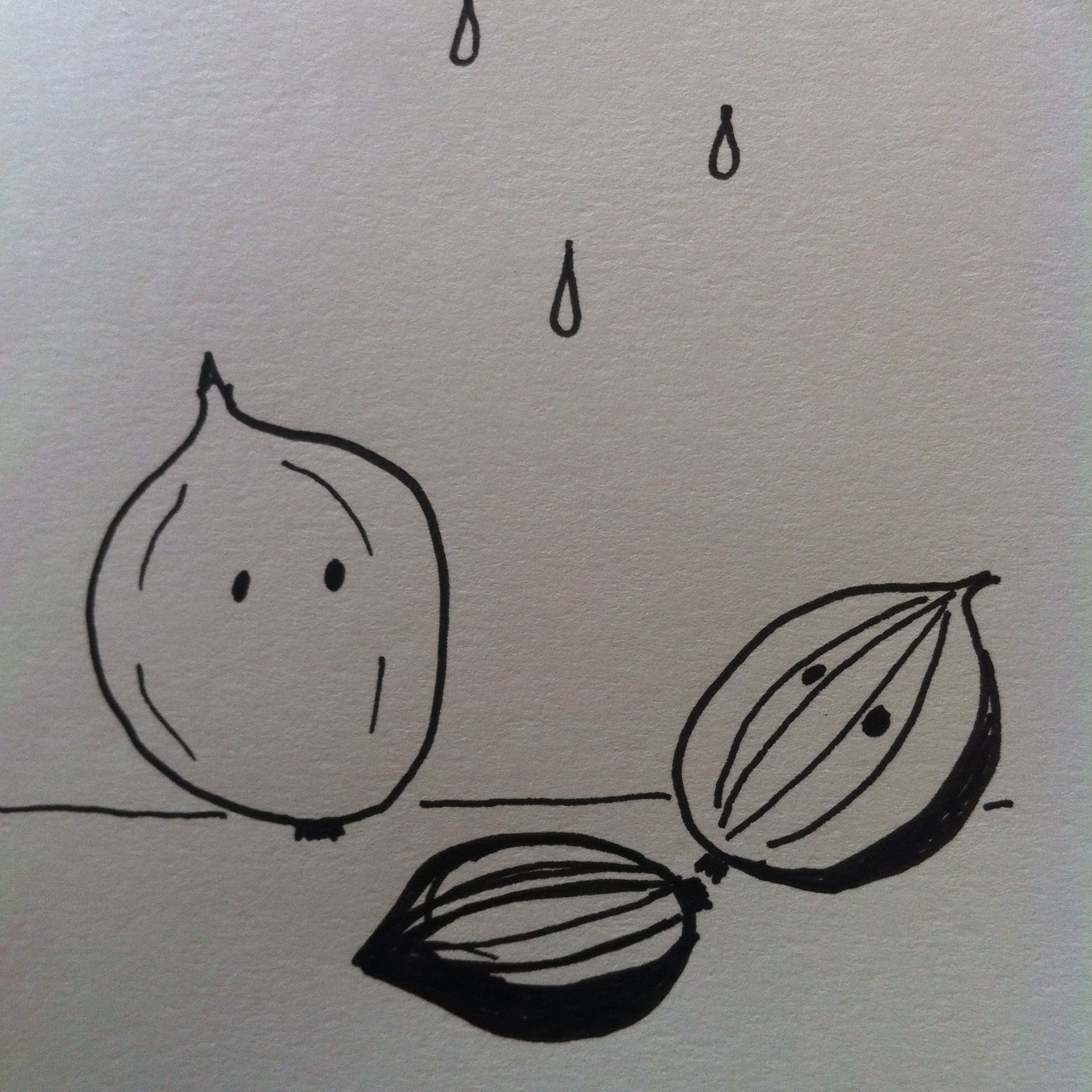
I’m not sure there is anything in all of world cuisine better than the smell of onions gently sweating in butter. (For once I’d definitely recommend it over lard.) Even the garlic you add half-way through, just as the smell is reaching its peak, only adulterates it. I was obsessed with it when I started to cook, trying to capture and prolong it as far as possible, trying to get as much of it as I could into the finished dish. The smell is nearly complete in itself, a heady oxymoron of fat and acid, carrying both deep savoury tones and a hint of sweetness which nods towards the dark, caramel browns of onion soup, but more than anything it is the smell of possibility. Think of all of the things those onions could grow up to be! Sauces, stews, the rich juices around a roast, pilafs and pastas, hashes and frittata and fricassees – onions (I’m including their relatives) are the basis of almost everything savoury and delicious. It’s a shame that recipes mistreat them so badly. The first thing to do when looking over any recipe is to double the time it tells you to cook the onions for. I’m not sure why this is the case. Whether the length of time actually required to sweat an allium down into soft, giving delight is considered off-putting for the amateur cook, or whether it’s instinctive Masonic secrecy on the part of food professionals I don’t know, but it’s certainly irritating. If you’re making, say, a tagine, which rests on heaps of sweetly browned onions, then you’ll need to cook them for at least half an hour – and that’s if you’ve sliced them thinly.

When preparing onions for this purpose, you should always slice the (halved) onions from root to tip, and (generally) do it as finely as you can. This smashes across the structure of the vegetable, leading to quicker breakdown and cooking (slicing the ‘other’ way, across the middle in half-moons, is best for pickles and salads, when you want to maintain structure) – and more tears, unfortunately. I’ve forgotten most of the methods I’ve heard to avoid crying over your dinner. The latest was to hold a metal spoon in your mouth while you sliced, which I haven’t tried for fear of looking ridiculous. None of the tips seem to work, anyway. You get used to it after a while. Think of it as a period of mourning, if you like – weep for the onion’s brief moment of glory, bathed in gently sizzling butter, before other flavours drown out its potential – weep for the lost dreams of your own childhood. All of the things you could have grown up to be! But here you are, an adult crying hot tears over a common vegetable. To console yourself, remember that the acids which stimulate your lachrymal ducts are what make the onion so useful. You could have – you wish, for a moment, you had – chosen a large, milder Spanish one, but you went for the small brown English, and your stew will be the better for it, your cheap braising beef lulled into submission by those sharp juices.

Not that the milder ones don’t have their uses. In general, the simpler your recipe is, the milder your onion can be – and should be, in onion-centric dishes. (Cooked ones, that is – a pickled onion can be as sharp as you like). The fat Spanish example sits well in a soup or, appropriately, a tortilla, where they are one corner in a trinity of ingredients, but when you really want them to shine, the small white-skinned Italian is best of all. These are becoming increasingly available here, and are worth getting, and shaping your dinner around, when you can. You can burn them in their jackets and dress the smoked-caramel innards in pomegranate, and have them with lamb; they are excellent in place of the ubiquitous red in salads and salsas; and they are glorious cooked down en masse to form the basis of sardines agrodolce, Venetian liver, or the Neapolitan salsa Genovese (some social history in that name, which I haven’t delved into). This last, particularly, almost succeeds in capturing that essence of onion in a pan (although it also contains meat, the latter acts more as a seasoning to the vegetable, heightening the deep umami of the onion rather than the other way round) – almost, but not quite. Probably nothing can. The ancient Greeks, with a laudably scientific approach, noted the gap in savour between the smell and the taste of their sacrificial meat, and concluded that the aroma, lost with the bubbling bone marrow, went to feed the gods. Hopefully, somewhere, a small and smelly deity grows fat on the fumes of a thousand onions, and blesses us for the feast.

Over-Cooked

I first tried rabbit on a pork-tasting trip around the Peak District – specifically, around parts of Derbyshire – where we sampled the quite impressive array of pork scratchings (and crackling – the difference, in a pub snack context, has never been clear to me) on offer in various pubs. Fun though this was, we had decided to take a night off (a birthday was involved) for a meal in Buxton. With its opera house, its spring water, the distant grandeur of the surrounding skyline (and despite being in the Midlands), Buxton can, I think, justifiably claim the title of the Italy of the North; we weren’t surprised, then, to find a lovely trattoria right in the town centre, all wood and leather and stairs and painted glass. The menu was pretty decent, too, from what I remember (we had quite a lot of wine – a birthday was involved) – we had snails to start, topped with vivid splashes of green, and there was squid-ink ravioli and calf liver and onions and I had rabbit, as I said, which had been stewed on the bone in a tomato sauce that could have been richer if you ask me. It was overcooked, dry but still tasty, and it might have been the wine or the company but that stands out in my mind as a hugely enjoyable dinner (we went clubbing afterwards – not an activity I recommend in Buxton), and I’ve loved rabbit ever since. The trick, of course, is not to overcook it – and to make the tomato sauce richer.

“Taking care not to overcook” is a particularly annoying piece of recipese, up there with “if liked” on my personal list. Presumably you are always taking at least some care not to overcook, and if not, the odd admonition is unlikely to make much difference. The implication, of course, is that the ingredient and process mentioned are particularly likely to result in overcooking, or that the consequences of overcooking are more drastic than usual. Without telling you exactly how not to overcook, though, or what the early-warning signs that you are doing so might be, these imprecations are worse than useless, throwing the cook into a panic without giving any way out. With any slow-cooked meat, it can be hard to judge the point where slow, happy disintegration shades into overcooking, a problem which is exacerbated in a meat as naturally lean as rabbit (all game suffers from a similar problem, which is why I’m not a huge fan of slow-cooked venison) – especially, and I’m sorry if I’m labouring this point, the tomato sauce (or other cooking medium) isn’t rich enough. When I started cooking rabbit, I used to stew the animal in its entirety, something which, for a number of reasons, you’d never do with a cow or sheep, though you might get away with a pig. As a result, the tender saddle meat always ended up tough and dry, a problem which I thought could be fixed by longer stewing, thereby messing up the whole dish. Now, of course, I keep the saddle fillets separate, and make rabbit nuggets.

This is a happy place to have arrived at, but the journey could have been halved if anyone had told me what to look for while I was taking care not to overcook my rabbit. A problem with recipes as a genre is that they do rather assume you know what the finished result should taste like – an assumption which robs them of a large part of their use, or certainly of their egalitarianism. A good cookbook should throw open the cuisines of the world and of history, and make them available to anyone who can follow a set of instructions. Without a certain degree of precision in the matter, say, of what overcooked rabbit looks like, or the degree of reduction in a tagine, or the careful balance of spicing in a proper Istanbul kebab, you are narrowing your audience to those who can afford to go and get the real thing. I mention examples from world food, but this applies just as much to restaurant cookbooks, which need the same sort of precision if they are to be more than just souvenirs of a good meal. The Nose To Tail cookbooks are so good because they manage to call up the whole atmosphere and ethos of St John, and I loved them long before I could afford to eat there. They are welcoming, in a way that, say, White Heat is not, and this welcome is extended in the balance between blithe imprecision – ovens are only ever gentle, medium, hot – and absolute clarity. Rabbit is ready when a knife can be slipped easily into its haunch; this is true, and useful, and immediately understandable. If only those Buxton-Italians had known. They could have taken some advice on the sauce too.

A Pinch Of Salt

In my experience, the most common way to express praise for someone’s cooking (after furious consumption) is to ask for the recipe, by which they often mean a list of ingredients. This is odd. It could be construed as mildly insulting (as if the recipe was the only good thing about the dish), and at the least it displays an almost wilful ignorance as to the mechanics of cooking. This is especially noticeable in restaurants. Yes, they have better equipment, more cooks, and often much better ingredients than you would normally use at home – but the main difference is that the people who work there are better at cooking than you. People sometimes seem to think they’re being tricked when this is pointed out to them. They ask how you make your scrambled eggs, as if there was one secret ingredient only available to the trade, and are disappointed when they hear the answer – “eggs and butter”. And “extremely well”. This is a charade that a lot of cookery writers are involved in. Not wanting to admit that cooking requires skill and effort, and a lot of practice and cock-ups of various kinds, we are told that all you need to do is buy the best, the free-rangest, the rarest – helpful in constructing a tomato salad, less so in making, say, a soufflé, though I guess nobody makes soufflés any more. A loaf of sourdough, say. Yes, good flour is better, and of course you need your well-fed, bubbling SCOBY, but your bread will still be awful if you don’t know how to knead it properly – worse, in fact, than a loaf made with dried yeast, because wet, recalcitrant natural leaven is quite difficult, or at least frustrating, to work with.

In fairness, baking books suffer the least from this affectation, but only because baking (especially bread-baking) is seen as inherently “different” from cooking (by which is meant roasting, braising, sautéing, grilling, and so on), being more scientific, precise, a boys’ game (only bread-baking), a craft requiring patience and graft, totally unlike the free-form expression of personal genius one finds, say, in the construction of an omelette. (You might have guessed from my tone that I find this position a little immature.) It might be true that a sourdough boule requires greater precision of execution than a “rustic” (horrible word) stew, but that doesn’t mean that the latter requires none – only that the consequences of imprecision are more obvious, and less fixable, in the former. Baking is a high-stakes game. Mess up at any one stage – kneading, proving, even (especially) in the proper feeding of your yeast source, before the recipe begins – and you have probably messed it up for good. No amount of prodding and tweaking will rescue it. This is important, and it’s what people mean when they say that baking is more of a “science” – but it doesn’t follow that stewing (braising, sautéing) is a free-for-all. The many opportunities for personal intervention only really offer more opportunities to mess the whole thing up. If you know what you’re doing, you won’t – but the same is true of baking. It’s just easier to master the basics of stewing, which – depending as it does on controlled interactions between heat, protein, acids and salt – is just as much of a science as baking.

Anyway. The consequences of this, for the average cookbook user, are that while some (not all) baking books, (to which I might add brewing and barbecuing – notice a trend?) as purveyors of a specialised craft, are happy to give technical instruction to an almost exhaustive degree, most (nearly all) cookery books, on the other hand, are content to give almost none – or to give the pretence of it in a way that is almost useless. Sweat, sauté, sear; it is assumed that we (I mean you) know the difference between all of these, their particular applications and circumstances. But – and this is the paradox of food writing – if you did, you wouldn’t need the cookbook at all. What you would require is a list of ingredients and the instruction “make a stew (fricassee, daube, whatever)”. A smattering of technical language lets you feel you’re in the club, and ignore the fact you’re reading a recipe that takes two pages to reiterate a basic technique, and add cardamom. I’m being unfair, perhaps, but only a little. This does, however, ignore the real reason we (I) read recipe books, which is for the recipe introductions, sparsely evocative, lushly hedonistic or winningly self-deprecating, which I’m told are a particular forte of British food writers. (In America, where practicality and competence are not considered personal defects, recipes do tend more toward the technical.)

This trend for inclusivity is a relatively new one. Look at old books of “receipts”, as they are still called by the kind of person who says “sparrowgrass” and owns waistcoats, and you will find a shorthand written by and for professional, or experienced domestic, cooks. These are, in the main, just lists of ingredients, which assume you know how to perform a plethora of kitchen tasks (cake-baking, pastry-making, braises and sauces and so on), and need no instructions; often, quantities and timings aren’t given, at least not precisely – the assumption is that you can judge for yourself how much pastry you need for your joint of lamb, or whatever. Partly, I’m sure, this reflects the now-broken oral tradition of “real” “peasant” cooking, handed down from master to apprentice, mother to daughter; equally, though, it’s just that cooking has got more complicated. A pastry designed half as glue and half as insulation, and not at all as edible, can be a little rough around the edges – add enough water to make the flour stick together, and you’re done. A pastry designed to hold a rich, golden custard through baking without cracking, and then to melt into butter in the mouth, needs a little more precision. Or take thickeners. A handful of breadcrumbs or ground nuts, added to a sauce, has an effect that is both intuitive and quickly obvious; the amount of slightly cooked egg yolk, stabilised yoghurt, roux, cornflour, or agar agar that might have a similar but more refined effect is less easy to judge by eye – and, as with baking, a mistake does more lasting damage. There is a tendency to a sort of Golden Age view of cooking which ignores the steady technical progress in the field.

All of this, really, avoids the original question, because the answer is quite unpalatable. Yes, I am better at scrambling eggs than you; I know the texture, the look, when to take off the heat and when to return, when to quickly shuffle out of the pan – and when to chuck the lot away and start again. Yes, my eggs are better, larger, fresher, their yolks more golden, their hens happier – but I also use a lot more butter and particularly salt than you would care to think about. It’s a sad fact, but people who will scour the outer reaches of Waitrose for the most obscure of Ottolenghi’s demands are often scared of simple brute seasoning – a shame, when the way to improve on almost any recipe is to take it with a big, three-fingered pinch of coarse sea salt.

Life of Pie

You could walk around Greece and eat a different cheese pie every step of the way. Filling, construction, pastry, all seem dependent on local custom or whim. You might get a brittle, multi-layered filo affair, sliced in a wedge from the round on an aluminium counter, dripping spinach onto the sunburnt concrete; or something more like a pasty, short and buttery, filled with feta alone, crumbling warmly on the deck of the night-ferry to Crete; or something between the two, soft and pungent with dill, with chips and tomato salad who-knows-where except it was hot and smelled of coffee. (That might have been in Turkey, actually, but we’ll let that slide.) I say ‘you’ but I’m obviously talking about me. I wish I’d taken notes, really, except then I’d probably be touting myself as some kind of expert on Greek cheese pies (tyropita, since you’re asking), spouting on about the traditional pastry of the night-ferry to Crete, the fillings particular to the lunchcarts of Athens, when really I don’t know anything about it. I’m sure some of the ones I ate, far from Mediterranean authenticity, were equivalent to those of a Grecian Greggs – but none the worse (or less interesting) for that. I’d like to see someone do a serious study into regional variations on the chicken lattice, or the ritual significance of cold pastry products in British life.

Pies here (no pastry dogmatician, I happily include plate pies, dish pies, and pasties under this umbrella) tend to come in various shades of meat, notwithstanding the noble cheese-and-onion slice – often a good option if you’re somewhere you ‘don’t trust the water’, so to speak, like a service station, or Nuneaton. Pastry, in fact, seems to have come into being (I hesitate to say ‘been invented’ when a lengthy folk process was obviously involved) mainly as a means of cooking and preserving bits of animal, with edibility a secondary concern. Before well made, tightly-fitted Le Creuset dishes, an airtight seal could be made with flour and water; before fridges (or tins?), cooked meat could be coated with a rich jelly, the whole encased in pastry and left in the larder til Christmas. (When romanticising such practices of our hardy ancestors, it’s good to remember that all of these people are dead.) The association of pies with meat, gravy, and the trencherman’s diet is still so strong that the prospect of a vegetarian pie (and here I’m not including pasties) seems to throw a lot of chefs into disarray, out of which comes an ill-considered mush (I wouldn’t dignify it with the word ‘hodge-podge’) of parsnips, tomato, and lentilles de Puy. Calm down, I always think. Nothing wrong with a plain cheese pie – especially with a hot-water crust and served at room temperature, where the flavours of aged dairy really shine. When it comes to a hot pie, though, there’s no competitor to meat, a fact which is easily proved (the best bit of a hot pie is where the gravy soaks down into the pastry at the bottom, and up into the underside of the lid; without meat, there is no real gravy). I suppose it comes down to venison or beef. (Hot pork pies just don’t exist, for some reason, as pastry-covered lamb ones don’t, traditionally. And chicken pies, while delicious, rely on artificial aids – béchamel, usually – for their saucing, which compromises the aforementioned gravy-soak effect.) I am personally not a particular fan of slow-cooked venison, and I find the traditional mitigators of its haughty richness – sharp redcurrant, clanging, floral juniper – distracting in a pie, which should (to my mind) represent an almost monomaniacal depth, rather than a dilettante breadth, of flavour. I’m prepared to concede that this is a personal preference, however, and wouldn’t say no to a venison pie – unless beef was also available.

Pastry, of course, is a whole other matter. Once, as I said, mainly a cooking aid, pastry has attained an almost equal role to its filling (it is, after all, what makes a pie a pie -unless it’s a shepherd’s pie) and in the process become largely a vehicle for the consumption of butter. A really buttery shortcrust, beautiful on a lemon or custard tart, is far too fragile for a meat pie – and one made strong enough is far too solid to be enjoyable. Puff’s thousand layers, wonderful as a lid, are wasted on a pie bottom; weighed down and soaked through, they don’t have a chance to expand, and lose all purpose. Flaky is clearly the answer. (Having moved firmly onto British pie-making, I’m ignoring filo, wonderful though it is.) What might seem like a compromise – a cheating cousin to rough puff – is actually a star in its own right, especially when made with quantities of lard. (Old recipe books tell you to use lard for texture and butter for flavour, but I like the slightly rank fattiness you get with lard alone.) It has the added advantage of being easy to make, not a whole-day job like proper puff, a task which almost dares you to use Jus-Roll; a great product, but you can always tell it’s bought. And no-one wants to think about bought pies, all hooves and eyeballs and dust. (People, myself included, eat things in the name of nose-to-tail that they sneer at in a hotdog.) Still, pie-making is something you should set aside both time and space for. The filling needs time to stew and reduce to that desired depth, the pastry to rest, the whole to bake through, without a trace of raw flour at the base, and it’s nice to have a whole sunny kitchen to yourself for the duration.

As a final piece of advice, I would suggest you err on the side of making too much of everything; you can always eat the extra filling, and there’s nothing sadder than stretching a well-made pastry past its capacity for beauty. Be generous, and it will show in your pie.

Pigs and Peas

Pity the British food writer. A lovely last week of May, and all those pieces you’ve planned, on podding peas in the evening sun, the joys of stone fruit and cucumber and gin – the rich larder of an imagined English summer – are looking great. You can almost smell the lemonade. Then June hits, and it’s all autumnal gusts of sideways rain. Such is the problem of seasonality in a country where the weather barely pays lip service to the time of year.

Ah well. The whole point of summer produce is that you barely need to cook it anyway. You weren’t actually going to follow that clafoutis recipe, were you? Just eat the cherries out of the bag on the way home, like a normal person. When the late summer courgette glut hits, you might be glad of a few extra ideas (make chutney, leave it to ‘mature’ in the cupboard/shelf/oubliette) but for now (the imagined now, that is, where the weather’s really nice) it’s best to enjoy things as fresh as can be.

None if this helps with the need for early-summer warmers, though. Here, as so often, I suggest ham is the answer. Some conjunction of pea and pig is always appropriate, from London Particular to lovely little-gem-and-herb heavy salads, and this is a great way of hedging your bets. So.

BASIC HAM ADVICE

Ham hocks (gammon hock, bacon knuckle – same thing) are a perfect marriage of hard-working, pullable meat with gelatin-heavy bone and wibbly bits. Butchers usually have them. Get 1 or more if you’ve got a big enough pot.

Onions

Carrots

Leeks

Celery

Garlic, juniper, thyme, whatever

Put everything in a pot, cover with water, and bring to a lively simmer. Keep there for a good two hours, until you can easily pull out the main bone of the hock.

Fish out the ham(s) and leave to cool a bit before shredding, discarding bone, skin, and any wibbly bits that haven’t broken down. 

Strain the stock, which is now worth its weight in gold. The carrots will be deliciously hammy, the rest of the vegetables pretty insipid. Discard those too.

There you are! If the weather’s gone crap, you can cook split peas in the stock, add some shredded ham (maybe fried crispy) and eat with rye bread; glorious sunshine might warrant the aforementioned salad, scattered with freshly prodded peas, chervil and chives, and maybe a fresh curd cheese; somewhere in the middle (most likely, I suppose) and you could braise the lettuce and peas in your ham stock, enriching the broth with a good dollop of aïoli. If you want to just eat the warm ham with your fingers, slurping down jugfuls of broth, though, that’s fine by me. 

Anti-recipes


How many people actually follow recipes? Read them over, gather ingredients, and go through them step by step? Anyone with an interest in food writing will find themselves – through books, magazines, blogs – inundated with “new” recipes (which are almost the only accepted form of food writing now) for seasonal this or exotic that, but how many ever make it from page to plate?

There are, I suppose, two (very) broad categories of recipe – those designed to teach us technique, and those intended to suggest flavours. The first – a baking recipe, or for hollandaise, perhaps – does by its nature need following more closely, and might have something new to impart, a suggestion or explanation that clarifies a mystery of craft. The latter kind of recipe, though, barely needs to exist at all. When you read a recipe for a beef and orange ragu, you are really just reading the suggestion that Marsala and citrus go as happily with beef as claret and allium; the rest of the recipe is just padding, or to put it more kindly, a formal construction which allows the meat (sorry) of the recipe to be communicated.

With this in mind, here is today’s recipe.

SPRING LAMB, WILD GARLIC, YOGHURT

Pink, seared lamb, wilted ramson leaves, rich, seasoned yoghurt. Serves as many as you like.