


“When you have arrived at Phyllis, you rejoice in observing all the bridges over the canals, each different from the others: cambered, covered, on pillars, on barges, suspended, with tracery balustrades. And what a variety of windows looks down on the streets … how many kinds of pavement cover the ground” – Calvino, trans. William Weaver
So much of Venice reaches up and away from the water, from the intricate canals and from the lagoon itself. The long needle of the Campanile, and the squares of Paul and the Magdalene, where, if you stand in the middle, you can pretend you are in a solid, everyday city, are the most successful; all of the buildings, though, all of the warehouses and palazzos and the elaborate bridges, do their best to reach away from the seaweed which purrs at their foundations.
These days the canals are reserved for richer tourists, who the gondolas, still black-clad for shadowy assignations and espionage, ferry around a largely forgotten city. The trattorias, with their lace curtains, batteries of hanging pots and their poorly-rendered aquatic scenes, sell endless processions of cuttlefish and calamari, while the still-living markets heave with the terrestrial products of the Veneto, with puntarelle, with radicchios of all kinds – curled, spotted, delicately pink – with honey-sweet apples, large and baby and carved artichokes, cardoons and celery and cauliflowers and all of the other favourites of the vegetable-loving Italians.
Here, though, in the richest part of the country, leaves don’t carry quite the same respectability as they do in the poor, dried-up south; here, the restaurants which offer an alternative to seafood tend to do so in the form of elaborate dishes of meat. These days we tend to think of Italian cuisine as all cucina povera, breadcrumbs and strange fish and offal; liver and onions, of course, is a favourite of Venice, and I saw tripe, tongue and the like in various butchers windows and on the bars of smaller eateries. In a restaurant, though, you might get half a duck, roasted and drenched in a quite astonishingly rich ragu of chicken livers; fricassees of veal, both sweet and deeply savoury; and, of course, the famous carpaccio, a fairly recent invention of the upmarket Harry’s Bar.
Apart from the latter, a distinctly urban dish, this might get described as ‘mountain food’; aware, perhaps, that their amphibious city has become a playground for tourists, the Venetians look inland and up for a different taste of home. Even here, though, they can’t escape the water. If you wander about the houses between the Accademia bridge and the Grand Canal, you might find a strange replica of an Alpine hut, hung about with straw hands and opening on to a boat yard; it is a gondola workshop, and the people who build and pilot them are often, themselves, sons of the Dolomites and beyond, far from their solid mountain homes.
Category: Non-recipes
Invisible City pt. 1

“In Esmeralda, city of water, a network of canals and a network of streets span and intersect each other. To go from one place to another you have always the choice between land and boat” – Calvino, trans. William Weaver
Venice, it’s fair to say, is a city mainly composed of bridges and water, a fact emphasised when you enter it, by vaporetta, on a chilly, rainy day in late February, the kind of day when the sky and the water seem composed of the same great sheet of grey. The canals lap at the seaweed-bearded streets; bridges appear out of nowhere, and any alley might lead equally to a church or to the sea. Why anyone chose to build a city there is beyond me, but I suppose they made a good go of it, becoming “excellently amphibious” in response to their waterlogged, sinking surroundings, bringing, for a while, large parts of the Mediterranean under the control of their largely mercantile empire.
I always find it fascinating to trace the history of a place through its cuisine; part of what I love about Sicilian food is the little touches of Arab and Spanish flavour, the faint whispers, even, of Roman and Greek – seemingly un-Italian spicings, sweet fruit and meat, the absolute ubiquity of the anchovy – but apart from the occasional flourish of cinnamon, little seems to remain of La Serenissima’s once-vital place on the spice route. Apart from a few remnants of later occupations – the cream doughnuts and the peculiar Venetian lust for strudel – their cuisine is as amphibious as them, entirely a product of the lagoon and its immediate surrounds; which is to say that they eat a hell of a lot of fish.
Apart from breakfast, which for Venetians means an espresso and a cornetto and for us meant the bountiful purgatory of the Continental buffet, almost every meal we had was largely aquatic. The first night was cuttlefish in sticky ink, thick bigoli pasta in a dense sauce of anchovies, sardines in their beautiful sweet-sour bath, and simply boiled king crab; the next, tiny, toy-like octopus and spaghetti vongole; for lunch, the little soft-shelled local crabs, no bigger than the palm of your hand, which stuff themselves with Parmesan batter in a morbid frenzy before a quick end in hot oil. In between, very often, there was baccala. Although, as far as I can gather, this is made with stockfish rather than salt cod – that is to say, dried without being salted, giving it all the hairy texture without the sometimes overpowering flavour – it shares a lot, in its most common preparation, with the Catalan brandada and the French brandade.
Although all these (and salt cod in general) seem totemically Mediterranean dishes, they are essentially a product of trade, early fusion cuisine. The fish, from cold and teeming northern waters, was salted and dried on cold Scandinavian beaches, in dry Scandinavian winds, travelling almost to the other end of the known world to be revived and mixed with good southern olive oil and cracked eastern pepper – and, for the last few hundred years, served on grilled cakes of ground Mexican corn.
I make my own salt fish (normally with hake or ling, for various reasons) but don’t generally dry it; I’ll give that a go, and work on a recipe for baccala mantecato. In the meantime, look for Russell Norman’s POLPO recipe; or go and eat it at Polpetto, where it is perfect.
Carne-val
It is, of course, Pancake Day, Shrove or more pleasingly Fat Tuesday, more romantically Mardi Gras, time for Carnival, carne-val, when we prepare for the month-long renunciation of meat and much else that is the Lenten Fast by stuffing ourselves silly with all of the things that will soon be forbidden – except we don’t, really, because few people – outside, presumably, of monasteries and convents – go the full Catholic hog any more, the asceticism of the Roman tradition having withered along with some of its mystery in the hearty CofE. A Good Catholic Boy I used to work with once told me (I think I’ve got this right) that although most people give up something for Lent, in the ‘modern’ Church it is considered more as an opportunity to take something up, whether a useful and improving hobby or generic good works – like that Good Deed A Day book you had to keep as a Cub Scout, but just for a month.
The Coptic Christians of, chiefly, Ethiopia and Egypt, desert-forged by the tribulations of St Anthony (of Flaubert and Dali fame) keep a calendar which involves fasting of some kind for, I think, around two-thirds of the year; it’s believed that their often meatless diet gave us falafel, fuul medames, and other vegetarian staples of the Middle East. I have no idea what they do for Lent, but I assume it is strict. Although some people of my acquaintance do renounce some little thing for a month – Creme Eggs, takeaway pizzas, casual sex – for most of us happily godless heathens, today is just another day in the slow trundle towards easeful death. If we have a yearly fast, it is the grey feast-weary month of January; personally, I don’t believe in ever giving anything up at all. I still, for example, eat Babybel.
However, it wouldn’t do to throw the baby out with the metaphor, particularly if that baby (bear with me here) is a foodstuff. Today entirely deserves its modern British appellation, lacking though it might the weight and glamour of history; it is the day on which, without guilt or fear of reproach, you can eat pancakes. For DINNER. Recent years have seen the fat American pancake, fluffy with buttermilk and baking powder, make inroads into our breakfast culture; this is ok. Breakfast (or brunch, more accurately) is a time to be frivolous, to have bacon and banana and blueberries on a fat, syrup-soaked drop scone. I have made thousands of these pancakes over the last few years, and I still enjoy eating them; that is high praise. You have all year to eat those, though. Pancake Day is for the eating, at dinner, of crepes. I, for one, have never made a crepe on any other day – though I have been guilty of off-season galettes.
While galettes (especially the buckwheat variety) are good with shredded ham and good strong cheese, crepes should be eaten with lemon and sugar; in this Ed Smith and I are in agreement. As the redoubtable M. de Courchamps noted, even jam is an “affectation”. (Thanks to Bee Wilson for that piece of wisdom). In my younger days I would add to this duo golden syrup; I still might, if I didn’t find the bother of keeping the tin and its surroundings clean to be more trouble than the contents seem worth. As for treacle – pff! There is not world enough, and time – but I suppose that is rather beside the point. No one in their right mind would put treacle on a pancake. If we agree that lemon and sugar – and in small quantities – are the only necessities for crepe-topping, then Pancake Day becomes a very affordable feast, one which could have been achieved with only the store-cupboard ingredients on Ready Steady Cook, leaving you a fiver to buy a Django Reinhardt CD to cook to – essential for the preparation of crepes.
All of this makes the proliferation of those pancake mix kits all the more baffling; there are several brands in my local Spar, from Peppa Pig to retro Americana. Presumably food companies have realised that an unexploited feast-day is lost profit for them, and hastily put a quite astonishing mark-up on homeopathic amounts of cheap, plentiful ingredients; perhaps they’re simply trying to bring the joy of pancakes to households lacking the time or wherewithal to measure things. Assuming you have both of these luxuries, making pancakes is really extremely easy; pancakes of some sort, being an incredibly primitive form of bread, must have been some of our species’ earliest processed foods. I’d take Ed’s advice, above, and use St Delia’s recipe. This is the kind of thing she’s best at. Just remember that the first one is always the worst, that flipping is all in the wrist, and that you’ll eat more than you need but less than you want, and you can’t really go wrong.
Five New Things
I was going to do another dishes of the year post (it is Listmas, after all), but looking back at last year’s I realise that I haven’t eaten anything like as well. Apart from St John’s bone marrow, mullet at Lyle’s, smoked pork fillet at Morito, sausage and radicchio in Naples, snail-and-trotter-stuffed potato at the Poule D’Or, rabbit at the Walnut Tree, pig’s head and potato pie at St John, again (Bread and Wine, this time), the patty melt from Patty & Bun, cuttlefish at Taberna do Mercado, and perhaps a few other things I’ve forgotten, nothing really stands out. I just haven’t had the time for extravagant meals; I’ve been too busy working.
Luckily, all of this working means I’ve had plenty of time to experiment (mess around) with various new-to-me ingredients and techniques, many of which have found a permanent place in my repetoire. So, since it is the season, here are five things which have revolutionised the way I cook this year. None of them are new – quite the opposite really – and all are fairly simple. I call them techniques, but none are very technical. The point is flavour.
BRINING
Everyone who brines their meat is absolutely evangelical about it – and rightly so. The difference it makes is astounding. It’s only this year that I feel I’ve really got to grips with it – I used to brine EVERYTHING, quite heavily, but I’ve got more selective. Pork belly, for example, I don’t think wants it; brined pork just tastes of sausage (not necessarily a bad thing, but not always what you want), while brining pigeon does weird things to the flesh. Chicken, rabbit, tongue, anything you are going to smoke, most things you are going to poach. Most things, really. Following St Fergus, I use a pretty strong brine of 125g salt and 80g sugar per litre, plus spices as appropriate; I generally boil the dry stuff with half the water, then add the rest as ice when it’s ready, but that’s because I’m impatient.
FERMENTATION
Specifically, the fermentation of tomatoes. I’ve been pickling things for a while now, but this was a breakthrough. A recipe from Ukrainian chef Olia Hercules, it’s really simple; a weak brine (35g salt/ 35g sugar/ 1l water), a few cloves, peppercorns and juniper berries; a jarful of nice, underripe tomatoes; pour the one over the other, and leave for a couple of weeks. The tomatoes are great, but the resulting liquor is the secret weapon. I’ve cooked mussels in it, pickled other things in it, and used it as the base for a squidgut sauce. I now ferment almost all things.
SALT-BAKING
Salt has definitely been my most-used ingredient this year. For most things, but especially salt-baking, I use the coarse Cornish sea salt; Maldon’s is far, far too expensive. Salt-baking whole fish is something I’ve been aware of but never bothered with; when Stephen Harris tells you to do something, though, you sit up and listen. Like him, I’ve always found gurnard a challenge; obviously, it is cheap and good to eat, but I’ve often ended up chucking it into stews. Salt-baking it, though, gives you really moist, juicy and well-seasoned flesh. I serve it with a tomato-infused fish stock, and let everything sing.
RAISING
Not so much a new technique as a different point of view. After being obsessed with sourdough and all the obscure, manly practices which go with it, the Violet Bakery Cookbook reminded me that baking could be easy and fun. Claire Ptak is pragmatic. She doesn’t have the space, she says, for yeasted baking, so develops recipes, inspired by mid-century American cooking, using baking powder and sodas. Her cinnamon bun recipe is a thing of excellence and perfection.
EMULSION
You know how decent recipes always tell you to save the pasta water and add a bit to the sauce? Just do that. It’s magic.
Al Dente
It’s that time of the year when everyone starts arguing about sprouts. In one corner, the unapologetic sprout-lovers, for whom the smell of ancient, boiled socks goes hand-in-hand with Christmas like peaches and cream; in the other, the genetically superior brassicaphobic, who cherish and guard their ability to taste that hint of queasy bitterness which lurks at the back of every cabbage. In the middle, calling for reason, are those who understand that said bitterness is only activated by the preparation which the French are pleased to call a la Anglais; the long demolition of vegetables. A well-raised sprout, on the other hand, cooked until it is cooked, is edible to all, and capable, as most things are, of deliciousness.
The cooking of things until they are cooked, sadly, is a dying art, having lost significant ground on both sides, to the aforementioned English vice as well as to the tyranny of al dente. The latter phrase, you are probably aware, is Italian for ‘to the tooth’ or ‘to the bite’, and refers to the raw snap they prize at the core of pasta; I don’t think an Italian cook would apply it to a green vegetable, which tend, in my limited experience of Southern Italy, to be cooked until they are cooked, dressed heavily in good, bitter oil, and left to sit at room temperature – an excellent preparation for any bean or brassica. No – I think the blame here can be set squarely on the French, or at least on a certain kind of quasi-French cooking, which prizes colour, texture and structure above things like taste. In a thousand hotel kitchens across Europe, chefs are blanching beans, broccoli and spinach until a fixed dark green, shocking them immediately in iced water, and then reheating to order in a little emulsion of water and butter or, if pressed for time, in a microwave. Somewhere in this process most of the actual, distinct taste of the vegetable is lost.
Worse, when applied to certain things – cabbages, mainly – the process renders them actively unpleasant to eat. Having lost the crunch of rawness but not fully cooked through, they become chewy and curiously resistant to the eating. I had some ‘braised’ red cabbage the other day which just wasn’t – half-cooked, it had lost all its own flavour without anything to replace it, and I found it, really, a chore. Either cook it or don’t cook it; don’t mess around in the middle. I like my steaks cooked medium rare, just warm and giving in the centre; I love steak tartare with a fierce, barbaric passion. I don’t want great slabs of charred, mostly uncooked muscle. If the meat is good enough to stand up to that, give it to me raw and I will tear at it. There is a current fashion for raw fish, often salted or pickled, which is then singed with a blowtorch. Apart from the obvious pleasure of playing with a blowtorch, I can’t see any merit in this. Either cook it until it is cooked, or leave it alone. And please, please stop serving lentils al dente.
Noble Rot
It’s a little strange that Britain, for all its love of tracklements and preserves, has no particular tradition of lactofermentation, the preferred method of pickling vegetable matter from Korea to High Germany, and indeed further afield. In the United States, it is understood that the word “pickle”, unmodified, means a sour dill pickle; that is to say, a small cucumber, lactofermented in the Continental tradition mostly associated here with polski skleps and salt-beef bagels, though very similar to the pickles of Lebanon, Turkey, and Egypt, where they fill the same role as a foil to rich, smoky meats and sour dairy. Here, I suppose, “pickle” (“cheese & pickle”) means something anonymous, mixed and brown in the Branston mode, malty with vinegar and brown sugar – although if you were offered “pickles” you might reasonably expect onions, perhaps some beetroot or sweet, sliced cucumber; even, if you’re lucky, an inky Opies walnut. If we pickle cabbage, it will, most likely, be red and, once again, vinegared; the bacterial tang of sauerkraut is alien to the national palate. (Was, anyway; the Reuben has joined pulled pork on the supermarket shelves, and kimchi, we are told, is ubiquitous. As so often happens, these things have gone straight from out-there trend to mass-produced commodity.)
Lactofermentation is a chemistry experiment, or if you like, an artistic exploration into decay. Fruit or vegetables (generally) are placed into salted and perhaps sweetened water – or in the case of sauerkraut, dry-salted, the cabbage itself providing the required liquid – and left for some time, the exact recipe varying with ingredient, temperature, season. The amount of salt is important – you need enough to kill off any rogue yeasts, and the majority of bacteria, but not so much as to see off the lactobacilli, which will, given time, eat their way through natural and added sugars, creating lactic acid – after the manner of acids, a preservative – in return. This is one of those extremely useful processes, symbiotic between humanity and microscopic life, which form the foundations of our culinary history – and one of the more baffling ones. You can see how some sour grape juice was sampled, liked, and polished off; how old dough was found to swell fuller in the oven’s heat. To leave cucumbers entirely immersed in salt water for a period of time takes a certain amount of idle curiosity. However. To get back to those pickles, perhaps it’s the decay that puts us off; we don’t like to watch the cloudy, mysterious bubbling as the bacteria do their work. As I’ve mentioned before, we’ve never had much truck, historically speaking, with sourdough bread either, or, our noble cheese aside, soured milk products.
It’s a shame, anyway, as fermentation is an excellent method of pickling, preserving (haha!) as it does a lot of characteristics normally masked by heavy, sweet vinegars. I fermented some tomatoes recently, to an (I think) Ukrainian recipe via Olia Hercules, and they were delicious. Sour almost to the point of fizziness, they nonetheless taste of tomato – and of different varieties of tomato – in a way which chutneys and ketchups, however tasty, do not. It’s odd, when British cooking has such a reputation for plainness (simply boiled or roast meat, potatoes, vegetables) that in pickling we frequently pile on so much ornamentation, to the point where it overpowers the content – we don’t eat piccalilli for the beans and cauliflower, or Branston pickle for the whatever-they-put-in-Branston-pickle – although the same could be said of our charcuterie tradition. All across Europe, people dry-cure whole or boned pork legs in masses of salt, trusting in the quality of the animal, fed on acorns or herbs or common swill, to shine through; we, on the other hand, immerse the same in treacle, beer, sugar, cloves, marmalade, vinegar, saltpetre, peppercorns, herbs and hay, roast it, and still serve it with nose-tickling mustard, pickles, pickle, and piccalilli. We have a thousand sausages, but no salami – salt beef but no cecina. You could blame the climate, but I’m not convinced. I stuck a salted sheep’s leg up a chimney all through summer and it came out fine. I think it’s that same fear of rot, of seeing the white bloom of mould creep across the skin; deep in a Puritan part of our souls we are scared of decay – although that doesn’t account for Stilton or, for that matter, Stichelton.
Simple Suppers
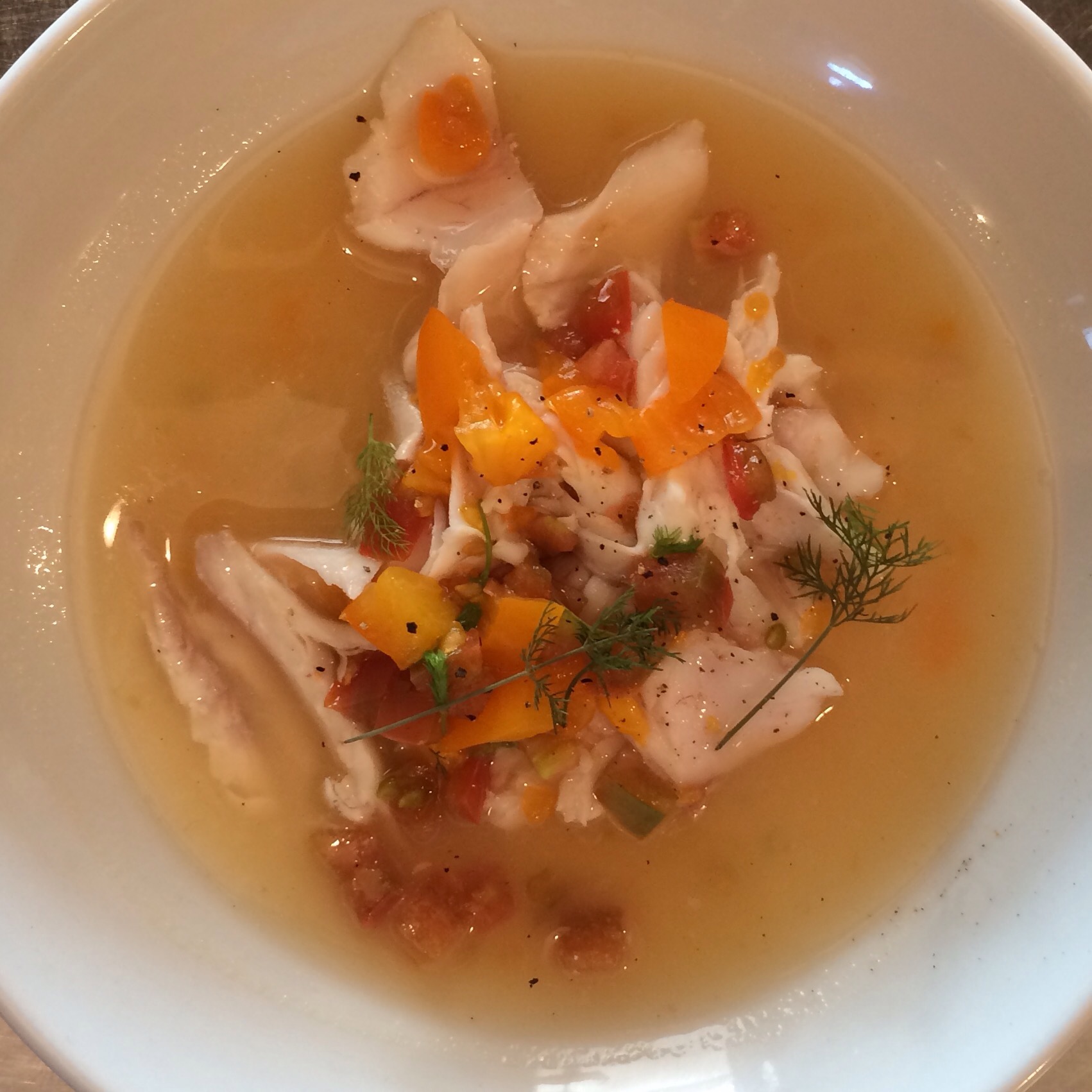
If you take a clear, well made, lightly gelatinous fish stock, season it with salt and sweet white vinegar and infuse it with lovage, mint and celery leaves, the result is a clean soup – a bone broth, if you must – which sits happily in the sometimes awkward period between summer salads and the dense potages of winter, although it might seem a little austere. Add some diced golden and orange tomatoes and gently warm through until the jelly round the seeds seeps out into the pan, then spoon the lot into a plain white bowl, where it will glow with brisk, late summer health. You might have started the bowl with some flakes of salt-baked gurnard, poached, shredded skate wing, or a lightly cured mackerel fillet, barely cooked through in a little spare broth; you might finish it with a fistful of chopped dill, fennel tops and parsley or a spoonful of a pungent, quivering aioli.
This is a way of cooking, precise and simple, that can only proceed from abundance, and as such is incredibly irritating to read about. No-one wants to hear about your well-stocked larder, your fridge full of home-made condiments and seasonings – I’m sorry for bringing it up. In my defence, ours is professionally so, with space to spare in cupboard, freezer, and dishwasher, and the time, inclination and imperative to do the kind of housekeeping, the straining, simmering, bottling, pressing, potting and drying which formed the backbone of our imaginary peasant cuisines; outside of work, it’s a fantasy, but one that it’s nice to inhabit for a while. I don’t think I’ve ever made fish stock at home. Meat broths can be thrown together out of ham bones or roast chicken carcasses, a few scraps of veg, simmered for hours with little attention, but fish needs a bit more care.
If you wanted to follow the non-recipe above, taking the mackerel option, then you’d need to start with another fish entirely. The bones of oily fish do not make a good stock. You want white fish carcasses (flatfish are good), which you’d need to ask your fishmonger for, if you have one and he likes you, or save from a previous meal of, say, fat bream you’ve filleted yourself – which brings us back into the realms of fantasy. I don’t think I’ve ever filleted bream at home either – I roast them whole, and the roast bones do not make a good stock. Cheap white fish fillets will do. Put them, or the bones, in a pan with onion, fennel, celery, peppercorns, bay – you know, all the standard stock accoutrements you have lying around your well-stocked pantry. Cover with water and bring to a bare simmer, which is where it should stay for about half an hour. “There was silence throughout heaven for about half an hour” – that’s when they were making fish stock, carefully watching the bubbles to ensure it never broke out into anything as frantic as a putter. I assume so, anyway.
When it’s ready, you can lift out all the bits with a sieve and pour the clear liquid into a bowl or tub containing lovage, if you can find it, mint and celery, leaving behind any fishy sediment. Lovage is an excellent herb, something like an intensely astringent celery, which I have never seen for sale anywhere, although it grows in this country fierce and strong. You can leave all that to infuse like some unpleasant, medicinal tea, before straining and, if you like, freezing the result. If you do the latter, then take the opportunity to clarify it upon defrosting – it’s an extremely easy process, but one I can’t be bothered to explain here; just writing all that about stock has exhausted me. Google, google, google. Time to cure the mackerel, if you’re still with me. You need ridiculously fresh fish for this. Red gills, bright eyes, rigor mortis, the works. You’ll probably need to find it whole, to ensure freshness, and then fillet and pin-bone it as quickly as possible. The flesh of oily fish degrades incredibly quickly. I generally put the fillets in a tub, floating in an ice-bath, then put the lot in the fridge and make the cure. Equal parts salt and sugar, some crushed fennel and coriander seed; mix together and spread out in a tray. Pin-bone the fish with your fish tweezers and place the fillets, flesh side down, in the cure. Put back in the fridge for half an hour, then wash the cure off and do any necessary trimming. A faff, yes, but it really helps to keep them in the first freshness – and as we know, there is no second freshness.
It’s plain sailing from here, anyway. Warm a saucepan of the stock, add salt, pepper, white balsamic vinegar (fine, white wine vinegar and a pinch of sugar if you must) and some very good, very ripe diced tomato. Separately warm a couple of inches of stock in a pan wide enough to take all the mackerel in one layer. When it’s just bubbling, add the fish and cook very gently for five minutes; lift the fillets out into bowls and spoon over the tomato broth. Top with herbs, and if you want more of a kick, some good, strong aioli, which of course you have in the fridge. Or if you’ve run out –
2 large egg yolks
a spoon of Dijon mustard
8 cloves of garlic, crushed with salt
pomace oil
juice of two lemons
extra virgin olive oil
Blitz the first three in a food processor or whisk together in a bowl. Slowly add pomace oil until it goes really thick. You DON’T have to do this in a constant stream, but it does have to be gradual. When it looks a bit too thick, mix in the lemon juice. Slowly add the olive oil until it looks and tastes right. That was easy, wasn’t it?
Sourer Wine
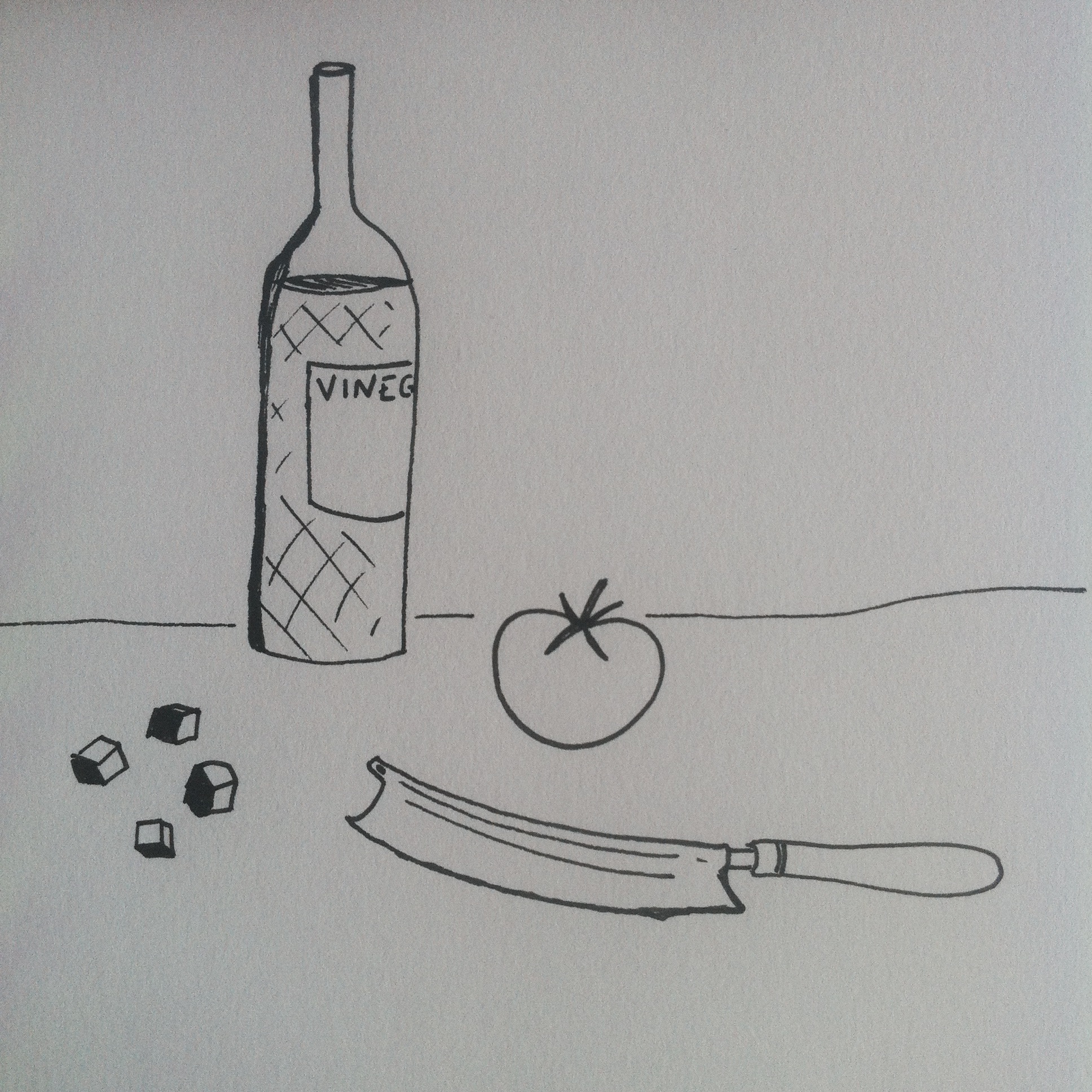
It used to be thought that standing wine was turned into vinegar by vinegar flies; or perhaps it was that these little insects were bred spontaneously out of vinegar, or maybe both, at different times – I don’t remember when or where I read this fact, these facts. Leave a cup of vinegar uncovered for an hour or two, anyway, and you’ll see why this possibly fictional belief persisted – flies you never knew were there will have suicided within it. I don’t know why they do this.
We now know, of course, that wine (or beer, cider, or fruit wine) is turned into vinegar by a helpful bacterium, the acetobacter, which – as far as I understand the matter (about as far as I could throw a gallon of barrel-aged sweet Modena) – consumes alcohol and pisses acid; vinegar-making is a process of controlled decay, whereby leftovers, left to rot, turn eventually into a preservative, without which British cuisine would be particularly bereft. The cured items, tracklements, chutneys, ketchups and sauces with which our food is scattered – roll-mops, pickled onions, pickled red cabbage, brown sauce, mint sauce, Branston, and so on – all rely heavily on the clanging collision of sugar and vinegar, with little recourse to simple salting and lactofermentation, as is found in other pickle-heavy cultures (Germany, Turkey, the US); and where would the chip-shop be without vinegar?
My brother, who has always had a love of extreme tastes, used to use malt vinegar, or possibly non-brewed condiment, as a universal seasoning, for which he was roundly mocked, and rightly so; pasta doesn’t need to be drowned in it. Still, he was on to something. A splash of vinegar works wonders on a long-cooked stew, revivifying what was lost in the murk; the magic that chilli sauce works on simply cooked eggs comes as much from the vinegar as from the heat, that welcome touch of sweet and sour. To my mind, seasoning a dish – that final adjustment, as it’s often called in recipes – means not just intensifying our apprehension of flavour with salt, but a balancing of all the basic tastes on the tongue. To a simple tomato sauce, already rich in umami, we might add a pinch of sugar, a little lemon juice or vinegar; bitterness comes from pepper and olive oil, which also contributes the pleasing taste of rich fats.
Come to think of it, forget that tomato sauce – make a salad dressing, one with a little anchovy in it, designed to perk up gentle, buttery salad leaves. Dissolve sugar and salt in good vinegar, add pounded garlic and anchovy, whisk in grassy oil – you have sweetness, salt, a sour kick, heat and deep savour, and a cleansing, fatty bitterness – you have, in other words, a powerful hit of all tastes, which is why (some) salad dressings are so delicious to drink by themselves. Taste, as distinct from aroma, is a real bodily pleasure that puts you firmly in the present. On the other hand, we are told – we know – that smell is the sense most hard-wired into our memories, to the point where it might have been designed for the express purpose of recollection.
Everyone must have had that feeling when, walking along entirely in the here-and-now, you smell an ex-girlfriend’s perfume, or the sweet, submerged scent of chervil and jump back five or fifteen years into the past, which slices through the present like a good knife through sweating fat. Flavour, then, although we experience it as one thing, is a combination of two very different sensations which dance around each other like two pigeons on a tiled roof, tending first one way and then the other, hopefully, in the end, to meet somewhere in the middle. The goal is that the taste lives up to the promises made by the first drifting smells.
T
his can be particularly hard to achieve when the smell is one happily remembered from childhood, which is why the trend for house-made ketchups, baked beans and so on can be such a minefield – they have such intense early sense-memories to live up to that they must nearly always fall short. The goal is that the opposite happens; that the new, fresher version retroactively transforms your childhood meals, making them seem daring, original and tantalising, in the same way that the most innocuous 50s ballad becomes, after its use in a David Lynch movie, haunting, rich and strange.
I don’t know if this version of brown sauce achieves this universally, but it does for me. HP sauce is a fine thing, the perfect foil to a heavy full English, and a good riposte to anyone who would insult the national palate; how can a country where a spiced date and tamarind sauce is eaten with dry-cured pork as a breakfast item be accused of dullness of cuisine?
BROWN SAUCE
This makes rather a lot, but it seems to keep indefinitely (sugar and vinegar there) in the fridge. You could bottle it properly if that’s your thing. It goes extremely well with black pudding, as well as bringing the bacon sandwich one step closer to perfection.
700g chopped onion
800g chopped fresh tomato
500g dates
500g prunes
250g dried sour cherries
500g light muscovado sugar
2tbsp salt
1l white wine vinegar
a pint of porter
1tbsp peppercorns
1 dried chilli
2 cinnamon sticks
1 tsp cloves
2 star anise
an optional splash of sherry vinegar
Tie up the spices in a little bag or resign yourself to sudden breakfast crunches. Put everything in a big pan, bring to a simmer, and let it putter for two or three hours until soft, cooked and dark. It’ll need some attention to stop it sticking.
Remove the spice bag and blend smooth in batches, adding an optional dash of sherry vinegar to each batch (it perks it up a little). Bottle or fridge, and leave for a week to get to know itself. Apply liberally to cured pork items.
A New Lump
Where does yeast come from, asks Elizabeth David in her quietly impressive work on bread and yeasted baking, out of the everything? Yes, is the simple answer. Wild yeasts float and permeate and surround us, settling and breeding where they find food, moisture and the conditions of their tiny lives; the act of collecting, taming and cultivating them to serve the specific purposes of man has been the work of millennia. In Middle English yeast was known as goddisgoode, God-Is-Good, because of the mysterious ways in which it works its benefits to mankind; until quite recently, we hadn’t got much further in understanding it. Now, of course, every kitchen and artisan bakery has their own culture of wild yeasts, among other entities, in the form of a sourdough starter or mother; more precisely, this is known as a SCOBY, a symbiotic culture of bacteria and yeast, to include the lactobacillus whose fermentation provides the sour part of the equation. The balance between these two factors, maintained and controlled by careful feeding, regulation of temperature, and culling of the livelier elements, is what gives each sourdough starter, also called a ferment or leaven, its particular character. It is undeniable that sourdough yeast provides a crust and flavour quite unlike, and in many ways far superior to, that created by commercial yeast, and the rhetoric (there is always a lot of rhetoric) around sourdough bakeries is that of proper, traditional, real, old-fashioned and true baking – the implication being that immediately prior to the invention of sliced bread in 1928, every village and street-corner bakery, every farmhouse and country home, had their own carefully nurtured sourdough culture; naturally, the facts are more complicated.
Time and again the emphasis in David’s narrative is on the avoidance of sourness and excessive fermentation; rather than keeping their bacteria alive, the protagonists, from ancient Egypt to modern Britain, discard excess starter, keeping perhaps a little dough aside for the next batch. Sometimes, though, they start afresh each time. The story of bread-making, in tandem with the rest of human progress, is thus not that of preserving wildness but of the steady elimination of the wildest aspects of it to leave only what is useful. Strange, half-live leaven was Biblically associated with corruption, both bodily and moral (see, for example, I Corinthians 5), and therefore looked on with, at best, suspicion, particularly in Protestant countries; that weird yeasty funk was filled with sourness, rot, taint, the creeping horror of the natural – was filled with the devil. I AM LEGION – WE ARE MANY could be the haunting scream of a teeming sourdough culture, invisible yeast and bacillus working as one. The good bakers of old England took no chances, and got their yeast from the breweries, while those households which continued to use home-made yeast did so despite rather than because of its sourness, which was kept in check but accepted as a fair price for the superior depth of flavour and texture achieved. Even this limited and somewhat hidden tradition had died out by the time David came to write her history; she describes home-made barms (only very occasionally does she use the now-ubiquitous term sourdough, and then to describe an inferior, rustic bread) as one of those lost tastes, alongside perhaps sylphium and dodo, flavours lost to the march of progress. In her businesslike fashion, she wastes no time mourning this apparent total break in the thread of tradition – admirable, perhaps, but she does consequently miss the fact that the tradition was alive and well elsewhere. Our artisan bread bakers of today take their cues not from the narrow field of the English farmhouse kitchen, but from the cuisines of Poland, Germany, of France and Italy and particularly America, which has refracted all of these into its own traditions. Things survive in immigrant cultures long after progress or turmoil have destroyed them at home, kept alive if only by force of nostalgia, and sourdough (I assume the word came to us from America) soon found its own niche, with an amenable ecosystem (the most common lactobacillus is named after its home city of San Francisco) and suitable attendant mythology. The Alaskan gold prospectors kept pouches of wild yeast round their necks through the long grey marches, a portable miracle-worker to help them eke more sustenance out of their long-stashed dry stores; old hands of more than a season were known as sourdoughs.
Although it’s been a long time, for most of us, since we had to rest so heavily on the staff of life, we still make bread do much of the symbolic work of food. Our daily bread, our bread and butter, the bread of heaven – its ubiquity was such that it could readily be used as a synecdoche for all sustenance, which is still how it is largely understood in much of the Islamic world. Wasting bread is a sin to many Muslims, and if a loaf is dropped you might see it retrieved, kissed and blessed, before being stashed in a nearby nook in case it should be needed; as is likely, given that quantities of bread are consumed at every meal, as they are also across the Mediterranean and most of Europe with the odd exception of Britain, which, as already noted, lacks what we might call a real baking tradition. It’s strange that the current generation of bakers, who really are doing something quite new in trying to raise the average quality of sustenance by such a degree, should so insistently define their work as old-fashioned or traditional. Like the Taoist acolytes who muddied the waters of history by ascribing all their insights to Lao Tzu, they hide real ability under the bushel of tradition; which is odd, when on the other side of the scale, you see countless food bloggers, writers and broadcasters continually talking about my this and their twist on that, constantly boasting originality – or perhaps it isn’t odd, but it is nevertheless a fact. If you consider what you do a craft, and if you look back into its long history as a craftsperson should, then everything you make will always be new and different, because it will always be imperfect; and it will always be the same, because it is all a part of the same process which started thousands of years ago. Each object, each meal or figure or painting or sentence, is only the local expression of that process, and as such is under constant threat of alteration, always a work in progress; that, anyway, is my view. I couldn’t tell you what bakers think.
Bottled Light
If you buy, forage or find a boxful of ripe plums, greengages, blackberries or cherries, their taut skins full to bursting of the warm south, then the first thing you should do is sit at an outside table and eat them, greedily and alone, with sticky chin and stained fingers, until you feel nearly ill; this is the appropriate response to abundance. The next thing you should do, though, is make jam. I’m not really a fan of half-cooked fruit, soggying cakes, hanging around with pancakes and meringues. The ripest of raw materials loses a lot of itself when just partially cooked (think of miserable grilled tomatoes), regaining its isness only through thorough boiling; the fact that you can keep the product long into the winter is a definite bonus, although it takes a certain amount of self-restraint.
I always find raspberry and strawberry jams a little too frivolous. Blackberries, if you find them wild (and if you don’t, you have more money than sense), should more properly be made into a jelly, unless you like picking the woody pips out of your teeth all morning; a spreadable jelly, that is, not a wibble-wobble one – although that would also be an option. Clear, jewelled jellies are a fine thing, but take a little more investment of time and equipment than a simple jam, for which the best starting point is the fat, fleshy stone fruit of later summer and early autumn, with their complexities of sweet-sour juice and bitter almond, all of which can be played up, down or with in the cooking process.
I must have read a hundred recipes for jam, often lengthy and enlivened with rose petals or various boozes, which is ridiculous when you consider that there is really only need for one, which could be expressed as a haiku –
weigh prepared ripe fruit,
an equal weight of sugar,
cook, add sugar, boil –
although I suppose recipe writers need to make a crust somehow. Where else would they spread their jam? If you are entering a WI competition or are very fussy about your set, you might need to follow particular recipes or at least guidelines for different kinds of fruit; if you stick to stone fruit, and add a couple of lemons to help the pectin along, though, you should be fine, although I suppose there are a few extra guidelines I normally follow.
I stress prepared fruit, as the stones (especially if you are decadently making peach jam) add quite a bit to the weight. Don’t believe recipes that tell you to skim the stones off during cooking, either – it is a nightmare without end. Always cook the fruit to the consistency you want before adding the sugar, which seems to stiffen them; the slow cooking needed to bring them back to softness will caramelise the sugar, introducing a taste you don’t want – unless you do, in which case ignore this advice. A few well-chosen spices, added with the fruit, can really lift a jam. Don’t just reach for the vanilla pods; Vanilla Is Not A Universal Seasoning (a rule to live, or at least make dessert, by there), and in any case its heady sweetness isn’t really what you want in something so sugary. A star of anise adds a lovely boiled-sweet note to a simple plum jam, but in general I like to add ‘savoury’ spices – peppercorns, cloves, bay and cardamom all contribute a tiny bitterness to the mix. Put in a pinch of salt too, as you should with everything.
Setting point, assuming you have cooked the fruit enough and your proportions were correct, is 108°C. It’s useful, if you have a probe thermometer, to use it alongside the plate test or that thing with the spoon, as one day the battery to your probe thermometer will run out or rust, and you will never buy another. I can never remember how to do that thing with the spoon, but the plate test is easy. Before you start cooking, put a plate in the fridge, then, when you think the jam might be ready, turn off the heat and put a spoonful onto the cold plate. Let it cool and poke it. If it jellifies, wrinkles, and otherwise looks like jam, it is ready; if not, cook for a bit longer and keep testing. Resist the urge to try the hot jam. I forgot to say you should be cooking in a really big pan – if you didn’t, it will probably have boiled over, ruining your hobs and possibly badly burning you, so make sure you do.
The jam should be bottled while hot, a process which again requires a certain amount of care and attention. I suppose once you have poured boiling jam over your foot you will, for one reason or another, never do it again. Of course you should sterilise your jars in some fashion, but if you don’t, just keep the jam in the fridge – although this would be a shame, as jams, jellies and cordials should all really be stored where the winter light can stream through them, casting stained-glass shadows on the kitchen floor.
 Thom Eagle