Tears and Memory


Fermenting sprouts, it turns out, smell exactly as you might expect them to smell; they will convince no-one of that brassica’s deliciousness. The chopped stalks of cavolo nero, on the other hand, fermented kimchi-style with green chilli and garlic, after an initial period of cabbagey pungence, enter a sort of late imperial phase during which they smell strongly of truffles (or at least of truffle oil), which, as everyone knows, in turn smell strongly of pig testicles.


Smell (and therefore flavour) is, like poetry, composed of a set of seemingly abstract and subjective connexions which turn out, on closer inspection, to be absolutely concrete and precise. Truffles do not just happen to smell like pig testicles; they have evolved that way to attract the rooting attention which, buried underground, allows their spores to spread. Nor, really, do they just smell like pig testicles; they smell of them, evolution having precisely replicated the chemical component of that heady musk. Remember that when some gourmand invites you to sniff his knobbly fungus.


It is a common piece of inverted snobbery to laugh at the descriptors on wine labels, with their vanillas and leathers and fruits; “it smells of red grapes to me!” is, to be sure, a fine and time-honoured dad joke, and if it keeps him out of the good stuff then all the better, but it ignores the chemical complexity of fermentation and aging, the interplay between grape, yeast, bacteria and wood which makes wine smell, in fact, almost nothing like grape juice. The reason, for example, that this particular red has a strong taste of vanilla is because it contains quantities of vanillin, the same ingredient found in the bean and synthesised for the flavouring, which is thrown up by the wine-making process.


More readily understood is the fact that similar-tasting plants often contain amounts of the same chemical flavourants; the mustardiness of cabbage comes from the same source as that of mustard; anise, aniseed, fennel, dill, tarragon and chervil all have a similar make-up. This might seem obvious, but it is only recently being understood. It’s what leads Heston to things like salmon in liquorice; at a less exalted level, it’s behind the current-ish fad for herbs in desserts, as well as the precise amplification of flavours which marks a lot of good modern cooking.


So what, you may well ask; well, I thought it was interesting, but what I’d really like to know is –

a) what made that kimchi smell of truffles?

b) will the smell ever come out of the jar?

c) can I use it to attract pigs, like the Pied Piper of Hamlyn?
 

Rolo Pilaf

There is more to seasonality than the comings and goings of fickle vegetation. Alongside the inexorable march of the sun, our own petty customs and habits might seem small and insignificant, but they can have just as great an effect on the patterns of our diets. Some things, while not seasonal as such, are tied by temperature or texture to the weather outside – ice cream and granita, mashed potato and gravy – while others stake a place in one of our various religious calendars, which may be more or less related to the movements of the heavens.


Ramadan and its associate Eids are tied to the Islamic lunar calendar, for example; the daily cycle of fast and feast might take place in scorching heat or in autumn rains, which doesn’t seem to effect the consumption of harira and those little date things. Christian festivities, on the other hand, align suspiciously closely to pagan celebrations and thus to the seasons; at any rate, although they are marked at the same time each year, the food is not fantastically seasonal. You could eat a goose any damn time you choose, I suppose, and brassicas seem to grow at any time and any place; when we get to Mars, I suspect we will find that a small pernicious cabbage has go there first.


At any rate, this dish, traditionally consumed on the feast of St Valentine – after using most of the packet in cooking, the cook would offer her loved one “the last rolo” – has become, in recent decades, thoroughly associated with Easter, or rather, Yeaster, the Sunday after Holy Week. In the middle ages, Yeaster Sunday would start with a great slaughter of all the tame rabbits bought as Easter gifts, which were then cooked inside a brioche of tremendous proportions. Gradually, the practice died out, and households would instead hold a great feast of all the unconsumed chocolate in the pantry. It is this practice that has given us the chocolate mousse, the chocolate eclair, hare and chocolate ragu, chocolate mole, toad-in-the-hole, and Badger Surprise (the inspiration for the better known, and less surprising, Kinder). Whenever eaten, this dish is in itself a remarkable remnant of the fusion fad of Victorian Britain, which gave us kedgeree, ketchup and kumquat. A real taste of history.


ROLO PILAF

serves 4

CHOCOLATE STOCK – CHOCK

2kg chicken necks or coxcombs

4 onions, halved and then peeled

carrots and so on

at least 6 easter eggs in their wrapping

Place all the chock ingredients in a saucepan, cover with water, place the saucepan full of ingredients and water on a lit or otherwise operative hob, and leave for 6 hours. Strain.

ROLO PILAF

2 onions, fine dice

2 carrots, fine dice

2 sticks of celery, fine dice

12 cloves of garlic, minced

400g basmati rice (Tilda is best)

100g wild spaghetti, broken into 1-inch pieces

1l of chock (see above)

200g salted caramel spread (Bon Maman do a good one)

1 packet of rolos, the last removed, the rest julienned

lard

Melt some lard in a wide-bottomed pan, and cook the onion, carrot and celery until nicely softened and starting to colour. Wipe the garlic around the rim of the pan. When the edges start to sizzle, stir in the rice, counterclockwise, until each grain is vaguely translucent and fully coated in lard. Stir in the broken spaghetti (standard tree will do if you can’t find wild). Add the chock, bring to a boil, and let it bubble away until you can see holes start to appear. Put on a lid, turn the heat down and leave for 5 minutes. The rice should be cooked through and dry. Check for seasoning, remembering the salted caramel spread will be salty, then ripple it through and turn into a bowl. Pour the rice into another bowl, garnish with the julienned rolos, and let sit for 8 minutes before serving immediately. With a green crisp salad and a bottle of chocolate stout, this is a complete meal.

The Matter of the Heart

  
One man’s (or woman’s, or culture’s) offal is another man’s premium cut; these things are as much about demand as about supply. A beef fillet may be prized partly because there is only one of it, but its status, still, as an expensive piece of meat comes as much from its giving tenderness – a texture which, coming as it does at the expense of flavour, many (yes, myself included) find if not unpleasantly then at least indifferently soft – at least when raw or extremely rare. Overcook it, of course, and it will be as dry and grainy as a minute steak.


Premium cuts often follow a French ideal of quality, and as such are rated by their edibility when sanguine; the cheaper ends of animals, either fatty or sinewy, tend to need much longer cooking – This is one of the things which defines their cheapness, despite the fact that a slow-cooked piece of belly pork is infinitely more delicious than a tenderloin cooked any way at all – unless you’re talking really cheap, in which case, things having come full circle, a quick sear in a very hot pan is often the best course of action. These cuts – skirt, flatiron, whatever – have long been enjoyed as steaks by the French (at a bistro level, perhaps, rather than haute cuisine) but are only now making their way out of our mincers and diced mixed stewing steak and onto waiting coals. Not premium, perhaps, but no longer as cheap as they were.


Heart, though, and despite its uniqueness in the animal, is still very cheap – in fact, our butcher gave us one for free, along with the tongue, kidneys, and some scraps of skirt, when we bought some excellent veal chops from him. He had the whole bullock, you see, and they were only going in the pet mix. Well, when life gives you offal, make a Fergus Henderson recipe, that’s what I say; and it turns out quickly cooked calf heart is a wonderful thing. I’d only ever braised hearts before, which takes bloody hours. I had a willing commis to do the wibbly bits for me, but even if you don’t, preparing hearts is pretty straightforward, should a jolly butcher ever give you his.


Essentially, you want to remove from this strange, muscular organ anything which is not in fact muscle; the top is surrounded by hard, suety fat, which you trim off; inside there are tubes, which you cut out; slicing the heart lengthways and opening it like a book, you will find the heartstrings, which it turns out are both real and extremely strong. Cut them off at each end. When you have a more-or-less homogenous pound of flesh, cut it into steaks. There’ll be a couple of triangular flaps which can be sliced off as is; as for the rest, it depends on your needs and appetite. You’ll want, though, to cut the thicker sections lengthways, so that everything is roughly of a muchness.


Now, following Fergus, toss the steaks with a splash of vinegar, a good pinch each of salt and pepper, some oil, some rosemary or whatever seems appropriate. The vinegar, I think, performs vital tenderisation, but the herbs, I suppose, are fairly optional. Leave in the fridge til tomorrow.


Now, get an appropriately sized pan screaming hot, lightly oil it, and add your steaks, pushing down on them to discourage curling; season a bit more if you feel it necessary. Cook until you get a good brown crust, (say 2-3 minutes) then flip and cook a minute or so more. Remove to rest.


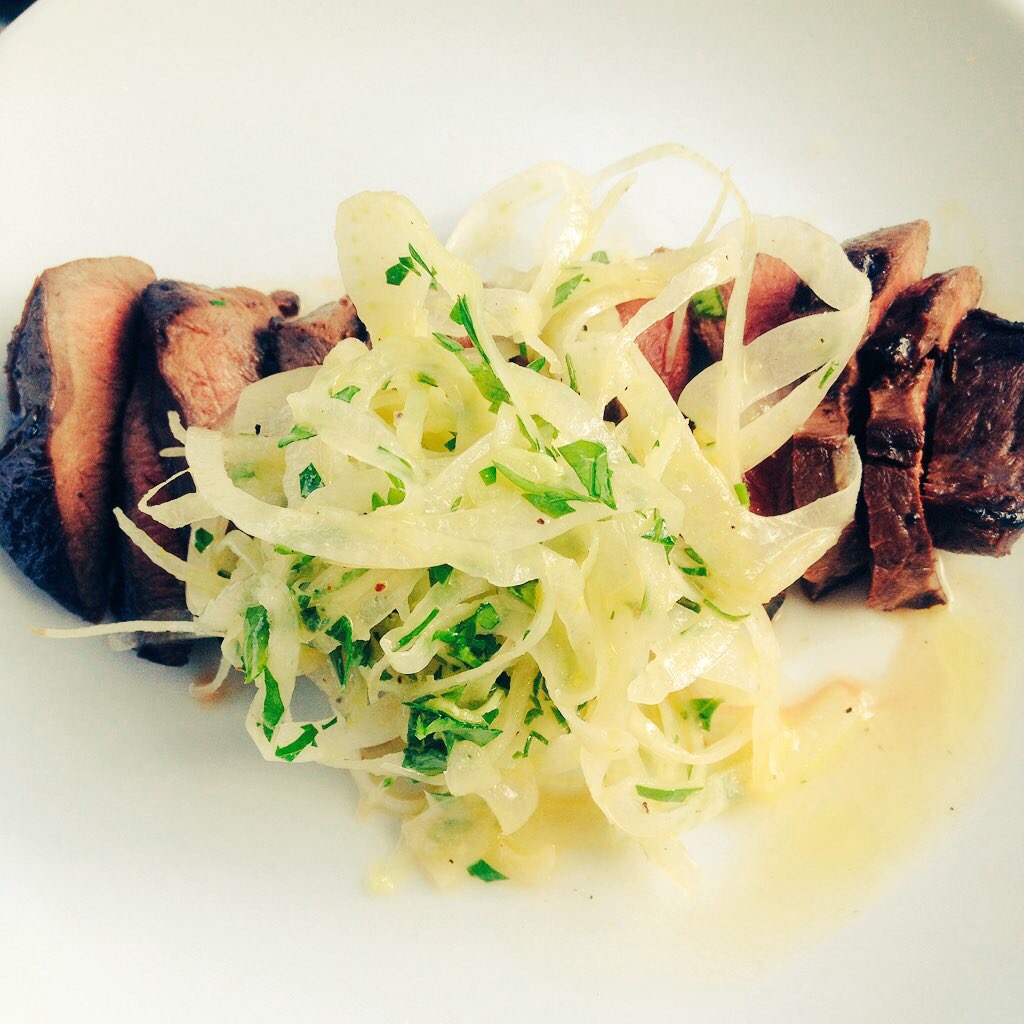
While it rests, shave some fennel and sweet white onion as thinly as your mandolin will allow you, then dress heavily in a lemon vinaigrette and finely chopped parsley. Slice the heart, which should be pink and gently weeping, and serve with a little fennel and onion. This is true love.

Act Natural

I’ve been reading a lot about natural wines recently. This style, as distinct from organic winemaking, which bars chemical intervention in the vineyard, requires a more or less additive-free approach to the brewing process itself, barring added yeasts, sugars, and various other chemicals and techniques which have become standard in the industrial wine trade. While I wouldn’t call myself a fanatical convert – for one thing, I’ve barely tried any natural wines – it’s certainly been interesting to learn about the various practices which are allowed, and frequently used, in even very high-end wine making.

The wine industry, more, perhaps, than any other part of the food industry, is a large, efficient, modernised engine which still masquerades as small-scale, artisanal, somehow, in essence, natural. Much is made of terroir, of vintages, of the vast differences which aspect and soil and wind make to each bottle; but when yeast can be added to practically guarantee a certain body and mouthfeel, when wine can be physically ripped into its component parts to correct levels of sugar, water, alcohol, how much can terroir matter? The various DOP groups exist more to guarantee a certain quality and adherence to a sort of imagined local style than to actually ensure local individualism.

The real triumph, in fact, of modern winemaking – as with industrially brewed beer – has been the slow annihilation of variance from the norm, the sad reliance on weather and air – in other words, quality control. Even bad wines, now, aren’t really bad. They might be bad for you – the high levels of sulphites allowed in industrial wine can cause health problems – and they are certainly bad for the environment, especially in France, where their natural tendency to shoot or poison anything that moves is given free rein in vineyards; then again, they never claim not to be. The assumed ‘natural’ component of winemaking is much more nebulous than that.

Part of the current ‘clean’ ‘natural’ eating movement is a railing against processed foods, which is patently ridiculous. Nearly everything which ensures the continued existence of our species is processed in some way. As yer man (citation needed) found when he tried to live like a chimpanzee, we simply aren’t good enough at chewing to live off raw foods; without cooking and further processing, we would die. Bread, for example, is heavily processed, the base ingredient dried, ground, fermented, and held at various temperatures before consumption; because of this, it is pretty much a complete food, the staff of life, rightly holy to various cultures. The problem with industrially-produced bread is not that it has been processed, but that it has been processed very badly, with little reference to taste or nutrition.

The same could be said of wine, of cured meats, of cheese and of pickles. All of them have undergone a heavy process of industrialisation, resulting in a product which is much worse for you than it should be; but I don’t think that necessarily means the idea of industrialisation is bad. Cheaper, larger scale food production can only be a good thing, right? Maybe not. Maybe it’s inevitable that industrialisation throws out the good parts, the ferment, the yeast, the bacteria; perhaps, though, the success of natural winemakers, of raw-milk cheesemakers, who combine traditional techniques with a scientific understanding entirely born of industrial food processing, points a way for today’s artisans to feed us all.

Cheek to Cheek

One of the best things about moving to coastal Suffolk (and working with a curious, conscientious fish supplier) is the real variety of seafood on offer. Up to last year I’d barely cooked more than mackerel, bass and bream, with the seasonal additions of mussels or sardines; now we regularly use sand soles, gurnard, cod and monkfish cheeks, octopus and clams, thick slices of dogfish or turbot, our own salted hake and ling. Not, of course, that these are all from round these parts – cephalapods might come from Cornwall, salmon from Scotland, while the vast shoals of herring which sustained Lowestoft and Yarmouth have moved on to other waters – but the interest which people have in seafood, and the extent to which it has formed part of the local cuisine, is always evident; there is, for example, a biennial herring festival in Halesworth – a small inland town on a trickle of a river.

People, as I think I’ve mentioned before, make a lot of fuss about cooking fish. The angst of a crispy skin & juicy flesh! Rick Stein, with his hot pokers and his face, only helps to obscure the point, which is that all you have to do to cook fish is cook it – until it’s cooked. Fish skin, like potatoes and totally unlike the muscle of land animals, has the capacity to be taken gently from cold to brown without suffering for it. Do that to a steak and you will have a weeping grey mass – you will be a weeping grey mass; do it to a neatly-trimmed fillet of good, fresh sea bream and you will have a perfectly cooked piece of fish which only needs a brief rest on its cut side before proceeding to the plate, with the added bonus that you can, in the intervening time, see exactly what is happening to that flaked white muscle. I’m repeating myself, however.

Browning seafood without that nice, protective skin, is to be fair, a slightly more difficult proposition – but that’s only to say it’s slightly more difficult than shooting sleepy sea urchins in a wide-topped bucket. In the case, say, of scallops or of cod cheeks, you should put on a frying pan, wide enough to take the seafood in a single layer with about a centimetre in between each piece, and leave it to get extremely hot – slightly hotter than you think is sensible. Make sure each cheeky little nugget is nice and dry. Add some oil, add some coarse sea salt, add the (for the sake of argument) cod cheeks, and then leave them where they are; leave them until they are pretty much cooked through, which you can tell by the pearlescent sheen and beads of moisture which appear on top of the cheeks. Flip each cheek, one by one, then take off the heat and add a spoon of butter. When it stops sizzling, they’re done. See! That was easy. Serve with a salsa verde AND some aioli, if you’re feeling frivolous. Very cold white wine, good bread and butter – dinner.

Invisible City pt. 3


“In Chloe, a great city, the people who move through the streets are all strangers. At each encounter, they imagine a thousand things about one another; meetings which could take place between them, conversations, surprises, caresses, bites. But no-one greets anyone; eyes lock for a second, then dart away” – Calvino, trans. William Weaver

They drink quite a lot, in Venice. In the south of Italy, alcohol seems confined mainly to the aperitivo and the wine with dinner; too hot, too sluggish perhaps to drink your way round the dusty streets of Naples or through the shadows of Palermo, especially filled with spaghetti or the fat doughy pizza of Sicily. The south runs more on their oily thimbles of coffee than anything else.

That’s not to say that Venice is constantly sloshed, awash with binge-drinking gondoliers, fishmongers, restaurateurs, wine merchants, sellers of glass and tat, although the pre-Lenten carnival presumably affords some opportunities for public drunkenness; although (relatively) northern and seafarers to boot, their drinking is restrained in comparison to your Dane, your German, and your Swagbellied Hollander, let alone our own fair nation.

It’s more that Venice affords so many different opportunities for drinking; every hour of the day and of the night seems to have its own particular drink, whether a little shadow of wine, a good, cooling beer, an expansively refreshing spritz or a glass of medicinal bitters. At one or two in the afternoon the bars around the Rialto market are full to bursting; the butchers, the fishermen and the greengrocers have all been up since the very early hours of the morning, and they need a drink.

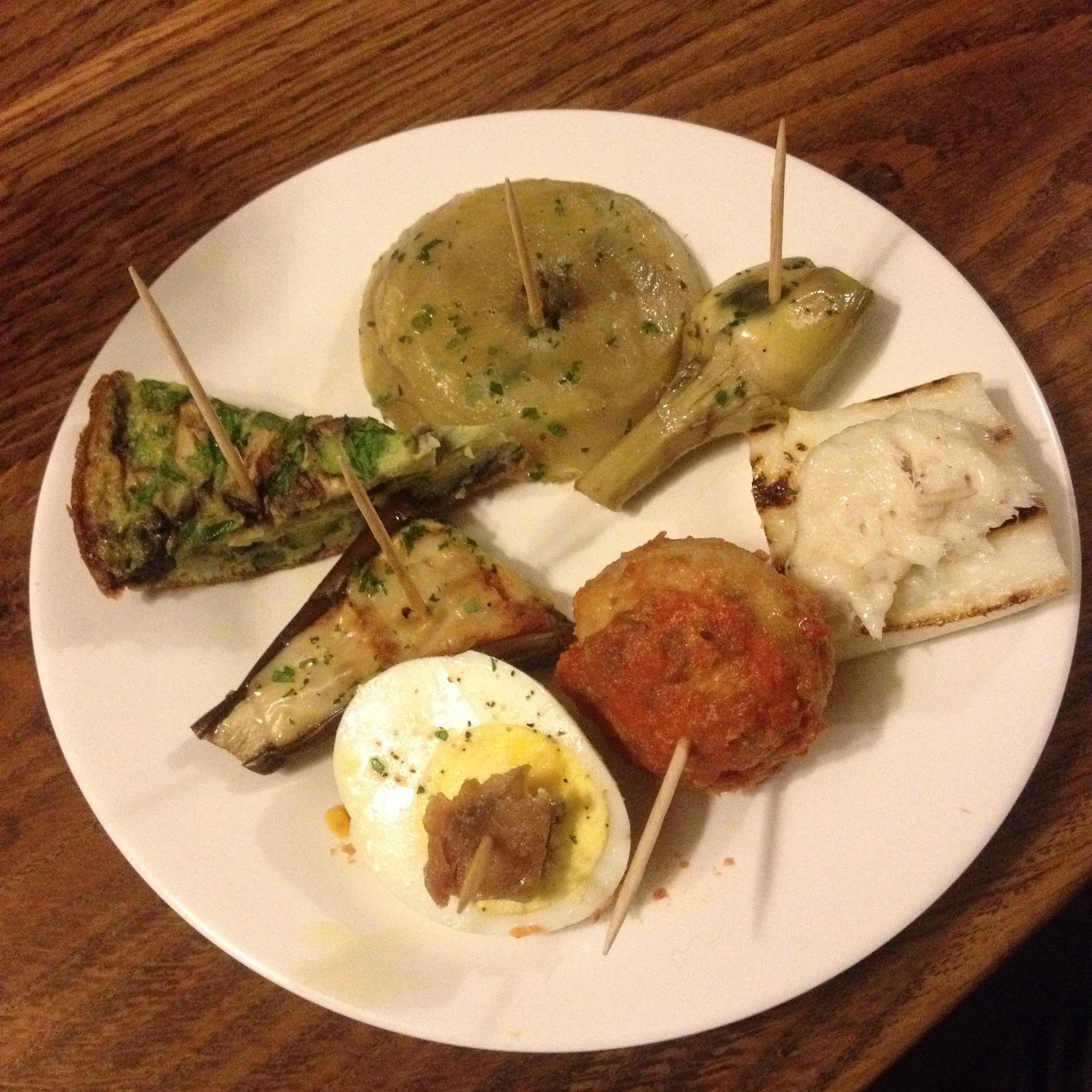
This is good; obviously, it’s good, but it’s especially so because a lot of the best (and certainly some of the best value) food in Venice is found in bars, in the form of cicheti, little snacks on toothpicks or rounds of toasted baguette or, very often, squares of grilled white polenta; more substantially, you might have slices of good, dense sausage or halves of sandwiches, with tuna, egg, creamed radicchio, salami or bresaola stuffed between the cheapest white bread.

You finally see where all those artichokes from the market go; they end up here, trimmed and simply cooked, between the frittata and the crostini, in the glass case on this small bar in this long, narrow room, hung about with pots and lined with barrels and bottles, which contain sweet honeyed whites, inscrutable reds, and, of course, the abundant and quite surprisingly cheap prosecco. Apparently it even comes defizzed.

Although expensive, crowded, prone to flooding, trashy, smelly, labyrinthine and the rest, it is hard not to love a place which revolves so closely around this daily cycle of eating and drinking; where Fernet Branca is an acceptable breakfast food, and where there is always time for a snack and a little glass of something, out of the shade.

Invisible City pt. 2


“When you have arrived at Phyllis, you rejoice in observing all the bridges over the canals, each different from the others: cambered, covered, on pillars, on barges, suspended, with tracery balustrades. And what a variety of windows looks down on the streets … how many kinds of pavement cover the ground” – Calvino, trans. William Weaver
So much of Venice reaches up and away from the water, from the intricate canals and from the lagoon itself. The long needle of the Campanile, and the squares of Paul and the Magdalene, where, if you stand in the middle, you can pretend you are in a solid, everyday city, are the most successful; all of the buildings, though, all of the warehouses and palazzos and the elaborate bridges, do their best to reach away from the seaweed which purrs at their foundations.
These days the canals are reserved for richer tourists, who the gondolas, still black-clad for shadowy assignations and espionage, ferry around a largely forgotten city. The trattorias, with their lace curtains, batteries of hanging pots and their poorly-rendered aquatic scenes, sell endless processions of cuttlefish and calamari, while the still-living markets heave with the terrestrial products of the Veneto, with puntarelle, with radicchios of all kinds – curled, spotted, delicately pink – with honey-sweet apples, large and baby and carved artichokes, cardoons and celery and cauliflowers and all of the other favourites of the vegetable-loving Italians.
Here, though, in the richest part of the country, leaves don’t carry quite the same respectability as they do in the poor, dried-up south; here, the restaurants which offer an alternative to seafood tend to do so in the form of elaborate dishes of meat. These days we tend to think of Italian cuisine as all cucina povera, breadcrumbs and strange fish and offal; liver and onions, of course, is a favourite of Venice, and I saw tripe, tongue and the like in various butchers windows and on the bars of smaller eateries. In a restaurant, though, you might get half a duck, roasted and drenched in a quite astonishingly rich ragu of chicken livers; fricassees of veal, both sweet and deeply savoury; and, of course, the famous carpaccio, a fairly recent invention of the upmarket Harry’s Bar.
Apart from the latter, a distinctly urban dish, this might get described as ‘mountain food’; aware, perhaps, that their amphibious city has become a playground for tourists, the Venetians look inland and up for a different taste of home. Even here, though, they can’t escape the water. If you wander about the houses between the Accademia bridge and the Grand Canal, you might find a strange replica of an Alpine hut, hung about with straw hands and opening on to a boat yard; it is a gondola workshop, and the people who build and pilot them are often, themselves, sons of the Dolomites and beyond, far from their solid mountain homes.

Invisible City pt. 1

“In Esmeralda, city of water, a network of canals and a network of streets span and intersect each other. To go from one place to another you have always the choice between land and boat” – Calvino, trans. William Weaver


Venice, it’s fair to say, is a city mainly composed of bridges and water, a fact emphasised when you enter it, by vaporetta, on a chilly, rainy day in late February, the kind of day when the sky and the water seem composed of the same great sheet of grey. The canals lap at the seaweed-bearded streets; bridges appear out of nowhere, and any alley might lead equally to a church or to the sea. Why anyone chose to build a city there is beyond me, but I suppose they made a good go of it, becoming “excellently amphibious” in response to their waterlogged, sinking surroundings, bringing, for a while, large parts of the Mediterranean under the control of their largely mercantile empire.


I always find it fascinating to trace the history of a place through its cuisine; part of what I love about Sicilian food is the little touches of Arab and Spanish flavour, the faint whispers, even, of Roman and Greek – seemingly un-Italian spicings, sweet fruit and meat, the absolute ubiquity of the anchovy – but apart from the occasional flourish of cinnamon, little seems to remain of La Serenissima’s once-vital place on the spice route. Apart from a few remnants of later occupations – the cream doughnuts and the peculiar Venetian lust for strudel – their cuisine is as amphibious as them, entirely a product of the lagoon and its immediate surrounds; which is to say that they eat a hell of a lot of fish.


Apart from breakfast, which for Venetians means an espresso and a cornetto and for us meant the bountiful purgatory of the Continental buffet, almost every meal we had was largely aquatic. The first night was cuttlefish in sticky ink, thick bigoli pasta in a dense sauce of anchovies, sardines in their beautiful sweet-sour bath, and simply boiled king crab; the next, tiny, toy-like octopus and spaghetti vongole; for lunch, the little soft-shelled local crabs, no bigger than the palm of your hand, which stuff themselves with Parmesan batter in a morbid frenzy before a quick end in hot oil. In between, very often, there was baccala. Although, as far as I can gather, this is made with stockfish rather than salt cod – that is to say, dried without being salted, giving it all the hairy texture without the sometimes overpowering flavour – it shares a lot, in its most common preparation, with the Catalan brandada and the French brandade.


Although all these (and salt cod in general) seem totemically Mediterranean dishes, they are essentially a product of trade, early fusion cuisine. The fish, from cold and teeming northern waters, was salted and dried on cold Scandinavian beaches, in dry Scandinavian winds, travelling almost to the other end of the known world to be revived and mixed with good southern olive oil and cracked eastern pepper – and, for the last few hundred years, served on grilled cakes of ground Mexican corn.


I make my own salt fish (normally with hake or ling, for various reasons) but don’t generally dry it; I’ll give that a go, and work on a recipe for baccala mantecato. In the meantime, look for Russell Norman’s POLPO recipe; or go and eat it at Polpetto, where it is perfect.

Cabbage-head


They’re funny things, brassicas, capable, depending on context, age and variety, of Italian sophistication, Teutonic rigour or gently British irrelevance. Few gourmands would admit to a love of a broccoli and tuna pasta bake; reconfigure that as purple sprouting, orecchiette and bottarga and you have a death-row meal. Although your basic cauliflower is now gaining in popularity over the fractal, reptilian Romanesque, there is still a rigid hierarchy of cabbages, with varieties like hispi, January King, and that flat stuffable one allowed on to menus never sullied by the honest white, mainstay of coleslaw and kebab shops.


The cabbage, plain and dull as it might be, is one of our oldest vegetables, a gift, as with so many other edibles, of the Romans – I don’t know where they got it from. At one time it would have formed almost the entire diet of the European peasant, from Naples to Nottingham; it’s no wonder we have so many varieties. Luckily, the cabbage takes well to inteference and mutation. The cauliflower, as its name suggests, is a sort of artificially fattened cabbage blossom, allowed to let itself go almost to seed, becoming bloated and corpulent; its sleeker, odder cousin is the kohlrabi. This is one of those vegetables rarely seen outside of restaurants, and has never received an English name. In (I think) Dutch, it simply means ‘cabbage-turnip’, but I prefer Cabbage-Head. Vaguely resembling a root, it is in fact a fat, distended cabbage stalk, with only a few waving leaves and tendrils to remind you of its cabbage-hood. It is crisp, sweet and appley, with only a whisper of mustardy brassical heat, excellent raw in slaws, remoulades and pickles – so much so, in fact, that I’ve never cooked with it, and I’m not sure I want to.


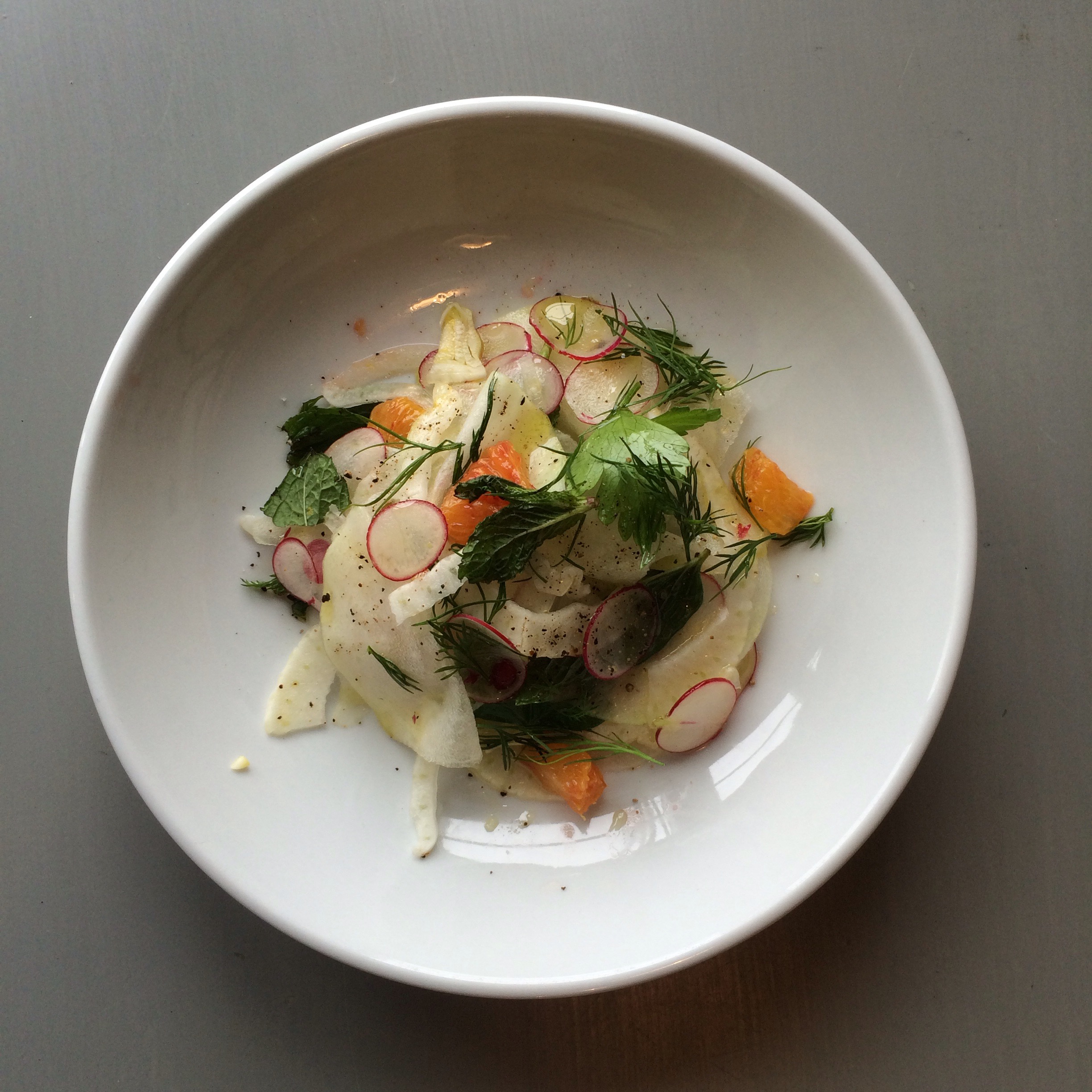
It has a great affinity with aniseed flavours and with fish, and slips well into the sort of fennel-orange-chicory combinations that are your main salad option at this time of year; try finely slicing all of the above, dressing with capers, bitter oil and sweet white vinegar, and serving with crisply seared cod cheeks. Shredded and mixed with scant spoonfuls of aioli, it stands up to thinly sliced raw or cured beef as well as to poached salt ling, flaked through a salad with handfuls of roughly chopped herbs. Lacking these things, or with an abundance of winter vegetables, this mixed pickle is an excellent thing to make. The bitter citrus cuts through the mild funk of fermentation, and the whole thing is like a jar of pale winter sun.


MIXED PICKLE

70 g salt

70 g sugar

a few juniper berries, peppercorns, bay leaves and cloves

1 kohlrabi

2 fat carrots

1 bulb of fennel

4 sticks of celery

1 onion, preferably sweet and white

1 lemon

1 blood orange

3 cloves of garlic


Put the sugar, salt and spices in a pan with 2 L of water and bring to the boil, just to dissolve the salt and sugar. Leave to cool down while you prepare the vegetables.

These can be more or less thinly sliced. I like them shredded, so the whole is more like a spoonable condiment that individual ‘pickles’, but that’s up to you; the lemon and orange should be good and thin, though, whatever else you do. The fermentation will take longer the bigger the pieces are, mind. Pack the veg into a sterilised jar and pour over the brine. Seal and leave somewhere warmish.

In a few days they should start clouding over – this is good. Start tasting soon after, and refrigerate when you’re happy with the pickliness. The lactic sourness should be enough to counteract the bitter lemon.


Carne-val

It is, of course, Pancake Day, Shrove or more pleasingly Fat Tuesday, more romantically Mardi Gras, time for Carnival, carne-val, when we prepare for the month-long renunciation of meat and much else that is the Lenten Fast by stuffing ourselves silly with all of the things that will soon be forbidden – except we don’t, really, because few people – outside, presumably, of monasteries and convents – go the full Catholic hog any more, the asceticism of the Roman tradition having withered along with some of its mystery in the hearty CofE. A Good Catholic Boy I used to work with once told me (I think I’ve got this right) that although most people give up something for Lent, in the ‘modern’ Church it is considered more as an opportunity to take something up, whether a useful and improving hobby or generic good works – like that Good Deed A Day book you had to keep as a Cub Scout, but just for a month.


The Coptic Christians of, chiefly, Ethiopia and Egypt, desert-forged by the tribulations of St Anthony (of Flaubert and Dali fame) keep a calendar which involves fasting of some kind for, I think, around two-thirds of the year; it’s believed that their often meatless diet gave us falafel, fuul medames, and other vegetarian staples of the Middle East. I have no idea what they do for Lent, but I assume it is strict. Although some people of my acquaintance do renounce some little thing for a month – Creme Eggs, takeaway pizzas, casual sex – for most of us happily godless heathens, today is just another day in the slow trundle towards easeful death. If we have a yearly fast, it is the grey feast-weary month of January; personally, I don’t believe in ever giving anything up at all. I still, for example, eat Babybel.


However, it wouldn’t do to throw the baby out with the metaphor, particularly if that baby (bear with me here) is a foodstuff. Today entirely deserves its modern British appellation, lacking though it might the weight and glamour of history; it is the day on which, without guilt or fear of reproach, you can eat pancakes. For DINNER. Recent years have seen the fat American pancake, fluffy with buttermilk and baking powder, make inroads into our breakfast culture; this is ok. Breakfast (or brunch, more accurately) is a time to be frivolous, to have bacon and banana and blueberries on a fat, syrup-soaked drop scone. I have made thousands of these pancakes over the last few years, and I still enjoy eating them; that is high praise. You have all year to eat those, though. Pancake Day is for the eating, at dinner, of crepes. I, for one, have never made a crepe on any other day – though I have been guilty of off-season galettes.


While galettes (especially the buckwheat variety) are good with shredded ham and good strong cheese, crepes should be eaten with lemon and sugar; in this Ed Smith and I are in agreement. As the redoubtable M. de Courchamps noted, even jam is an “affectation”. (Thanks to Bee Wilson for that piece of wisdom). In my younger days I would add to this duo golden syrup; I still might, if I didn’t find the bother of keeping the tin and its surroundings clean to be more trouble than the contents seem worth. As for treacle – pff! There is not world enough, and time – but I suppose that is rather beside the point. No one in their right mind would put treacle on a pancake. If we agree that lemon and sugar – and in small quantities – are the only necessities for crepe-topping, then Pancake Day becomes a very affordable feast, one which could have been achieved with only the store-cupboard ingredients on Ready Steady Cook, leaving you a fiver to buy a Django Reinhardt CD to cook to – essential for the preparation of crepes.


All of this makes the proliferation of those pancake mix kits all the more baffling; there are several brands in my local Spar, from Peppa Pig to retro Americana. Presumably food companies have realised that an unexploited feast-day is lost profit for them, and hastily put a quite astonishing mark-up on homeopathic amounts of cheap, plentiful ingredients; perhaps they’re simply trying to bring the joy of pancakes to households lacking the time or wherewithal to measure things. Assuming you have both of these luxuries, making pancakes is really extremely easy; pancakes of some sort, being an incredibly primitive form of bread, must have been some of our species’ earliest processed foods. I’d take Ed’s advice, above, and use St Delia’s recipe. This is the kind of thing she’s best at. Just remember that the first one is always the worst, that flipping is all in the wrist, and that you’ll eat more than you need but less than you want, and you can’t really go wrong.