Cold Comfort

I’m currently reading Elizabeth David’s Harvest Of The Cold Months, her final and possibly greatest book. Resting on neither recipes nor personal anecdote, those twin crutches of the food writer, it is rather an extensively researched and meticulously detailed social history of both ice and what David rather Enid Blytonly calls ‘ices’, that is, the various and surprisingly ancient attempts by humanity to store up the best of winter’s cold against the dog days to come. It is an odd book, suffused, despite its easy academic tone, with a certain melancholy, an acknowledgement of the mad futility of the ice trade, the dangerous crossings and mountain paths, the expensive landscaping and building of lakes to provide ice and cold, half-buried houses to store it in – and all for what? Cold wine and elaborate desserts for the tables of Nero, the Medicis, the Sun King, the Empire – all for sherbet.

It’s easy, I suppose, to scoff at the decadents of Florence and beyond, with palates so rarefied they require fresh snow to cool their wine; easy, because in the heat of today’s early summer I could get ice from the ice machine, and put it in my drink, if I had needed to; I didn’t, because my drink was in the fridge. What it may lack in terroir, our ice makes up in convenience. Even more conveniently, you don’t even need it to make ice-cream, let alone the quantities of saltpetre which used to be a necessity; ice-cream-makers, with their freezable bucket and simple paddle-and-motor, must stand alongside John Lanchester’s tinned tomatoes (if not the outmoded CD) as one of the unqualified benefits of modern civilisation. Of course, you still have to make a custard, chill it, realise you have forgotten to freeze the bucket, do that, and wait overnight, but once you have done that you have ice-cream in twenty minutes flat – and what ice-cream! If you have always thought ice-cream could do with more booze, you can make that happen – if you have forever longed for Marmite sorbet, then you could, I am sure, try that too. Or you could make this, because it’s delicious.

RYE & BROWN SUGAR ICE-CREAM

750ml full fat milk

200g rye flakes

6 egg yolks (obviously you make almond biscuits with the whites)

150g dark muscovado sugar

about 25oml double cream


Put the flakes in something and pour the milk over them. Leave in the fridge overnight or a little longer. Strain out the soggy flakes, squeezing some milk out but not so hard you get bits of rye. Discard this beige mush.

Beat the yolks and sugar with a pinch of salt. If you have a freestanding mixer, you’ll want to use it for this, because it takes a long time. The mixture should go much paler and at least double in volume. Meanwhile, bring the milk up to boiling point.

If you’ve timed this right, you can pour the just-scalded milk straight over the still-moving egg mixture, and whisk until well incorporated; if not, make sure you don’t let the milk boil over. Either way, return the lot to the pan, and heat very gently, stirring constantly, until it reaches the right thickness. Two guides to this are that it coats the back of a wooden spoon and that it falls in a steady stream from said spoon when lifted out of the pan; really, though, you just get a feel for it. Don’t, whatever happens, let it boil and scramble.

Now, chill overnight or at least until fairly cold, then churn in your ice-cream-maker. Ta-da!


Nothing But Flour

Imagine if there were no more recipes. A provincial lifestyle blogger quietly posts a gluten-free iteration of Southern Fried Chicken, accompanied by her Smashed Cucumber Salsa and Rainbow Slaw, and that is it; the last possible combination of edible ingredients with heat, salt and time. There are no more recipes. The deluge of food related content begins to slowly dry up. The first things to go are the words “my”, “new”, “unique”, from headlines, tweets and titles; the writers know there is nothing unique in their oat cookies, their mixed salads and complex braises – not that there ever was. The adjectives of surprise start to disappear, too; as the rabid hunt for the new dies down, cooks realise that they never wanted dinner to amaze, only to fill and to delight.

As professionals and amateurs alike return to the archives, to their heaps of coffee-table cookbooks, to family recipe collections and to the depths of the Good Food website, to revisit old favourites and to finally try that dish they’d always meant to, the food-writing community is thrown at first into a blind panic. What are they to do without their newness? For a while there are no food pages in the supplements, no blog posts, no stop-motion recipe videos; Ottolenghi weeps into his spice cupboard, for there are no more worlds to conquer. Gradually, though, they recover. If they cannot create, at least they can still cook, interpret, curate; days can be spent exploring the possibilities inherent in a few lines of Elizabeth David, Mrs Beeton or Apicius. The fringe elements of cooking, the bakers, brewers, charcutiers, anyone who has spent months or years perfecting a single technique, come to the fore at last; their patience, long appreciated, is finally celebrated as a love of craft overtakes that of creativity.

This new sensibility, transferred to more everyday cooking, to the slow perfection of pasta, crackling, fried fish or salad, has immediate results; palates widened by a thousand flavour combinations become narrow of focus, gradually attuned to more subtle variations, to salt applied half an hour before or five minutes into cooking, to leaves picked in the heat of the day or by wet moonlight, to different ages of wheat. No-one can master all of these things; as specialisation deepens, meals become communal and sprawling, as everyone contributes the element they do best to the table, which might be cultured butter, pork pies, or a croquembouche. All of these things are equals at the feast, and our food has never been better.

Craft turns into cult, as the special knowledge of each technique – of little interest to anyone else, busy as they are with their own trades – is hardened into mystery, to the secrecy of family and guild; experimentation and perfectionism, at first the lifeblood of what has become known as the New Cooking, is discouraged. Adherence to the rules, to the recipes laid down in the ancient texts and websites, becomes a matter of almost religious discipline. There is clearly a best way to make, say, bread, which is that enshrined in the Book; any deviation is, by definition, inferior, and should be rooted out in case it spoils the palates and the hands of future bakers – so the thinking goes. Understandably, many baulk at this; they are suppressed. Finally, after generations of this, someone dares to tinker. Rebellion builds in their heart until they can take it no more. One day, at Stage Two of The Recipe, they swap the vinegar for lemon juice and capers for finely chopped cornichons; they serve it, against all precedence and logic, with salmon. It is disgusting.

Wild Ferment


Although I’m still learning and experimenting, I’ve done enough fermentation now, I think, to consider myself reasonably experienced, at least when it comes to solid, savoury foods; in the field of fermented drinks, I’m still a complete beginner, at least in my adult life. The first ferment I made, in fact, was Binger Geer from The Weird And Wonderful Cookbook, a comically fizzy and powerfully gingered concoction made first with the help of, and then, as I got bored with the lengthy, repetitive process and realised I didn’t much like the stuff, almost entirely by my dad, himself a keen home brewer. He makes a fine dark ale, and a number of more or less experimental and palatable country wines; the blackberry has, in years past, made an excellent mull for Christmas Eve.

Brewing beer has always seemed like a complex and arcane process to me, requiring large investments of time, skill and equipment, and so, in fact, it is; you can buy one of those can kits and make yourself a batch of indifferent bitter with relative ease, but as you can easily buy indifferent bitter at any supermarket, cornershop or pub, it seems a little pointless. Making anything decent or interesting is hard, and best left to professionals or dedicated hobbyists; making country wines is much easier. This is obvious, when you think about it. With beer, you take a sweet-smelling but fairly unpalatable mash and coax it gently into a complex deliciousness; wine-making lets you start with something delicious and basically leave it alone, your only input being to not cock it up. Moreover, light, gluggable wines are something I generally want to drink, and they’re quite hard to come by in this country. So.

With this in mind, and with the help of Sandor Katz, I thought I’d try making honey wine. Given that honey is basically the tastiest natural thing, this is very easy. You just mix honey with water (1:4) in a bucket and leave it to do its thing; once it’s done that, you put it in a sequence of bottles until you want to drink it. There’s a little more to it than that, but those are the basics. Deciding when you want to drink it – that is, when it is at its best – is the hard part, but since it’s your wine you can sort of decide what its supposed to taste like anyway. There, that was easy, wasn’t it? Even if it goes really wrong, you’ll probably end up with vinegar, and fresh, unpasteurised vinegar is a lovely thing. You can, if you want, use it to make more drinkables, in the form of shrubs or sipping vinegars; or you can pickle things in it, taking the all-my-own-work glow of preserving up a notch. Or you can just use it as vinegar, in dressings and sauces and marinades. Honey wine vinegar is bloody lovely. Next time you find yourself with a lot of something sweet, I urge you – stick in a bucket and wait. You might not be disappointed.

Never Failed Me Yet

Cooking with offal was once truly common sense. You slaughtered Francis (I’ve always wanted a pig called Francis) in the late autumn, and it was not just respectful to his memory but entirely necessary to your own survival that you used every single bit of his fat pink carcass; except for the oink, of course, which had in any case departed when you stuck him. With the help of salt and smoke and many hands, each part would be rendered gradually edible, for today, tomorrow, or for the long winter ahead. Most of us no longer live like this.

Some parts which come under the broad heading of offal are still truly waste; my butcher gives me heads and feet, hearts and scraps for free, as they would only be destined for landfill, and I’m more than happy to take the time and energy to transform these stubborn pieces of meat into something delicious. Others, perhaps, are making the slow transition from unwanted cut to delicacy; a pig only has two cheeks, after all, and if everybody realised how good they were they would be prized higher than fillet, with a price tag to match. Still other bits are so hard to get hold of that their consumption becomes more performative than practical, in which category I’d put blood.

Fresh blood is hard to find, but even in its dried form it is cheap, nutritious and delicious; if we no longer need to use it to thicken or to bind, or just as a handy, sausageable form of protein, it is still worth doing, both – I’ll admit – for the B-movie fun of it and for the elusive, rusty flavour. Perhaps, too, by keeping a taste for it alive, we prepare for a time when its fresh form is not treated as a poison but used and celebrated at its abundant source. This southern Italian recipe would once have been a part of the pig-killing festivities; now, almost black and with a fudgy, spoonable texture, it is simply a delicious thing to eat. You’ll need, I’m afraid, a reliable thermometer.

SANGUINACCIO

Makes six little cups

35g dried pig’s blood

100g lukewarm (blood temperature) water

100g light muscovado sugar

200g dark chocolate, chopped

100g olive oil (a lowish grade is fine)

100g double cream

Whisk the dried blood with the water and a pinch of salt until you have a smooth liquid, rather thicker than water; pinch a drop between your fingertips to check it has all dissolved, then add to all the other ingredients in a heatproof bowl.

Set this over a pan of simmering water, and stir the whole lot together while the sugar dissolves and then the chocolate melts; keep stirring until it reaches 67°C, and then immediately pour into a waiting jug and from there into your six little cups. Put in the fridge for a few hours to set.

Serve, if you like, with candied pine nuts, raisins and orange peel, or with more cream. Ask your diners to guess the secret ingredient, and then await their wrath.

Icumen In


The weather seems to have finally caught up with the calendar, having sensibly skipped April in favour of a rerun of February; the skies are a bright, clear blue, small birds sing in the hedges, hares roam the fields, and greengrocers start to stock local produce other than various and manifold forms of cabbage. God, in short, is in his heaven, and all is right with the world; it is time to sit down and write about asparagus.

Asparagus is green, and while it was once the thing to cook it in bunches to a muted pliability, you are now as likely to find it fried, grilled, or otherwise blackened, wrinkled and intense; that’s all I have to say about asparagus, delicious though it is. I like to serve it with feta blitzed with salted lemon until it goes grainy, separates, and then comes back together into a thick cream, though you might not. If there is any overlap between the seasons (which seem to be longer, for wholesale purposes, than the ones stated in magazines and shops), then a blood orange hollandaise can be a lovely thing. So much for asparagus. There is more to the endless somersault of the seasons than green vegetables.

I made the most of one of the hotter days of the year thus far by cooking four halved pigs’ heads, filling the kitchen with a thick, fatty steam for around five hours, extended to six while I picked the nuggets of meat from the skulls and reduced the resulting liquor, which could probably, if the smell didn’t bother you, be used as hair product, though not on hotter days. As an added bonus, the kitchen temperature (hovering around 20°C) and humidity seems to be ideal for fermentation of various kinds – my honey and rosemary wine is bubbling away merrily, and the usual array of pickles are all doing what they do at a steady pace; summer will soon be here, and with it the heaps of courgettes, tomatoes, herbs, beans and flowers, all needing preserving in their various ways. It’s good to get the practice in now.

If you get bored of pickling things, and bored of plain-ish asparagus, and if the weather drops a bit, a risotto primavera is a nice thing to make; if you get bored of risotto rice, the same thing done with buckwheat grains, quick to cook, nutty and wholesome, can be very good. As ever with spring cooking, lemon is your friend. A recipe? This is no time of year for recipes. You just take what looks good and you cook it, to make it the best it can be; recipes are for the darkening tail of the year. Besides, any recipe would be redundant soon. The broad beans and the peas, the radishes, the lettuces and the soft herbs are filling the air with the bright promise of a late English spring.

Sloppy Thinking


It’s surprising (to me, anyway) how difficult it is to make a luxurious dessert from cocoa powder and pig blood. The problem, I’m convinced, is the powdered blood I’m using, the jars of impossibly fine purple powder which sit on the shelves like something in an alchemist’s workshop; no matter what combination of temperature, hydration and whisking I use to produce a thick, black liquid blood, there always seems to be a slight grainy residue on the back of the tongue – though perhaps this is a residual squeamishness from thoughts of scabs, clots, stains and streaks. Eaten incognito, maybe this blood custard would seem the creamiest of desserts.

It always seems to be this issue of texture – that is to say, of the precise feeling in the mouth – which divides people over certain meats and offal. Take tripe. A beautiful shade of marble-white, the bleached and pre-cooked stomach lining has, once stewed in its usual heavy accompaniments of abundant onion or heavy tomato sauces, little distinct taste of any kind, let alone an offensive one; but the texture! Either rug-hairy or covered in soft, giving spikes, above all rubbery, it can seem like chewing on some chimerical alien’s hide; I find it edible, but I can’t say it’s something I would seek out very often – unless I was in Rome.

We don’t tend, in this country, to particularly value sloppiness – unless it is mitigated by a surrounding crunch. Jellyfish and sea cucumber have never made inroads here, and nor, really, have gelatinous okra, fermented beans, or the slimier of sea vegetables. Put it in a fritter, though, and that’s a different matter! I find simply poached brains, with their creamy, spreadable texture, intriguing if not overwhelmingly enjoyable; but deep-fried brains! Beautiful clouds, with a perfect surrounding crunch. While any sloppy meat – cheek, foot, belly, chest – does well in a croquette or similar situation, nothing matches the absolute transformation of the brain from worthy curiosity to pure, golden joy.

I suppose, really, that this is just a late adolescence of the palate, the start of a parallel journey to the one from chicken nuggets, turkey burgers and fish fingers to un-breaded protein; I need to go back to those spreadable brains, and see if the fritters have taught me their value. I suppose the lesson here is that anything can be made delicious by deep-frying, which we all knew anyway. Apologies for taking up your time. Now, where did I put those rabbit eyes?

With Relish

Despite repeated resolutions to the contrary, I don’t really use cookbooks. I own a lot, and I read them all and often look at the pictures; apart from a select few, covered in cake mix and butter and blood and tomato, which I know and love and trust, I don’t really follow their recipes. I think I do, though. “That sounds nice”, I say to myself on the sofa, “I’ll try making it sometime.” When that time comes, of course, I don’t have the book to hand – and if I did, I wouldn’t have half the ingredients – so I cook from memory, which is to say I make it up. Only after months of cooking a dish do I look back at the book at realise that my recipe has become something entirely other, related to the original book only in the manner of folk songs or language – tangentially, driftingly.

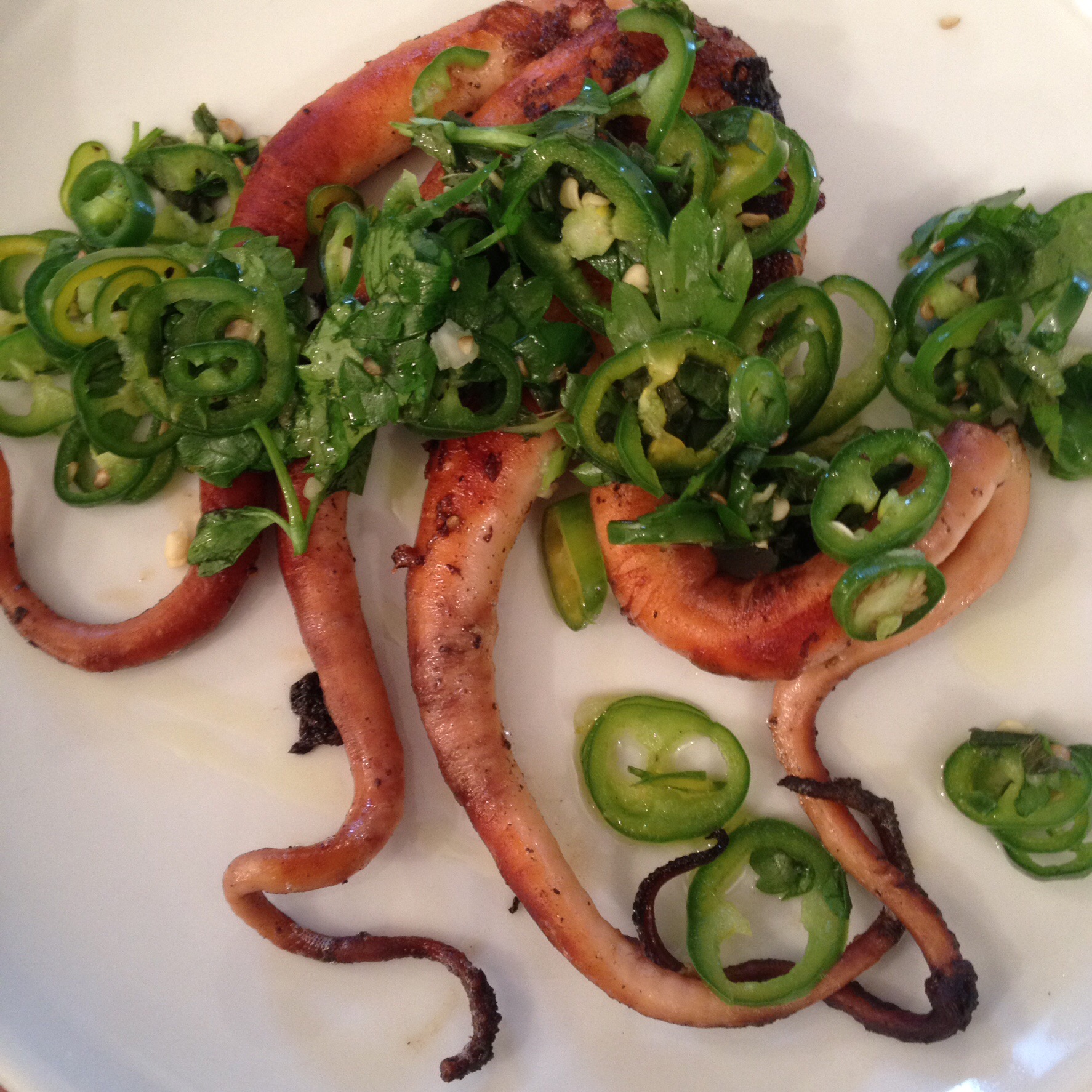
If, sometimes, this can be limiting – it means that you rarely stray outside your own idiom and technical comfort zone – then it can also be liberating. It is certainly convenient; few cookbooks are actually easy and pleasant to use for their intended purpose. Anyway, here is a recipe I remain convinced comes from Diana Henry, despite her original (itself an imagined version of a never-tasted Turkish dish) containing, it turns out, coriander (don’t much care for it) and green olives (totally forgot about them). That, I suppose, is how cooking works. Conveniently, this goes extremely well with octopus.

GREEN CHILLI RELISH

15 green chillies (or a mix of red and green), thinly sliced

6 cloves of garlic, crushed with salt

about a tbsp caster sugar

a slosh of sweet white vinegar

a big handful each of mint and parsley, chopped across a couple of times, to encourage them to join in

Mix together everything except the herbs, scrunching a bit to dissolve the sugar. Add the herbs and toss and scrunch some more. WASH YOUR HANDS. An hour or so hanging around mellows things out, but much longer and it’ll go a bit manky.

Eight Legs Better


 I’m fairly comfortable with my meat-eating, generally speaking. I don’t buy a huge amount, and when I do it’s often game, or odder cuts from well-reared animals; having been vegetarian for 10 years, I’m conscious of the ethical arguments, but feel that informed meat-eating is a better choice than the outright protest of vegetarianism, quite apart from the ecological ramifications of removing the entire meat industry (and I’m conscious there’s a counter-argument to that, thank you). We’re lucky in this country that animal farming is comparatively well-regulated, and that while the horrors of battery farming still continue, its products are easy enough to avoid; if we keep making informed decisions, perhaps it will wither away – although that may be a trifle optimistic.

Fish-eating, in comparison, is a bloody minefield. Although we have the MSC certifications and so forth, the actual state of fish stocks change so frequently and vary so much from sea to sea that the best of intentions often go astray. I get round this by almost never buying fish – something of a copout. At the restaurant we’re lucky in having a small fishmonger (his operation, I mean – he’s of average size) who deals only with dayboats and sustainable sources; he makes the informed choices so we don’t have to, which is good, and means we often use things we might not have otherwise tried, such as sand soles, cuttlefish, and fresh, British octopus.

Now, I don’t have a lot of time for the argument that we shouldn’t eat the more intelligent animals. The intelligence of dogs is, I think, highly overrated, and while I’d happily eat them I don’t think their meat would taste very nice. There’s a reason we don’t generally eat carnivorous mammals. Pigs, while smart, are also quite smart enough to up and leave if they aren’t happy with the situation; there’s a good argument that their ‘domestication’ was something of a reciprocal arrangement in the first place. At any rate, pigs are quite happy to eat their own young if the situation requires it, so I don’t think they’re squeamish about such things. So much for pigs.

The intelligence of the octopus seems of a quite other order. The more I read about them, the more chillingly intelligent they seem. When captured, they refuse to participate in research which could teach us more about them; they escape from their tanks in the dead of night through holes the size of their beak, walking on dry land if necessary to reach their goal; in the wild, they decorate their homes, they use tools, they communicate. They are an intelligent alien life form, and when they rise up out of the sea with their stolen weaponry, I fully expect to be held to account. The problem is, they’re just so tasty. 

Maybe it’s their intelligence that makes them so delicious. Just as pigs are, objectively speaking, the tastiest of animals, so the flesh of the octopus is nicer by far than that of their dumb, brutish cousins the squid and the cuttlefish, really rich and sweet, capable of standing up to the thick, beefy flavours of stifado as well as the subtle astringency of a celery and potato salad. If we don’t get them much here, I think it’s because people are rather afraid of cooking them. There’s all kinds of nonsense about how to tenderise their flesh – beat with a hammer, dry on a clothesline, add corks to the cooking liquor – but the best way to do it is just to stick them in the freezer as soon as you get them, and leave them at least overnight. The violent effect this has on their cells, undesirable in delicate white fish, tenderises them perfectly.

The next day, I normally braise them in oil, wine and herbs before chopping their tentacles and adding to salads, or leaving them whole and blackening on a hot grill; if you clean them properly (brains out, beak off) you can cook them directly in your tomato and purple olive ragu, and so much the better for everyone. Just be prepared for the day when the sea-spiders rise up and come seeking revenge.


I contain multitudes 

The kitchen is alive at the moment. Better than alive; it is thriving. Under the sinks, in a space just high enough for the airlocks, there are two demijohns of bubbling honey-water; on the warm shelf on top of the pass are jars of carrots, asparagus and turnips, each brined with its particular citrus and spice, and murkier pots of peel and trim, ageing into edibility. A bowl of plain water and strong flour teems with fungus and bacteria. Today it smells good and sour, reminiscent of rye and pickle and milk – tomorrow it will smell of yeast, of warmth and buns and baking. In the hot dark, squid entrails slowly change.

We chop and pound dead matter, sow it with salt and starve it of oxygen – and life springs up from these airlocked graves. It’s like bloody Dracula. Maybe the whole coffin-full-of-native-earth thing was to keep him stocked up on the bacteria and fungi which supported his particular microbiome; perhaps a vampire is merely a highly advanced form of pickle. There is certainly something (as they say) of the night about the whole process – if you want to look at it that way. I prefer to see it as a creation myth. Various cultures have given us worlds birthed from the brains of giants, the testicles of elder gods, raven shit and living clay; we create a squawling life from compost and salt – our breath moving over the cabbagey waters.

Chop stalks of kale, broccoli, or kohlrabi; mix in 100g of salt and 50 of sugar to every kilo of vegetable. Squeeze and crush it in, and leave overnight.

Tomorrow, make a paste of green chillies, garlic, spring onion, mint, and fish sauce or seaweed; mix and pound that in, too. Pack into jars, seal tight, and leave for a week. It lives!

Cabbages (and things)

  
Dinner last night, after a weekend of fairly gluttonous feasting, was a nearly meat-free dish of white cabbage wedges, thickly pot-roast on a bed of beans, bacon and leeks; taking around an hour and a half of hands-off cooking, it was reasonably delicious, although it would have been more so if the cabbage had been fermented first. The deep umami flavours of sauerkraut cooked with cured pork are quite extraordinary, something the Poles, the Germans, the Alsatians and indeed the Luxembourgeois know full well.


The week before we had eaten a pot-roast red cabbage, simply browned in lard and then cooked slowly in its own juices; served with stewed apple and a heaping dollop of creme fraiche, it was a revelation, with meaty, giving textures and a real depth of flavour, from charred and peppery to rich, sweet mustard – but what else would you expect from Stephen Harris? The Sportsman head chef’s recipes, which express the elegant precision of his cooking in simple language and accurate instructions, are a great gift to both the lay and the professional cook; almost as great as his grotty, rundown pub by the sea.


One of the reasons Fergus Henderson has become such a towering figure, aside from his revolutionary cooking, his unimprovable restaurants, and his remarkable dress sense, is the work of his acolytes across London and beyond. Justin Gelattly, James Lowe, Claire Ptak, Lee Tiernan; if these were the only cooks to have passed through his kitchen his legacy would be assured. They aren’t, of course. Noble Rot, a dark and odd wine bar in Bloomsbury which approaches, between the colfondo prosecco and the violent espresso, its own particular perfection, has a kitchen headed up by one Paul Weaver, who has done time under both St Fergus and Stephen Harris, who also consults on the menu.


Now, I’m not a restaurant reviewer, and possess neither the patience nor the vocabulary to be one; look elsewhere for a fuller appreciation of this excellent, terse menu, which raises a brasserie menu du jour to a particular, vibrant beauty. I’m still thinking about the Comte tart, warm and quivering, with a custard that offers no resistance to the edge of a fork and a pastry which crumbles in all the right places; of the salad of red chicories and pickled walnuts, sweet and bitter and razor-sharp. It is the sort of thing that you eat in an anonymous station bistro with a glass of rose and dream about for the rest of your life; to have it easily available in West London seems cheating, somehow, but also glorious.