
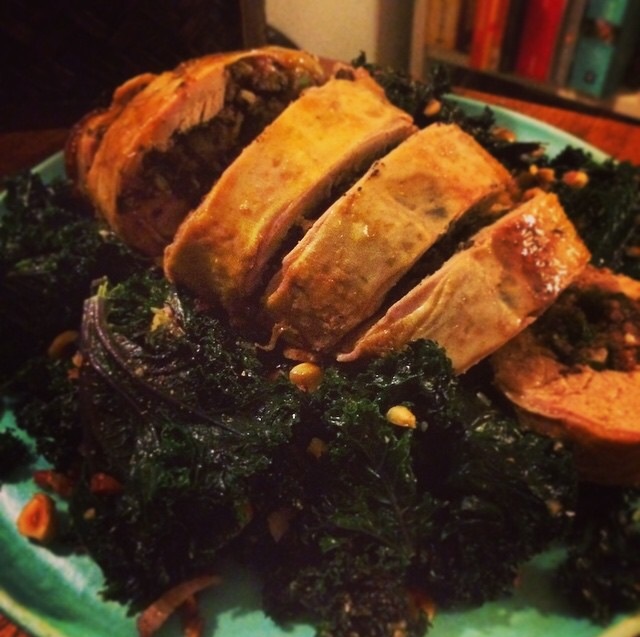
Stuffed

Stuffed Pheasant

Don’t get me wrong, I love hands-on, elbows-on-the-table, sauce-on-the-face eating – wings, ribs, mussels, snails, whole crab, anything that goes well with lots of friends and napkins and beer – but it’s nice occasionally to have something a bit more, well, refined. Something where the hard work, the nuts and bolts and bones, is got out of the way long before dinner, and all you have to do at the table is sit and eat. This is especially true, I think, over Christmas, when you’ve got quite enough to eat without making it any harder for yourself, and when the tradition of carving at the table leads to unwanted scrutiny of your knives and skills.


Carving a bird isn’t the hardest of tasks, but there is something a bit silly about the whole affair; taking off the breasts before you can slice them, utensils wrestling with tasks better suited to hands, and then the whole question of stuffing. If you actually stuff the bird with it, it plays havoc with the cooking time, and of course you have to get it out again; if you don’t, well then it isn’t really stuffing, is it? Drastic as it may seem, de-boning the whole bird is really the best solution to all of these problems. To carve, you simply slice across, and the flesh becomes, really, a wrap for the stuffing, which after all is usually the best bit.


Against this, of course, is the work of actually boning the damn thing. Well, you could always ask your butcher to do it (I’d give him a little advance notice, though). Or you could (as I did) learn how to do it from this excellent video. It isn’t that hard, although it certainly isn’t quite as easy as he makes it look. Or, of course, you might already know how to do it! It’s incredibly satisfying, anyway. Here’s what I did with mine.


PHEASANT WITH BLACK PUDDING AND CITRUS STUFFING

serves 2, festively, or more in leaner times.

STAGE 1

1 pheasant, fully boned (keep the bones)

1 leek

1 fat carrot

1 onion

2 cloves of garlic

bay leaves

peppercorns

juniper berries

Roast the pheasant carcass in a hot oven, then make a stock with it and the rest of the ingredients, covered with water. It’ll need a good 2-3 hours of simmering. You could pop the pheasant in brine overnight, too.

STAGE 2

1 rasher of streaky bacon, finely chopped

1 small onion, finely diced

2 cloves of garlic, finely sliced

2 good chunks of black pudding (about 100-150g)

a small handful of parsley, chopped

a small handful of dried breadcrumbs

1/2 tsp allspice

a grating of nutmeg

1 tbspn chopped candied citrus peel

1 small egg

lard, salt and pepper

Sweat the bacon, onion and garlic in a dollop of lard until soft and clear. Crumble in the black pudding, then stir through the rest of the ingredients. Season. When cooled slightly, beat the egg lightly and mix that in too.

STAGE 3

the pheasant

the stuffing

the stock

1 leek, sliced into chunks and washed

1 carrot, peeled and sliced into chunks

1 onion, peeled and sliced into chunks

5 rashers of streaky bacon

another onion, finely diced

1 tbspn flour

a little mustard, redcurrant jelly, and/or booze, as you will

lard, salt and pepper

string

Get the oven to Gas Mark 4/180C/350F. Lay your pheasant, skin side down, on a board or counter. If not brined, season enthusiastically. Rearrange any ragged bits of meat so there’s a good, even layer, then spoon over the stuffing. Spread it out, leaving a slight border, and work some right down into his trousers. When happy with your work, begin the reconstructive surgery. Fold over one side into the middle, and then the other, overlapping the skin slightly. Turn over onto the seam, cross the legs at a jaunty angle, and tie, again as shown here; finally, lay the rashers of bacon across the breast, then get his bed ready.

Melt a little lard in an appropriately sized (ie small) roasting tin, then toss in the vegetable chunks, making sure they get a good coating. Place your handsome pheasant sausage in the middle of this, then roast in the oven for about 45 minutes. As ever, you’re after clear juices and crispy bacon. Remove from the oven, remove the bacon, and wrap the bird up to rest. While this happens, make the gravy.

Sweat the onion in a little more lard, then stir in the flour, cook until it smells vaguely of biscuits, and add whichever of mustard, jelly and booze you see fit (I used all three). Gradually add the pheasant stock, stirring slightly manically, and simmer until thickened nicely. How much stock, and how much further liquid you add, depends on how you like your gravy. Pour in the vegetables and juices from the roasting tray too, and simmer some more. Strain into a jug.

Serve, sliced thickly, with the gravy, greens, perhaps tossed with hazelnuts and mustard dressing, and some sort of potato. As for the bacon, you could chop it and add to the greens, or just have as a treat on the side. Or eat it, while making the gravy, and pretend it never existed.


Give Us This Day

I mentioned last month that I had been getting into baking, particularly sourdough baking, with the qualification that I was pretty new to the whole game – I didn’t, then, feel qualified to offer up any kind of recipe, as all I’d been doing was following other people’s. Well, I’ve made quite a bit of bread since then, with varying degrees of success, and have hit upon a method which seems to work for me. I am in no way claiming this as ‘my’ recipe – I have strong feelings about that sort of claim – but rather a set of minor variations and techniques, suited to my own particular cirmcumstances. It is basically the (handmade, home-baking) techniques of Dan Lepard applied to the (professional standard) recipe of Justin Gellatly.

A few disclaimers – yes, you will need your own sourdough starter, and no, I am not going to tell you how to make it; it is time-consuming, but easy, and you can find a recipe online. Once you’ve done that, the bread still takes two days to make, and probably doesn’t work out much cheaper (certainly not if you value your time) than buying it. That’s not really the point, though. It is deeply satisfying, and freshly-baked sourdough is incredibly delicious. With all that in mind, I find it odd how many baking recipes insist on electric mixers, proving baskets, and so forth – the whole thing’s intimidating enough as it is. Other than the starter, this recipe requires nothing more specialist than your hands and some bowls.

I know all the resting seems like a pain in the arse, but it does make everything much easier. This is a recipe for a lazy, pottering day at home.


SOURDOUGH

400g strong white flour

50g strong brown flour

50g rye flour (this mix, as used by Gellatly, gives a great taste, and a satisfying, workable texture to the dough.)

200g sourdough starter

2 big, multi-fingered pinches of salt

300ml water

a little sprinkle of polenta

a splash of oil

extra flour of some kind, for sprinkling

In a bowl, mix together the flours, starter, and water, then stir in the salt until well combined. Oil your work surface; oil your hands, and with them, oil the surface of the dough, which will be quite wet. Turn it out onto the oiled surface, and knead briefly, in ten fluid movements. Oil the bowl and scrape the dough back in. Leave it to rest for ten minutes. Repeat this knead and rest twice more. It should now be fairly pliable and dry.

Now wash, dry and flour your work surface; turn the dough out onto it, lightly flour, then pat out into a rectangle. Fold the top third of this towards you, and the bottom third over that, like a letter. Do the same lengthways, left-hand third over, and right-hand third over that. Flip over, onto the fold, dust with flour, and cover. Leave for an hour. Repeat this for the next three hours.

This process, tedious as it may seem, it what starts the process of fermentation and rising in your loaf. Don’t try to rush it, don’t try and kick-start it by putting it somewhere warm. Sourdough yeast is not the same as commercial yeast, and won’t be hurried along. At the end of the three hours, take a sharp knife and make a deep slash in the unfolded side of the dough – you should see lots of little bubbles within it, like a Wispa. If not, leave for half an hour or so and try again.

When happy with the bubbles, roll your dough into a nice tight ball. Heavily flour a tea towel, then use it to line a nice deep bowl, a bit bigger than the dough. This is your proving basket. Place the ball of dough in it, fold over the rest of the tea towel, and put in the fridge overnight. Yes, overnight. I told you it won’t be rushed.

Next morning, take it out of the fridge, reshape into a ball, and put back in the bowl. Leave at room temperature until roughly doubled in size. This will take at least 3-4 hours, but at least you can get on with something else now. When you’re sure it’s ready (I can never remember how big the damn thing was in the first place; I had to start measuring it against the bowl), preheat the oven to Gas 7/220C/425F. Hot, basically. Sprinkle a tray with polenta, turn the loaf out onto it, and neatly slash the top in a circle or square. THIS IS NOT JUST FOR DECORATION. It will rise weirdly, and won’t have that distinct, chewy crust, if you forget to slash it. Use a good, sharp knife, and cut like you mean it.

Open the oven, put in the tray, and splash or spray a little water on the oven floor, closing the door immediately. This, again, is for the crust. Bake for half an hour, then take off the tray, put directly on the oven shelf, and bake for ten minutes more. Turn it down a little if it’s colouring too much. Tap the bottom of the loaf; if it sounds hollow, it’s ready. Cool at least slightly on a rack before devouring.

Bake Against The Dying Of The Light

10402798_10152785373432559_2727655711948833627_nI meant to write a post about autumn. Something about the wonderful, crackling transience of it, about the brief period of crisp, bright days, and, of course, about the food, fungi and wet nuts, the first of the year’s game, the last of the summer in hedgerow berries, orchard and stone fruits – the way it seems to be the most British of seasons, not having to borrow from other cuisines the way we do in summer, but able to fully express our ingredients and our heritage. Well, I missed autumn. It seems to have lasted about a week between Indian summer and early-onset winter.

The thing about our autumn is that it is really itself. We don’t really have an idealised autumn to hold it up against, the way we do with summer (Cornwall, the south of France, wherever) and winter (Christmas stories, the Alps). Is it dry and clear? Beautiful. Is it rainy? Good! All the better for splashing in the mud. Winter, on the other hand, rarely matches up to our desires. It’s never really that cold, and even decent snowfall soon turns into filthy slush. We want to sit huddled up with hot cocoa, scarves and mittens, and various arrangements of potato, meat and cheese, but that hardly seems justified when it’s 10 above freezing and drizzling.

As such, we don’t really have winter food as a distinct entity. We have the late autumn repetoire of soups and stews, and then we have the month-long tyranny of Christmas, which infects every meal in December. Even a quick supermarket sandwich becomes an opportunity to eat turkey, stuffing, and some cranberry-related concoction. There are two things wrong with this. Firstly, turkey and cranberry are vile, unless prepared very carefully indeed; secondly, Christmas is supposed to be a celebration, a feast. No wonder people complain about Christmas Day, about the endless tedium of the family meal – they’ve already experienced the most important part of it, watered down and adulterated, about 20 times, at drunken office parties, in petrol stations, pubs, Pret a Manger. I’m not saying that we shouldn’t celebrate at Christmas, but do we have to do it for so long?

What we need is a new winter festival, one that hasn’t been corrupted by Americanism, commercialism, and Pret a Manger, a new way to rage against the dying of the light and bring back the setting sun. For much of European peasant history, the big event of the winter has been the pig-killing festival, the whole village coming together to slaughter and to create, curing and salting and hanging meat to see them through the dark days. I appreciate that most people don’t have a pig to slaughter; still, perhaps we could nod to the toils of our ancestors, and make black pudding. Besides being delicious, it is ridiculously cheap, although you’ll need a couple of specialist ingredients. This recipe is adapted from the excellent Nose To Tail iteration, and makes a flat, Yorkshire-style loaf.

BLACK PUDDING

Buy dried blood off the internet (here is good); you’ll have to ask a butcher for back fat. I got mine free, but we’re good pals. It shouldn’t be expensive, anyway. I guess you could use fat snipped off back bacon? Mr Henderson suggests salted lardo if you can’t find raw fat.

Serves 8-10

1 spanish onion, finely chopped

6 cloves of garlic, finely chopped

A chunk of lard

A small bunch of sage, finely chopped

Half a nutmeg, grated

1 tsp allspice

150g dried pig blood

150g fine polenta

250g back fat, chopped into little cubes

salt and pepper

Preheat the oven to Gas Mark 3, and line a loaf tin with clingfilm.

Melt the lard in a big pan, then sweat the onion and garlic until soft and translucent. Meanwhile, whisk the dried blood into a litre of blood-temperature water. When the onion is done, tip in the sage and spices, cook out for a minute, then add the polenta and blood. Turn the heat right down, and cook, stirring, until it starts to congeal and thicken. Blood is very like eggs, so imagine a custard. You don’t want it to set yet. Taste (this is gross, more because of the raw polenta than the semi-cooked blood), and season appropriately. It wants a surprising amount of salt, and a free hand with the pepper.

Take off the heat and stir in the back fat – you want it evenly spread through the bloody porridge. Pour into your loaf tin, which you cover with foil and place, on a folded tea towel, in a good deep oven tray. Pour boiling water to just under the lip of the tin, then carefully slide into the oven. Back for about 1 and a half to 2 hours, until a knife comes out cleanish, then leave to set overnight.

To eat, slice appropriately, and fry or bake until hot and crispy. Serve, perhaps, with black badger peas and black kale, on the shortest day of the year.

Sour Soup

The thing about being a chef is never having any free time. A normal working day is at least 13 hours long, not including the necessary wind down into drunkenness after a busy service; days off are spent either catching up on normal life (shopping, laundry, friendships) or else in full recovery mode. This is tolerated because of the mix of monomania and bloody-minded machismo that fuels most kitchens. The majority of chefs are either totally obsessed with food, to the exclusion of all other interests, or else in love with the camaraderie that comes from working long hours in close proximity, masochistically driven to work harder, longer, better. Or both.


The problem, for me, was that working full time in a kitchen didn’t give me the chance to indulge my love of food. Don’t get me wrong, I loved it – I contributed to the menu, and had carte blanche when it came to specials, so it’s not like I was ‘creatively stifled’- but the pace and demands of a busy kitchen meant I had no time to try longer projects. I was getting more interested in older, slower processes, in pickling and fermentation and salting and curing, and there was no way I could do that. I couldn’t start making something that would be ready in 5 days, a week, 2 months – it was busy now!


Unsurprisingly, then, when I quit to concentrate on freelance catering and popups, I got into preserving straight away. I’ve written before about pickling, and I’ve done a fair bit of smoking and salting, but the most satisfying thing for me has been cultivating a sourdough mother. I’ve always wanted to do this since reading about the psychotic baker Adam in Anthony Bourdain’s Kitchen Confidential,(“Feed the bitch! Feed the bitch or she’ll die!”) and even more since reading the St John and Justin Gellatly cookbooks, but it always seemed too complicated and time-consuming. Well, I’ve got loads of time now, and it turns out to be not that complicated at all. You just have to treat it like a little pet.


I’m not going to go through the actual process of creating the mother – I just followed Gellatly’s recipe, swapping grapes for the rhubarb and adding a little live yoghurt – nor give any recipes for bread, as I can’t pretend to be anything other than an enthusiastic amateur. I will, however, give you an answer to the question “what else can I do with this weird pet bacterial culture?” It’s a good question. It takes quite a lot of motivation and time to make sourdough every day. You can leave your mother in the fridge to go dormant, but that seems a little dull. Luckily, a Pole of my acquaintance pointed me in the direction of this rather odd soup.


ZUREK (SOUR RYE SOUP)

This is weird, and needs judicious seasoning. If you like the tangy taste of rye bread, though, this is delicious, warm and filling. Serves four.

You’ll need to feed your starter some rye flour the day before.

VEGETABLE BROTH

2 onions, diced

2 sticks of celery, sliced

2 carrots, quartered

2 cloves of garlic, peeled

a few juniper berries

a few peppercorns

a few bay leaves

Put everything in a pan, and cover with water (a litre or thereabouts). Bring to the boil, and simmer for about an hour. Strain and discard the vegetables, which have done their job.

SOUP

About 150g sourdough starter

the broth

2 tbpsn of chopped fresh marjoram or oregano, or 1 of dried

A big dollop of sour cream

extras

Just whisk the starter into the broth while heating gently, until it comes to a nice simmer. Leave it for about 5 minutes, then add the herbs and your extras. This being Polish food, these should definitely include some sausage – raw smoked sausage, sliced and then boiled in the soup, ideally, although I used Mattessons smoked sausage (sorry, all Poles) – and maybe some bacon too. Any sort of cured pig, in fact, would be good, a savoury hit to counteract the sourness. Hard-boiled eggs and diced boiled potatoes are usual, I think, although the soup is already quite heavy. Greens, cabbage, some parsley, whatever. When you’re done, stir in the sour cream, heat, but DON’T BOIL AGAIN. It’ll split. Season well with salt and plenty of pepper. Serve with beer, pickles, and rye bread.

His Mother’s Milk

A return visit to Istanbul. There is so much – too much – to be said about the food there, about the glorious collision of Ottoman and Arab, the creeping influences of Eastern Europe and India, its place on the spice route that has gifted it with saffron, pepper, aromats and unguents, the love of produce, of fish still twisted with rigour, gigantic, ruddy tomatoes, organ and muscle and milk. There is so much that I am not going to attempt to say it, at least not now.

Much easier to lump that varied cuisine into a few, very broad and simplistic categories. Firstly, you have the fish restaurants. Some are great, some are awful, most are much of a muchness – a selection of mezze to start, salads, grilled and fried fish, chips. Like I said, these are all pretty similar, at least on first inspection – it’s only when you start looking more closely – the exact selection of mezze, for example, the precise doneness of the fish – that they start to reveal their differences. Something for another time, perhaps.

Secondly – and this is a huge and varied category – you have the street food. Kebabs, yes – including ones we would recognise as doner or shish, but also the glorious, gravy-soaked tantuni, the fat-and-sweetbread-sausage called kokoreç – but also pilafs, potatoes, dubious molluscs, crisp flatbreads topped with lamb… you could wander the city all day, with a different snack every hour.

These foods, though – from restaurant or street – are not the food of Turkey. They are very much a product of Istanbul, of a dining and a drinking culture on the one hand, and of graft and city grind on the other. The food elsewhere in the country – as represented by a few restaurants – is relaxed, more varied and expansive, more redolent of home cooking than the fill-up-and-fuck-off haste of city cuisine. The undisputed king of these Istanbul restaurants is Çiya, in the heart of Kadikoy. As much an anthropological and historical project as an eatery, this restaurant – or restaurants, rather, with a few branches on the same street – serves an eclectic and ever-changing selection of mezze and main courses from all across Turkey, as well from Syria, Armenia, and other related cultures.

We had a pickled, twiggy sea vegetable there, stuffed lamb intestine, a yoghurty celeriac dish that seemed a distant cousin to remoulade; salads of purple herbs and soft white cheese, a heavy paste of beans and dill; and rich, long cooked meat dishes of beef and quince. This dish, though, is one that really stuck in my mind, as it seemed so un-Turkish. Apart from the typical Middle Eastern combination of lamb and yoghurt (which seems to have been concocted just to annoy the Jews, if the Lebanese dish ‘His Mother’s Milk’ is anything to go by) the flavours seem Northern, comforting and hearty – although with that light, green freshness that is typical of Turkish food.

SAKIRIYE

This recipe is as close as I could come at home; I think the original had vegetables not readily found over here. Enough for 4, with rice and bread and salad.

LAMB
1 breast of lamb, boned
1 onion, halved
2 cloves of garlic
1 red chilli

SAUCE
500g yoghurt – ideally live, which’ll be really tangy. If not, squeeze in some lemon at the end
1 tbspn cornflour
1 leek, halved, sliced, and washed
a handful of chard stalks, chopped (you could have the leaves on the side, blanched and dressed)
4 cloves of garlic, peeled but left whole
2 tspn dried mint
olive oil
salt and pepper
pepper flakes, sumac, and fresh parsley, to garnish

Cook the lamb first. You could use other stewing cuts, diced, but breast is what I got. Place in a casserole with the vegetables, cover with water, season and bring to the boil. Cover and put in a gentle oven for a couple of hours until really tender.

For the sauce, you first need to temper the yoghurt. This is easier than it might sound – although I must admit I cocked it up the first time. All you are doing is stabilising it so the emulsion of fat and liquid doesn’t split when heated. First put the yoghurt in a large bowl, and really beat it until it loses its structure and liquifies. Then mix the cornflour to a paste with cold water, and beat than in too. Really make sure it’s mixed.

Scrape into a pan, and bring to a boil, stirring constantly – in one direction only, apparently, though I haven’t tested this. As soon as it starts to putter, turn it right down and simmer gently, stirring now and then, for 5 minutes or so, until it thickens nicely. I don’t know if it’s saveable when split; try not to let that happen. Just don’t let it get too hot. Thus nurtured, the yoghurt will last for a day or so in the fridge and will be able to handle a certain amount of cooking.

Ok. Sweat down the vegetables in a little oil – you want some structure, not a stewy mush – and then add the mint. When the lamb is ready, add this too, and stir in, letting everyone get acquainted, and encouraging the meat to break down further. Add your stable yoghurt, bring to the boil and let it all simmer, stirring some more, for around 15 minutes. Season liberally and garnish with spices and herbs.

There you are – fresh, comforting, filling.

Sherry Baby

I love cooking with sherry – the rich, raisiny stuff, not your gran’s Bristol Cream – and keep a bottle of Pedro Ximinez by the stove, adding a slosh to braises, sautés, or anywhere a drop of wine would be welcome. It goes really well in a beef stew, giving it a sweet, light note that blends well with orange peel and cinnamon, a nice change from the heavy peals of red wine, rosemary and juniper that dominate winter food.

It sits very happily with cheese, and I imagine a splash would be welcome in a fondue, or a plain old cheese sauce, taking the place of beer in a rarebit; it has a smooth roundness that gives body and depth to other ingredients, without the need to cook out the tannins or acid you get with wine, which makes it particularly useful in quick sautés and sauces. This body and quick cooking makes it an especially good partner for offal; sherry can oppose and sweeten the metallic tones of liver and kidneys, which red wine would have bullyingly sided with.

SPICED CHICKEN LIVERS
This method, of quick searing and a brief simmer, is a very good way to cook offal generally – it keeps it moist and pink, and allows you to introduce a variety of other flavours. Just change up the herbs and spices, and maybe add a dash of cream at the end, for different dishes.

For 2, with salad, or more with rice or whatever

400g of chicken livers, washed and trimmed
1 small onion, sliced
a good pinch each of red pepper flakes, urfa flakes, sumac, dried mint, and dried thyme
a slosh of PX
3 tbspn of pomegranate ketchup, or two of a good tomato ketchup and one of pomegranate molasses
a handful of chopped flatleaf parsley
oil
salt & pepper

Cook the onion to a slow sweetness in a little oil, then add the herbs and spices and cook for a minute. Set aside.

Whack the heat right up, add some more oil, and when it’s smoking hot, sear the livers, in batches if necessary, for a few minutes each side, until nicely browned. Season them with salt as you go.

Return all the livers to the pan, if you cooked them in batches, then add the sherry, letting it bubble away as you scrape all the crusty bits from the pan into it. Add the ketchup/molasses and a splash of water and simmer for two minutes or until the livers feel nicely giving. They should be blushing pink inside. Chuck in the parsley and some pepper and stir. Not a particularly pretty dish, but a deeply satisfying one.

I, Me, Mine

I got really annoyed at something I saw on Instagram earlier. (Not the most auspicious start to a blog post, I know). Someone I follow – who shall remain nameless – was preparing dishes from her cookbook, and posting a picture of each with the caption “my” salad or stew or whatever. I’ve always found this particular construction (often used on food programs) annoying, but I’ve never really thought about it before. Here, though, as the cook in question is mainly known for iterations of traditional Persian and Turkish food, it was particularly grating. When she posted a picture of “her” Turkish Gavurdagi salad, I wanted to shout at my screen. “It’s not YOURS! It belongs to a centuries-old tradition which you aren’t even part of, and you haven’t altered it in any way!”

Instead of shouting at my iPhone, or posting abusive comments, I thought I’d write about it here. The whole idea of ownership of recipes is a vexed question. You can’t copyright anything except the exact form of words used in a cookbook or whatever, and even innovative processes, which I guess could be patented, never seem to be. The result of this is that any any gastropub that fancies it can do Heston’s triple-cooked chips – surely a good thing – while this same hypothetical eatery can also make a hash of Adria’s foams. Swings and roundabouts. Recipes move around, are handed down to acolytes who then open their own place, they are altered and watered down and commercialised – good techniques and flavour combinations stick around because they work, and may have been ‘invented’ more or less simultaneously by a few different people. Accusing someone of stealing your idea for salmon and licquorice is like saying “this combination is so disgusting you would never have thought of it yourself”. It’s not polite to rip off a whole dish, but apart from that it’s pretty much a free-for-all. Everyone’ll know if menu items aren’t original anyhow.

The odd thing, in the light of all of this, is that people are so obsessed with the idea of personal creativity, the Romantic conception of the inspired artist, and of the chef as a creator in that tradition. It’s not that long ago that being a great cook would have simply involved a careful mastery of Escoffier, with maybe a couple of daring creations that became your signature dishes. Now every ‘food personality’ (with a few venerable exceptions like Locatelli and Roden, who deal in tradition) is expected to churn out book after book of new, exciting recipes; every bloody pub has to have its own take on the burger, or on sausage and mash… Of course, this is maybe preferable to total stagnation, but it’s ridiculous that everyone who wants to cook must become an artiste; there’s nothing wrong with following a tradition with the great skill of a craftsman. That’s why French bistros are so good. You can just get a steak tartare or some onion soup that hasn’t been dicked around with by someone who thinks he’s better than hundreds of years of tradition.

That’s the point really. No-one, except maybe people like Blumenthal, Adria, Redzepi, is creating genuinely original food. There are only so many preparations, so many ways of combining ingredients with heat and making them edible. Pretty much any dish you can make is just a version of something else. Someone like Ottolenghi, who personifies daring originality to the boho middle classes, pretty much just takes a traditional recipe, whacks on a cheese you’ve never heard of and a couple of garish spices, and makes it new. And there’s NOTHING WRONG with that. His food is delicious, respectful but fresh, interesting. So, second-rung supper-club chefs, stop banging on about “my” this and that. Be proud of the generations of cooks who have made your dish before.

“MY” GREEK SALAD
I’m not going to give quantities. I don’t know how much salad you want to eat.

cucumber, quartered lengthways and then chopped
tomatoes, cut in the same size chunks as your cucumber
red onion, sliced in thin half-moons
dried oregano, none of that fresh stuff
feta and olives are optional as far as I’m concerned. The latter kalamata, halved and pitted, if you want, the former cut in a slab and stuck on top rather than crumbled into the salad.
Maldon salt
pepper
red wine vinegar
good olive oil.

Put the tomato and onion into a bowl, and sprinkle with a pinch of salt. Mix gently with your hands, and leave for ten minutes or so. This will soften and mellow the onion, and draw out some of the juices of the tomato, which will form part of the dressing, and is my sole original contribution to this recipe.

Add the cucumber (and the olives, if using), a pinch of oregano and pepper, a splash of vinegar and a slosh of oil (a slosh is larger than a splash). Stick the optional feta on top. Sprinkle with more oregano.

Kimchi?

I’m hesitant about posting this recipe, as it is really something I should disapprove of. I’ve written before about my dislike of ill-considered fusion food, the lack of respect for ingredient or tradition that it implies, but that is exactly what this is – a gleeful mishmash of the technique of one culture (Korean) with the ingredients of another (Turkish), the end result unrecognisable as being from either. I’d like to think this is partly justified by the Turkish love of pickles, if not exactly in this form, or at least by the deliciousness of the end result. Maybe I’m just a hypocrite, though.

This is a little more involved than the basic pickle recipe I posted before, though not by much, and although the hands-on process is spread over two days, both stages are quick and simple. It also lasts a while once it’s been made, and continues to improve up to a point – although traditionally kept for months or years, you should probably eat it within 2 or 3 weeks to be on the safe side. As with anything like this, sterilise your equipment, which is easier than it sounds – wash utensils and bowls really well, and either boil your jars on the hob, wash well and then dry in a low oven, or just stick them through the dishwasher.

TURKISH CELERY PICKLE
Apologies for the specialist ingredients. If you don’t have a Turkish grocer’s nearby, some large Tescos sell them.

makes 1 litre jar

DAY 1
600g of celery (1 large head), sliced
2 bulbs of fennel, sliced
3 tbsp sea salt
2 tbsp caster sugar
4 small dried chillies

Put the vegetables in a plastic or glass bowl with the chillies, sprinkle over the sugar and salt, then massage it in to the veg, making sure it all gets a coating. Weigh it down with something like a plate and a can, and leave at room temperature overnight.

DAY 2
PASTE –
6 cloves of garlic
10 brown anchovies
2 tbsp Turkish pepper flakes
3 tbsp Turkish pepper paste
1 tbsp caster sugar

1/2 a white onion, sliced in fine half moons
1 carrot, grated

Fish the chillies out of your veg and blitz them with the rest of the paste ingredients until smooth. You might need a little (up to 50ml, say) water to get it all going.

Drain the celery and fennel, rinse thoroughly and drain again. Mix with the onion, carrot, and paste, and pack into a sterilised jar. How long you leave it is up to you – mine is lovely now at 6 days, though it was pretty good after a couple. When you’re happy, stick it in the fridge, where it will continue to mature, but much more slowly.

Try with buns and wraps, or stirred through rice or grains; eat, shamefully, out of the jar, using cheese as a spoon; David Chang recommends (proper) kimchi on oysters, but I can’t confirm this.

Pickle & Smoke

There’s an excellent David Chang article – I forget where he wrote it – in which he defends rot against the cult of freshness in food. He’s obviously not talking about mouldy, greying meat, but rather the process of controlled decomposition which is central to so much in cooking. ‘Ageing’ meat, ‘maturing’ cheese, are both euphemisms, basically, for ‘allowing to rot’. Freshly killed meat is inedible to us, our teeth blunted by evolution. Even fish, where freshness is especially prized, need to pass through rigor in order to be toothsome. Quite apart from this necessity, he points out, controlled rot also produces much that is simply delicious. Fermentation and pickling are experiments with yeasts and moulds and time, arresting and manipulating the process of decay in order to produce some of the most important parts of a cuisine. Where would a ploughman’s be without pickles and beer?

As you can probably tell, I thoroughly agree with Chang here. I love aged cheese and cured fish and beer and pickles – especially pickles. I am half of a pop-up catering company called Pickle & Smoke, and spend a lot of my time pickling things. As well as the pleasure of the end results, I really enjoy the whole process of making them. There is something magical, ancient, about preserving, taking the best of the summer and laying it down to last through the long winter, little jewels glinting in rows of jars. For a lot of people, though, I think pickling can be quite daunting. It takes ages, there are worries about sterilisation and so on… It is true that it is a very different process from cooking, say, a stew or a sauce, where you taste, adjust, reduce, let down. There is a certain amount of faith involved, in both the recipe and yourself, when you seal up a jar and leave it for the allotted time. Did you forget something? Was the recipe any good?

My dad always pickles his shallots in the summer, which was a lengthy process of cleaning and peeling, brining, then laying down, hidden in malt vinegar and spices, for a period that always seemed unfairly long. Once or twice I tried them before they were ready, still tucked away on the shelf above the stairs, and was rewarded with the harsh bite of raw onion for my impatience. They do take time. Unless you are actually making pickles that can last the year unrefridgerated, though, they don’t take as much time as you might think. The main pickles we make are based on Turkish pickles, much lighter and ‘fresher’ than traditional British ones, and are very simple to make. Here’s a recipe –

BASIC PICKLE BRINE

100g sea salt
150ml white wine vinegar
500ml lemon juice
500ml water

Just stir the salt into the vinegar until it dissolves, and add the other liquids. All you have to do it pour this over your jarred vegetables, seal and leave in a warm place for one or two weeks. They’ll keep in the fridge for a good while after that. The brine itself will keep for another day if you have some leftover.

The classic mezze pickle is baby turnips, with a bit of chopped beetroot in the jar to turn them a vivid pink. I’ve also used this brine for sour plums, sliced rhubarb, and ripe blackberries, adding various aromats to each jar. It’s a very flexible recipe – you might also want to consider adding a little sugar for sourer fruit and veg, though I like the odd savoury edge you get from salt alone. As I said, though, you don’t have the same process of instant trial and error you get from normal cooking, so be prepared for a few failures. They make the successes much more satisfying.

Those take a little time, then, but are very simple to prepare. This is a little more involved, but only needs to pickle overnight. It’s based on a classic bread and butter pickle recipe from Diana Henry.

SWEET SPICED COURGETTES
500g courgette, sliced fairly thin
350g white onion, sliced in very thin half-moons
2tbsp sea salt
500ml white wine vinegar
250g caster sugar
a pinch of saffron
1tbsp mustard seeds
1tbsp nigella seeds
1 red chilli, halved

In a bowl, massage the salt into the courgette and onion, cover and leave overnight, preferably somewhere you don’t have to smell it, unless you love weeping raw onion.

Next day, rinse and drain. Put everything else in a pan, and bring to the boil, stirring until the sugar dissolves. Boil and reduce for 5 or ten minutes. Meanwhile, pack the courgette and onion into jars.

When the brine’s ready, pour it in, seal the jars, then leave til tomorrow. These are good in any situation, particularly those involving cheese. I imagine they’d be pretty good in a lamb burger too.

Tomato & Pomegranate Ketchup

I’ve spent the last couple of days developing recipes for Pickle & Smoke, curing rabbit, salting and pickling various things. This ketchup was a late addition, as I wanted to replace the rejigged bought stuff we had been using before.

House-made ketchup has become pretty common in cafés and gastropubs, in a form that’s now almost as standardised as Heinz – based, I think, on the excellent recipe in the River Cottage preserves book, it is a roast tomato passata that gets spiced, seasoned and reduced. This results in a sort of relish, which is delicious in its own way but a little wholesome, and not much like the glossy, sweet sauce that everyone secretly loves. It also takes bloody ages to make, what with roasting and puréeing and boiling and passing and reducing.

I wanted something a bit more Heinz-y, a bit trashier, for Pickle & Smoke, so I though I’d try the recipe in Marc Grossman’s New York Cult Recipes, which is basically a stock thickened with tomato purée and cornflour. The result is satisfyingly shiny, triggering that gastronomic nostalgia, with the added bonus that you can add whatever else takes your fancy, at either the stock or thickening stage. A bit of messing around yielded this, heavily adapted from Grossman –

POMEGRANATE KETCHUP
About 2 litres, but it should keep well. Easily halvable, anyhow.

For the stock –
2 sticks of celery
1 onion
6 garlic
1 carrot
1 tblspn smoked paprika
1 tsp allspice
Oil
900 ml water
400 ml pickle juice (I had some left over – half and half water and lemon, with a splash of vinegar and some salt and sugar. You could just use water and up the seasonings later.)

Finely dice the vegetables and sweat in a little oil until the onions turn translucent and soften slightly. Add the spices and cook, stirring, until they lose that raw smell. Add the liquids, bring to the boil, and simmer for 10 minutes or so. Strain, discarding the spent vegetables, and make the stock up to 1300ml with some water if it’s reduced too much.

For the ketchup –
The stock
280g tomato purée (2 of those little tins)
250g caster sugar
4 tblspns pomegranate molasses
1 tblspn really hot hot sauce, or to taste. (I used a home-made West Indian style one with loads of scotch bonnets in it)
2 tblspns mustard powder
4 tblspns cornflour
400ml white wine vinegar

Put the stock in a pan with the purée, sugar, molasses and hot sauce and bring to a steady simmer, whisking as you go. Let it bubble away for about 5 minutes, giving it a stir occasionally.

Beat the mustard powder and cornflour into the vinegar, making sure there are no lumps, then add to the pan. Simmer for another 5 minutes or so until nicely thickened. If you didn’t use pickle juice, it’ll need a fair bit of salt, so give it a taste, remembering that it’ll be less aggressively sweet when it’s cold, and that inhaling hot vinegar is not fun.

Done. Put into bottles or jars or whatever (you should do the sterilising thing if you want it to keep for ages) and you have minor gifts sorted for the next year. Or keep to yourself for secret chicken nugget feasts.